Starting a side hustle while living abroad on a visa can be a lucrative way to supplement your income and build financial independence. However, it’s critical to structure your side business carefully to avoid violating visa conditions, which can jeopardize your stay and future immigration prospects.
1. Understand Your Visa’s Work Limitations
Every visa type comes with specific restrictions on the kind and location of work permitted. For instance:
Tourist visas generally prohibit any paid work.
Student visas may allow limited work on campus or internships under strict regulations.
Some work visas restrict employment to a sponsoring employer only.
Before starting any side hustle, you must review your visa terms or consult an immigration expert to ensure compliance.
2. Choose Side Hustles That Are Legally Permissible
Certain side hustles are less likely to conflict with visa rules:
Passive income streams (like investing or renting property)
Online freelancing platforms where the employer is overseas and payments are received abroad
Selling handmade crafts or digital products on global marketplaces
Avoid activities that involve local employment without authorization.
3. Set Up Separate Financial Channels
Maintain separate banking and tax reporting for your side hustle. Using international payment services like Payoneer, Wise, or business accounts helps demonstrate that your income is legally separated from local employment.
4. Formalize Your Side Hustle
Consider creating a legal business entity, such as an LLC, in your home country or a freelance-friendly jurisdiction. Proper business registration, contracts, and accounting records can protect you during visa audits or applications.
5. Maintain Clear Documentation
Keep detailed records of contracts, invoices, payments, and communications related to your side hustle. Transparency and traceability are crucial for proving your side business is compliant and lawful.
6. Consult Professionals Regularly
Visa rules evolve, and individual circumstances differ. Engage with immigration lawyers or tax consultants familiar with your visa type and location to update your strategy and avoid pitfalls.
7. Avoid Risky Practices
Never work locally without authorization or under the table. Avoid misrepresenting your income or employment on visa applications. Such actions can lead to visa denial or deportation.
8. Understand Local Tax Requirements
Many countries require foreign residents and visa holders to file tax returns for worldwide income. Understand the tax treaties between your home and host countries to avoid double taxation. Keep your tax filings accurate and timely.
9. Use Contracts That Reflect Your Visa Status
Draft contracts clearly stating your legal business entity or freelance status. Avoid contracts that imply local employment unless authorized. Clear contractual language protects you from misunderstandings during audits.
10. Use Online Platforms Wisely
Choose freelance platforms that don’t require you to be physically present in the host country or imply local employment. Platforms like Upwork, Fiverr, and Toptal allow remote freelancing with international clients.
11. Be Aware of Changing Visa Policies
Immigration policies can change rapidly, especially during global crises or political shifts. Regularly check official government websites and consult experts to stay informed.
Final Thoughts
Running a side hustle abroad requires careful planning and constant vigilance. By understanding your visa’s limitations, choosing permissible income streams, maintaining clear records, and seeking professional advice, you can build a sustainable side income without risking your immigration status.
📌 Coming Up Next Tax Filing 101 for Immigrant Freelancers & Side Hustlers → Learn how to navigate tax obligations and maximize deductions while freelancing or running a side hustle abroad.
For digital workers pursuing long-term success abroad—especially those applying for O-1, E-2, or EB-2 NIW visas—choosing the right freelance niche isn’t just about income. It’s about strategy. Some freelance fields naturally align with immigration goals and strengthen your case. In this guide, we’ll break down the most visa-friendly niches that offer real income potential and support your long-term relocation dreams.
1. Graphic Design – Your Portfolio Is Your Passport
Why it works: Immigration officers love tangible proof. Graphic design lets you build a portfolio full of logos, websites, and brand materials for clients around the world. That evidence can directly support your O-1 or EB-2 NIW application.
Income potential: Top freelance designers on platforms like Upwork or Fiverr earn $3,000–$8,000 per month. Specializing in UX/UI, branding, or motion graphics can push your rates even higher.
Visa leverage:
Concrete portfolio items
Client testimonials
Publications and online features
2. Content Writing & Copywriting – Build a Global Voice
Why it works: Whether it’s blog content, marketing copy, or ghostwriting, writing builds a strong digital footprint. For EB-2 NIW or O-1, bylined articles, guest posts, and published work count toward your professional recognition.
Income potential: Top freelance writers earn $0.10–$0.75 per word, with monthly incomes between $4,000–$10,000. Niches like finance, health, and legal writing are in especially high demand.
Visa leverage:
Articles published in reputable outlets
Book authorship or eBooks
Speaking engagements or online courses
3. Software Development & No-Code Solutions – Solve Real Problems
Why it works: Creating apps, tools, or automations—whether in traditional coding or no-code platforms—proves innovation and technical ability. These are prized for O-1 and NIW applications, particularly when solving real-world problems.
Income potential: Full-stack freelance developers can earn $6,000–$15,000 monthly. Even no-code specialists (Bubble, Webflow, Airtable) earn $3,000–$7,000+ depending on complexity.
Visa leverage:
Public product releases
GitHub repositories or published tools
Case studies from client projects
4. Online Education & Digital Courses – Become the Authority
Why it works: Teaching what you know builds your reputation. Whether via YouTube, Udemy, or a personal platform, online education shows impact—ideal for EB-2 NIW, which values national interest and knowledge dissemination.
Income potential: Successful educators earn $5,000–$20,000 per course or monthly via memberships. Topics like tech skills, design, health, and business work best.
Visa leverage:
Public educational impact
Media features or interviews
Online course enrollment stats
5. SEO & Digital Marketing – Show Results with Data
Why it works: Digital marketers who rank content, grow brands, or scale businesses have a data trail. Google Analytics, case studies, and campaign results offer quantifiable evidence for immigration purposes.
Income potential: SEO consultants often charge $50–$200/hr. Email marketers and social strategists earn $3,000–$12,000/month depending on scope and clients.
Visa leverage:
Proven case studies
Awards or industry recognition
Google certifications or media appearances
Choosing a Niche That Matches Your Story
When picking a niche, ask:
Can I prove results and outcomes?
Is there room for public recognition?
Can I grow this into a long-term brand or business?
The more measurable your success, the easier it becomes to transition into a strong immigration case.
Action Steps for Visa-Oriented Freelancers
Pick a niche that balances income and public credibility.
Build a visible, verifiable portfolio (website, LinkedIn, publications).
Collect testimonials, press mentions, and impact metrics.
Align your freelance work with national interest narratives or exceptional ability criteria.
📌 Coming Up Next: How to Structure Your Freelance Income Without Breaking Visa Rules → In our next post, we’ll show you how to legally structure your freelance income streams—so you can earn with peace of mind on any visa.
Breaking into the U.S. as a freelancer with big goals? Whether you’re an artist, engineer, or digital nomad, freelancing can be the bridge to a long-term visa. This guide will show you how to use your freelance career as a launchpad to secure an O-1 or E-2 visa—legally, strategically, and confidently.
1. Understand the Purpose of Each Visa
O-1 Visa: For individuals with extraordinary ability in arts, sciences, education, business, or athletics.
E-2 Visa: For entrepreneurs and investors from treaty countries investing in a U.S. business.
If you freelance with the intent to prove expertise (O-1) or build a business (E-2), this path may be right for you.
2. Start Building a Freelance Portfolio That Matters
Not all freelance work helps your visa case. Choose projects that:
Have international or U.S.-based clients
Include media mentions or awards
Show high earnings and business growth
Involve prestigious collaborations
📌 Example: A graphic designer with 10+ published magazine covers and international clients has stronger proof for an O-1.
3. Set Up a U.S.-Compliant Business Structure
For E-2 applicants:
Set up an LLC or C-Corp in a U.S. state (Delaware or Wyoming are popular)
Open a U.S. business bank account
Invest a substantial amount in the business (usually $50K+)
Prepare a business plan, invoices, and income statements
For O-1 applicants:
Your freelance business should operate like a personal brand
Your work must be well-documented and public-facing
4. Document Everything from Day One
Start a digital folder with:
Contracts and invoices
Bank statements
Client testimonials
Awards or mentions
Media coverage (screenshots or PDFs)
📌 These documents become crucial for proving your qualifications later.
5. Work with a Visa-Savvy Immigration Attorney
You can begin alone, but visa transition gets technical fast. A qualified attorney can:
Structure your freelance work properly
Help position your business or achievements for visa approval
Finding the perfect travel insurance can be overwhelming, especially when you’re a digital nomad jumping between countries. With summer travel in full swing, unexpected health issues, flight delays, and lost luggage become more likely — and expensive. But not all insurance plans are created equal. Some overcharge for minimal coverage, while others offer serious value if you know what to look for.
This guide walks you through the best travel insurance plans for digital nomads in 2025, how to choose based on your needs, and tips to avoid paying too much.
1. Why Digital Nomads Need Travel Insurance More Than Ever
Most tourists only need short-term coverage. But digital nomads? They live abroad for months, work online, and may not have local healthcare. Here’s why insurance isn’t optional:
Emergency medical coverage is essential in countries where private hospitals demand upfront payment.
Trip interruption can cost thousands — especially if you’re running a business remotely.
Lost or stolen tech (laptops, phones) is a real risk for nomads.
Visa requirements: Some countries now require proof of travel insurance upon entry.
2. Key Features to Look for in a Good Nomad Policy
Don’t just buy the cheapest plan. Focus on features that matter:
Feature
Why It Matters
Medical Coverage
At least $100,000 USD for global medical expenses
Trip Cancellation
Reimburses if plans change due to emergencies
Tech Protection
Covers laptops and work gear
Global Flexibility
Coverage across multiple countries
Monthly Plans
Flexible billing for long-term travelers
No Home Base Required
Many insurers reject nomads without a “home address”
3. Best Travel Insurance Plans for Digital Nomads (2025 Picks)
Let’s break down the top plans digital nomads love — and why:
SafetyWing – Nomad Insurance
Why it’s great: Built for nomads, with global coverage (except a few countries)
Price: Around $45/month
Pros: Covers COVID-19, automatic renewal, includes U.S. trips (optional)
Pros: Includes extreme sports, 24/7 support, gear coverage
Cons: Not available to all nationalities
Genki Resident
Why it’s great: Premium healthcare plan for EU nomads or those seeking long-term stability
Price: ~$75/month+
Pros: Private doctor visits, long-term care, optional dental
Cons: Slightly stricter application process
IMG Global – Patriot Travel Medical
Why it’s great: U.S.-based with global hospital access
Price: ~$80/month (flexible tiers)
Pros: Customizable plans, visa support letters
Cons: Complex setup if traveling frequently
4. Money-Saving Tips When Buying Insurance
Want the best deal? Use these tips:
Compare with aggregator tools like Insured Nomads, VisitorsCoverage, or TravelInsurance.com
Check for multi-trip discounts if you’re traveling frequently
Buy before you depart — plans bought abroad often exclude coverage
Avoid over-insuring: Don’t pay for cruise or tour protections you won’t use
Use a credit card that includes some insurance (then top up for the rest)
5. Bonus: Country-Specific Recommendations
Depending on where you’re heading this summer, some plans shine:
Thailand, Indonesia, Vietnam → SafetyWing or World Nomads
Portugal, Spain → Genki Resident or IMG Global
U.S. Trips → Make sure U.S. coverage is included (SafetyWing add-on or IMG Global)
Final Thoughts: Stay Smart, Not Scared
Travel insurance shouldn’t feel like a tax — it’s a tool. The right plan protects your health, your business, and your freedom to travel. As a digital nomad, investing in smart coverage means peace of mind, especially during unpredictable summers.
Don’t overpay. Don’t under-protect. Just plan smart — and roam free.
📌 Coming Up Next What to Pack for a One-Month Summer Trip – Digital Nomad Edition → From tech gear to lightweight clothing, our next post will walk you through the perfect digital nomad packing list for a month-long summer adventure.
Last-minute travel doesn’t have to mean last-minute regret. Whether you’ve got a spontaneous business trip, a sudden family visit, or you’re just chasing a spontaneous summer escape—you don’t have to pay outrageous prices.
In fact, with the right tools and tactics, booking cheap flights at the last minute is completely possible.
This guide breaks down real, proven strategies for finding affordable last-minute flights that actually work—no gimmicks, no outdated tips. Let’s get started.
1. Use Flight Aggregators That Prioritize Speed & Flexibility
When time is tight, search engines that specialize in real-time pricing are your best friend.
Best Platforms:
Skyscanner – great for date flexibility
Google Flights – powerful filters + quick refresh
Hopper – predictive price tracking (even for last-minute deals)
Kiwi.com – great for unconventional routes and virtual interlining
Pro Tip: Use “Everywhere” or “Flexible dates” options to uncover hidden cheaper routes or nearby airports.
2. Book One-Way Segments Instead of Round-Trips
Sometimes, booking a round-trip limits your options. Split your journey into two one-way flights on different airlines and you might:
Find better times
Save 20–40%
Use alternate airports more flexibly
Use platforms like Kayak Mix, Kiwi, or manual booking to test this.
3. Know the Cheapest Time of Day to Book
While there’s no perfect hour, patterns show:
Tuesday or Wednesday afternoons (local time) often reveal cheaper fares
Also, book flights that depart midweek (Tue/Wed/Thu) to avoid weekend surcharges.
4. Be Airport-Smart – Use Secondary Airports
Many major cities have lesser-known secondary airports with lower fees and less demand.
Examples:
Paris → Try Orly (ORY) instead of CDG
London → Try Gatwick or Stansted instead of Heathrow
NYC → Try Newark or even Philadelphia if you’re flexible
Use Google Flights’ nearby airport filter to compare total travel times.
5. Set Mobile Alerts & Go Incognito
Stay ahead of price jumps:
Set price alerts via Hopper or Skyscanner
Use incognito mode when checking prices repeatedly (to avoid dynamic pricing hikes)
Sign up for flash deal newsletters (Scott’s Cheap Flights, Jack’s Flight Club)
Real-time alerts can make the difference between a $700 flight and a $300 deal.
6. Use Points or Miles If Available (Even Partial)
Last-minute is when travel points shine the most. Even if you don’t have enough for a full ticket:
Some cards allow partial point + cash combos
Airline reward portals often release last-minute reward seats with lower fees
Consider cashing in points on baggage, upgrades, or lounge access if flight prices are fixed
7. Book at Off-Hours or Even on the Day Of
Yes, same-day tickets can be cheap—if:
You book them very early (midnight–6am)
You check for last-minute cancellations on airline apps
You’re flexible with layovers or routing
Airlines sometimes release standby seats or unsold premium class seats close to departure.
Real Example: Tuesday Night vs Saturday Morning
Same route: NYC to LA – 2 days before travel
Booking Time
Fare (Economy)
Tuesday 11 PM
$238
Saturday 9 AM
$472
Same airline. Same day. Just different booking windows.
Final Thoughts: Last-Minute Doesn’t Mean Last-Resort
The myth that “last-minute = overpriced” isn’t always true. With smart tools, flexible thinking, and a bit of boldness—you can travel cheaper, even on short notice.
It’s not just about saving money. It’s about saying yes to the moment, without draining your wallet.
📌 Coming Up Next
Best Travel Insurance Plans for Digital Nomads This Summer – Stay Safe Without Overpaying → Compare real coverage levels, hidden exclusions, and smart recommendations for global remote workers.
Not all summer vacations are created equal. Some destinations look amazing on Instagram but disappoint in real life. Others quietly offer unforgettable experiences—without the hype, crowds, or inflated prices.
In this guide, we compare the most overrated and most underrated summer destinations around the world. Our goal isn’t to shame popular places—but to help you make smarter travel decisions, based on value, experience, and authenticity.
Let’s dig in.
OVERRATED SUMMER DESTINATIONS
These places are popular for a reason—but that doesn’t mean they’re the best option for everyone.
1. Santorini, Greece
Why it’s overrated:
Extremely crowded during peak months
Overpriced hotels with average service
Instagram-famous spots often overrun by tourists
What to do instead: → Visit Naxos or Paros for a more authentic Greek island vibe without the chaos. → Naxos offers better value with a monthly cost around $2,100, faster Wi-Fi (35 Mbps), and fewer tourists compared to Santorini’s $3,200/month average and lower connectivity.
2. Bali, Indonesia (Canggu & Ubud areas)
Why it’s overrated:
Overdevelopment and traffic congestion
Rising costs due to overtourism
Beaches near Canggu are often polluted
What to do instead: → Try Lombok or the Mentawai Islands for unspoiled beaches and local culture. → Lombok features safer neighborhoods, faster Wi-Fi, and significantly less crowding—making it a rising star among mindful travelers.
3. Venice, Italy
Why it’s overrated:
Cruise ship crowds dominate the narrow alleys
High prices for food and lodging
Touristy atmosphere with fewer locals
What to do instead: → Head to Trieste or Bologna for richer cultural immersion and local charm. → Trieste combines Adriatic beauty with local life, faster connectivity (40 Mbps), and lower costs than Venice.
4. Dubai, UAE (in summer)
Why it’s overrated:
Temperatures often exceed 45°C (113°F)
Outdoor activities are limited
Most tourists end up staying indoors in malls
What to do instead: → Consider Georgia (Tbilisi) or Albania’s Riviera—they’re affordable and culturally rich. → Tbilisi, for example, has Wi-Fi speeds over 45 Mbps, a high safety score (89/100), and costs less than $1,200/month—ideal for digital nomads.
UNDERRATED SUMMER DESTINATIONS
These places don’t make every headline—but that’s exactly why they’re worth your attention.
1. Georgia (Country – not the US state)
Why it’s underrated:
Stunning Caucasus mountain scenery
Vibrant capital city (Tbilisi) with great cafes and history
Extremely affordable for long-term stays
Ranks high in safety (89/100), digital infrastructure, and value
2. Colombia’s Coffee Region (Salento, Manizales)
Why it’s underrated:
Lush green valleys and hiking trails
Unique rural culture and farm-to-table food
Less crowded than Cartagena or Medellín
Growing appeal for nature-loving remote workers
3. Albanian Riviera
Why it’s underrated:
Crystal-clear Adriatic beaches without the crowds of Greece or Italy
Inexpensive seafood and beachfront lodging
Friendly locals and increasing travel infrastructure
One of Europe’s best beach values with fewer influencers
4. Slovenia
Why it’s underrated:
Lakes, forests, and Alpine charm
Compact and easy to explore by train or car
Offers both natural beauty and cultural cities (Ljubljana, Bled)
Wi-Fi averages 50 Mbps and local transportation is top-tier
5. Naxos, Greece
Why it’s underrated:
Often overshadowed by Santorini and Mykonos
More spacious beaches, local tavernas, and relaxed pace
Cheaper accommodation and faster Wi-Fi than most Greek hotspots
Quietly becoming a favorite for those in-the-know
How to Choose: Overrated or Underrated?
Ask yourself:
Do I want photos—or peace?
Do I follow trends—or trust value?
Do I want to feel like a guest—or a traveler?
Sometimes, less famous means more memorable. Choose with intention, not just Instagram influence.
Final Travel Wisdom
The best summer destinations aren’t always the ones with the most hashtags. They’re the places that leave you feeling refreshed, enriched, and inspired. This summer, skip the hype—and travel wiser.
📌 Coming Up Next
How to Book Last-Minute Flights Without Overpaying – Summer Travel Hacks That Actually Work → Discover real-time tools, booking tricks, and the best days to fly for less—even at the last minute.
If you’re a digital nomad or remote worker, you’ve likely faced the challenge of balancing productivity and paradise. You want to explore dreamy destinations—but you can’t afford to drop your work commitments. The good news? You don’t have to choose between the two.
This guide reveals the top co-working spaces in summer hotspots around the world—where blazing Wi-Fi meets breathtaking views. Whether you’re looking for a beachfront desk in Bali or a mountain escape in Colombia, this list will help you work remotely without sacrificing your vacation.
1. Bali, Indonesia – Tropical Tranquility + Digital Community
Why it works in summer: Long sunny days, festivals, and great surfing spots just outside the city. Plus, Lisbon offers Europe’s best cost-to-quality-of-life ratio for digital nomads.
Bonus Tip: Enjoy lunch breaks at Time Out Market—just a short walk away.
Why it works in summer: Medellín is in the Southern Hemisphere, but its high altitude gives it eternal spring vibes—ideal for working without overheating.
Bonus Tip: Join a Spanish immersion group after work to connect deeper with locals.
4. Split, Croatia – Adriatic Charm with Remote Work Vibes
Why it works in summer: Croatia shines in summer with clear seas, island-hopping, and lively nightlife. You can wrap up work by 3 PM and catch a sunset ferry.
Bonus Tip: Book an Airbnb with a balcony to double as a workspace.
If your co-working spot is this inspiring, you’ll be more productive and happier on the road.
📌 Coming Up Next
Most Profitable Freelance Niches for Summer 2025 – Digital Nomad Edition → Find out which online jobs thrive in summer hotspots and how to turn your travel into serious income.
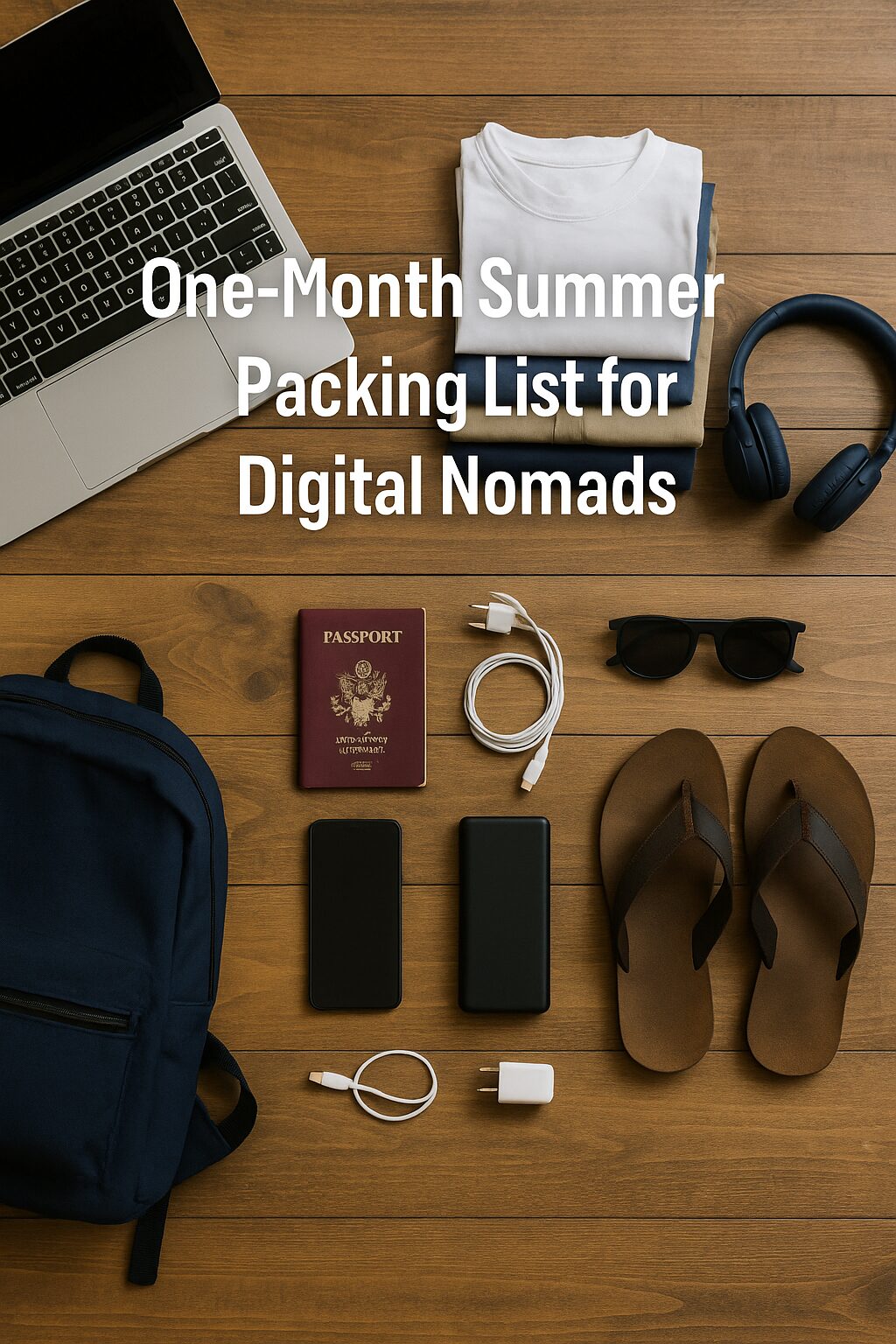
Packing for a one-month trip as a digital nomad isn’t about taking less—it’s about taking right. Every item should serve a purpose. The ideal pack is light enough to carry but complete enough to support your remote work, health, safety, and freedom.
Whether you’re headed to Lisbon, Chiang Mai, or Medellín, this is your one-stop packing guide to prepare for sun, uncertainty, and productivity abroad.
1. Digital Gear Essentials
Your gear is your income. Here’s what you need:
Laptop + Charger: Reliable, lightweight, fast. Your mobile office.
Universal Power Adapter: For those “uh-oh” plug moments.
Power Bank (10,000mAh+): Keeps your phone going on long layovers.
Noise-Canceling Earbuds or Headphones: Essential for focus in busy cafés.
Don’t pack for comfort—pack for capability. You can live lightly without feeling unprepared. What you leave behind, you can almost always find locally.
This is your chance to test how little you actually need to live and work well.
A Practical Guide to Choosing the Right Coverage While Living Abroad
Why Travel Insurance Is No Longer Optional
For digital nomads, travel insurance used to feel like a “maybe.” Not anymore.
Flight cancellations, lost laptops, sudden illnesses abroad—these are real risks when your life is 100% mobile.
In this post, we break down the top travel insurance options specifically designed for digital nomads, long-term travelers, and remote workers. We’ll focus on what truly matters: ✔️ Coverage for remote work gear ✔️ Emergency healthcare abroad ✔️ Visa compliance ✔️ COVID or endemic illness support ✔️ Country-hopping flexibility
1. SafetyWing – Affordable and Nomad-Friendly
Best For: First-time nomads, remote workers on a budget
Overview: SafetyWing is built by nomads, for nomads. It works in 180+ countries, renews automatically every 28 days, and covers most essentials.
Pros:
Starts at ~$45/month
Covers COVID, emergency medical, evacuation, and even political unrest
Includes limited coverage in your home country
Works even if you’re already abroad
Cons:
No coverage for trip cancellation
Gear protection (like laptops) requires add-ons
Key Features:
Can be bought after departure
Renew month-to-month
Good for visa applications (proof of coverage available)
2. World Nomads – Adventure-Ready and Flexible
Best For: Travelers who engage in sports or multi-country trips
Overview: World Nomads is well known in the backpacker and explorer community. It’s pricier but covers a wide range of sports and gear.
Pros:
Strong medical coverage
Covers over 150+ adventure activities
Generous limits for personal belongings and theft
Multi-destination coverage
Cons:
Pricier: ~$100+/month depending on location
May require proof of residency for purchase
Key Features:
Claims can be filed online
24/7 global assistance
Good for those traveling with camera equipment or instruments
3. Genki – Simple, Transparent Global Coverage
Best For: Europeans and digital nomads looking for ease and clarity
Overview: Genki is an emerging favorite among EU-based nomads. It offers one flat price for all countries and a clear policy structure.
Pros:
Transparent pricing (e.g., €69/month)
Accepts most nationalities
Long-term options (up to 2 years)
Direct billing available in some countries
Cons:
Does not cover trip interruption or cancellations
No U.S. home country coverage
Key Features:
App-based claim management
No hidden clauses
Especially helpful for EU citizens working abroad
4. Insured Nomads – Tech-Focused with Mental Health Coverage
Best For: Remote workers who want premium features
Overview: Insured Nomads blends traditional insurance with digital tools like global telemedicine and mental health support.
Pros:
Includes therapy and mental health sessions
Telemedicine and 24/7 support through their app
Works for both short and long-term stays
Visa support letter available
Cons:
Premium pricing: $90–$150/month
Coverage limits vary by plan
Key Features:
Cybersecurity and crisis response tools
Can cover families traveling together
Cryptocurrency payment supported
5. IMG Global – Classic Provider with Custom Plans
Best For: Families, older nomads, and complex itineraries
Overview: IMG offers high-limit, U.S.-style plans with many customization options. It’s ideal if you want serious medical coverage.
Pros:
Extensive hospital network
Custom deductible and max benefit options
Family and senior-friendly plans
Cons:
Application process can feel bureaucratic
Some plans not available in all countries
Key Features:
Excellent for long stays in one country
Suitable for those with pre-existing conditions
May help meet residency requirements in visa applications
How to Choose the Right Insurance as a Digital Nomad
Key Questions to Ask:
Will you be working remotely or taking adventure trips?
Do you need tech gear coverage (laptop, camera)?
Will you stay in one country or move frequently?
Do you want mental health, therapy, or virtual doctor access?
Are you required to show proof of insurance for a visa?
Comparison Snapshot:
Provider
Best For
Starting Price
Key Feature
SafetyWing
Budget nomads
~$45/month
Country-hopping + simple renewal
World Nomads
Adventurous travelers
~$100/month
Covers extreme sports & theft
Genki
EU-based nomads
€69/month
Transparent & no residency required
Insured Nomads
Tech-savvy workers
~$120/month
Mental health + telemedicine
IMG Global
Families & seniors
Varies
Strong U.S.-style medical network
Pro Tips for Filing Claims Smoothly
Keep scanned copies of receipts, medical records, and incident reports
Use your provider’s mobile app to report claims instantly
Always report thefts or accidents to local authorities
For gear loss, take photos and get documentation from hotels or airlines
Final Thoughts: Insurance That Matches Your Life
Don’t just buy “travel insurance.” Buy coverage that aligns with how you live.
If you’re working remotely, moving often, and carrying expensive gear, your needs are different from a tourist.
Investing in the right plan is cheaper than one emergency without coverage.
Peace of mind is not optional—it’s part of working smarter.
You’re ready to take off—but the flights are 3x the price. Sound familiar?
Last-minute flights have a reputation for being outrageously expensive—and for good reason. Traditional advice tells you to book months in advance. But what if you’re traveling spontaneously, responding to an emergency, or just didn’t plan ahead?
This guide will show you how to book last-minute flights without getting ripped off, using real-time tools, psychological pricing insights, and little-known hacks that even seasoned travelers miss.
1. Understand the Psychology of Airline Pricing
Airlines use dynamic pricing models that change fares dozens of times per day based on supply, demand, and search behavior.
Here’s how you can beat them:
Use Incognito Mode or VPN: If you keep checking a flight, the airline remembers. Prices may increase artificially.
Clear Your Cookies: Avoid search bias by removing your browsing history before comparing prices.
Switch Devices: Mobile searches may show different prices than desktops (yes, it still happens).
Timing also matters. Some airlines release unsold inventory 24 to 72 hours before departure, often with steep discounts.
2. Use Real-Time Fare Trackers and Predictive Tools
Instead of manually checking 12 times a day, let algorithms do the work.
The best platforms for this are:
Google Flights: Set price alerts and view fare history. Their “Date Grid” is ideal for flexible trips.
Hopper: Predicts price changes using historical trends and alerts you when to buy.
Skyscanner: Includes low-cost carriers and lets you compare across entire months.
Kayak Explore: Shows last-minute deals from your home airport to anywhere cheap.
💡 Pro Tip: Combine these tools. For example, find a cheap city with Kayak Explore → set Google Flights alert → book with airline app for best fare and customer service.
3. Be Flexible with Dates, Times, and Airports
If you’re willing to shift a little, you can save hundreds.
Flexibility Checklist:
Can you depart midweek (Tuesday/Wednesday)?
Are you open to flying red-eyes or early morning?
Can you use nearby airports (within 1–2 hours)?
Are you okay with one layover if it saves $200+?
Use Google Flights’ calendar view to see prices across 30 days.
Also, check regional airports. Sometimes, flying out of a smaller airport nearby offers a better deal—even after adding transport costs.
4. Check Hidden-City and Throwaway Ticketing
While controversial, hidden-city ticketing can cut costs dramatically.
Example: You want to go to Chicago. Instead of searching for “NYC → Chicago,” look for “NYC → Denver (via Chicago).”
Book the longer route, but get off at the layover.
Important cautions:
Only take carry-on luggage (your bags will go to the final destination)
Don’t do this repeatedly with the same airline
Never skip the first leg of any itinerary
Services like Skiplagged help find these hidden deals.
⚠️ Airlines dislike this practice. Use it responsibly and sparingly.
5. Set Price Alerts and Move Fast
Contrary to what you’d expect, some last-minute fares do drop—but briefly.
Here’s how to catch them:
Set alerts on Hopper, Google Flights, and Skyscanner
Turn on mobile notifications and check email twice a day
Book within 1–3 hours of seeing a drop—these prices usually disappear fast
Sometimes airlines “test” the market by dropping prices at random. If you’re lucky and alert, you can grab seats before they’re gone.
6. Use Points, Miles, and Alternative Booking Platforms
When cash prices spike, your miles can shine.
Use airline points through their official app or site
Try OTAs (online travel agencies) like Expedia or Priceline for bundled discounts
Look into credit card travel portals (Chase, Amex, Capital One)
Also try:
Booking with foreign versions of airline websites (e.g., use Korean Air’s KR site)
Checking local OTAs if flying within a specific country or region
Sometimes different currencies = lower base prices.
7. Follow Deal Communities and Flash Sale Alerts
Communities like:
Secret Flying
The Flight Deal
Fly4Free
TravelPirates
…often post last-minute flash sales or “mistake fares” that aren’t even listed on Google.
Join their email lists or follow them on Twitter/X. One alert can save you $300 or more—especially on international routes.
Bonus Strategy: Use a Throwaway Email to Simulate Demand
If you’re curious how airlines adjust pricing, try this experiment:
Search for a route frequently using your main account
Then search again with a throwaway Google account (new cookies, incognito browser)
Compare prices
You might be shocked by the difference. This trick shows how powerful data tracking is in airfare pricing.
Final Thoughts: Speed, Strategy, and Self-Control
Booking a flight at the last minute doesn’t have to mean overpaying. If you’re fast, strategic, and flexible, you can score fares that even advance planners envy.
Remember:
Don’t get emotionally attached to a specific airline or route
Always check 2–3 tools before buying
Consider alternative payment methods (miles, points, vouchers)
Travel smarter. Book faster. Keep your wallet intact.