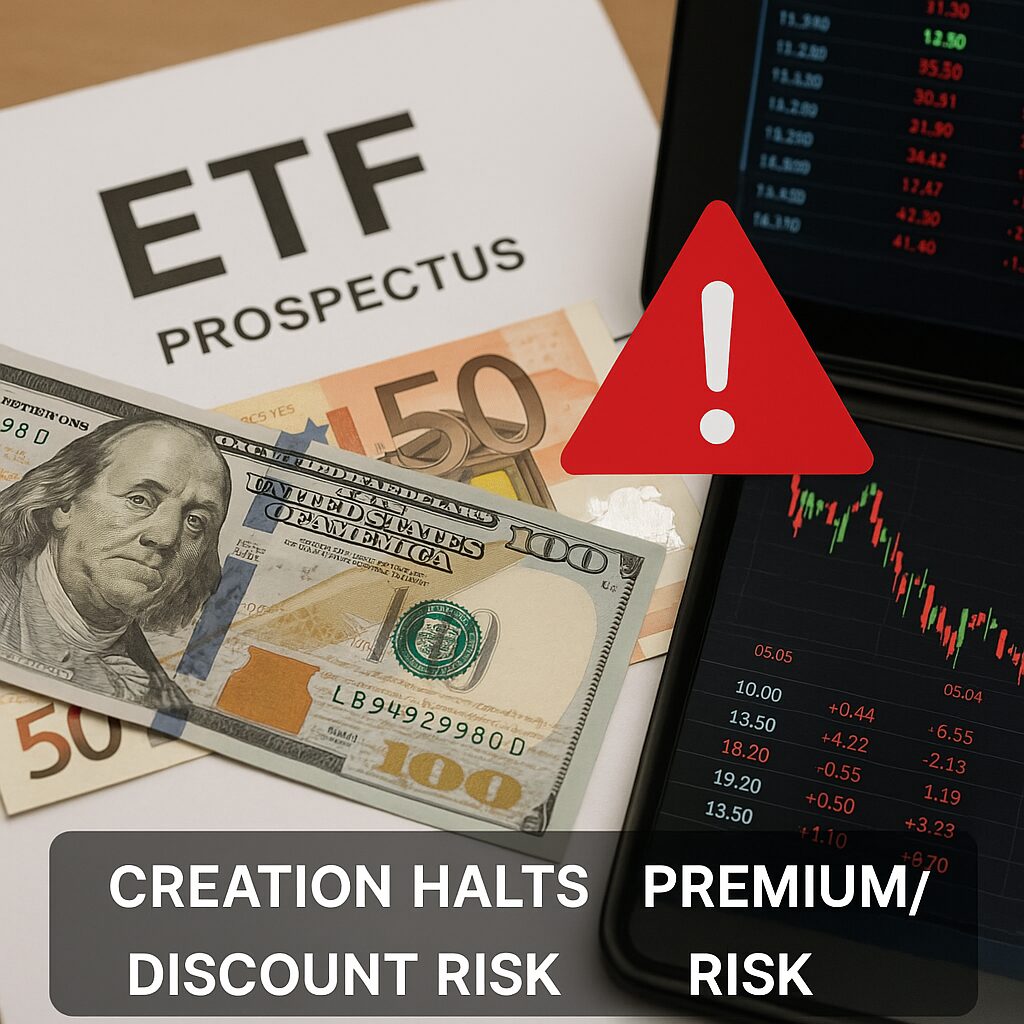
ETF Failure Files — Products That Froze, Collapsed, or Trapped Investors (and How You Avoid Them)
How to use this guide: This is a field manual. You’ll get a failure taxonomy, copy-paste red-flag checklists, an Audit File you can duplicate for every fund, and a Crisis Playbook for when premiums/discounts explode or creations halt. At the bottom: an English Case List (Quick Reference), then a must-read next-article preview.
No market gossip. No hindsight lectures. Only rules you can run.
1) Why good portfolios still blow up: the vehicle, not the idea
You can build a perfect allocation (core + barbell + factors + FX).
If the wrapper is flawed—structure, liquidity, leverage, governance—your portfolio still fails.
Your new doctrine: Never buy an ETF; buy an ETF after it survives your Audit File.
2) Failure Taxonomy — the four ways ETFs hurt investors
A) Structure failures
- Swap/synthetic exposure with counterparty limits, collateral gaps, or reset frictions.
- Commodity pool/futures funds with roll costs (contango), margin calls, position limits.
- Notes (ETNs) with issuer credit risk; redemptions can be called or halted by the issuer.
- Narrow or bespoke indices with discretionary methodology or reconstitution discretion.
B) Liquidity failures
- Illiquid underlyings (frontier equities, microcaps, distressed bonds) → wide spreads and tracking drift.
- Creation/Redemption (C/R) halts → premium/discount balloons; exit becomes costly.
- Few authorized participants (APs) or weak market maker support.
C) Leverage & path dependency
- Daily leveraged & inverse funds → compounding decay in volatile, sideways markets.
- Volatility & exotic payoff notes that can reset to near-zero after spikes.
- Implicit leverage via derivatives that your broker statement won’t show.
D) Governance & operations
- Index rule changes without clear notice → you own something new tomorrow.
- Fair-value pricing quirks when underlying markets are closed → “stale NAV” effects.
- Domicile/tax traps (withholding, PFIC/ADR quirks depending on investor circumstances).
- Securities lending practices where the fund retains little revenue or reinvests collateral poorly.
Bottom line: before yield, performance or theme, evaluate these four.
3) Copy-Paste: Pre-Flight Red-Flag Scan (use before funding)
Structure
- Replication: physical / synthetic (swap) / futures/commodity pool
- If synthetic: collateral quality & counterparty caps documented
- If futures: roll schedule, position limits, historical roll cost behavior
- If note (ETN): issuer credit rating & call features summarized
Liquidity
- Average daily dollar volume ≥ your trade size × 20
- Median spread ≤ 0.__% in your trading window
- # of APs/market makers > 2; evidence of resilient C/R in stress
Leverage & Path
- Leverage multiple: __x; daily reset? Yes/No
- Volatility drag scenario modeled (sideways-but-volatile path)
- Use-case limited to tactical intraday/short-term? If long-term → Do Not Use
Governance/Operations
- Index methodology & reconstitution calendar saved to file
- Sector/country caps stated; concentration rule documented
- Domicile & distribution policy logged (accumulating/distributing)
- Securities lending split: fund vs. manager %, collateral profile
- Tax notes relevant to you (withholding, reporting)
Decision
- PASS / WATCHLIST / APPROVED (date + initials)
4) Tracking the right numbers (ongoing monitor)
- Premium/Discount vs. NAV (intraday and close).
- Creation/Redemption activity (healthy vs. halted).
- Tracking difference (12-month and since-inception vs. index).
- Spread quality in your execution window.
- AUM trend (shrinking funds can close; thin funds lose market-maker interest).
- Index change notices (subscribe to provider updates).
Rule: If two of the above degrade persistently, freeze adds and review. If three degrade, begin exit ladder.
5) Position sizing & kill-switches (so one fund never sinks you)
- Single-ETF cap: ≤ E% of portfolio MV.
- Issuer cap: ≤ F% across that provider.
- Leverage rule: daily leveraged & volatility products → 0% for long-term stacks.
- Kill-switches (any two trigger exit):
- Premium/discount > P% for X days
- C/R halted or AP count drops to one
- Tracking gap widens beyond T% vs. index
- Methodology change that alters exposure materially
6) Execution rules (how you actually buy/sell)
- Staggered entries/exits in 3–5 tranches to average spreads.
- Use limit orders around mid-market; avoid open/close auctions on thin funds.
- Check underlying market hours: if underlyings are closed, expect “fair-value” marks and wider spreads.
- Route large orders via your broker’s block desk if available.
7) The ETF Audit File — one page you copy for every fund
Header
- Ticker / Name / Provider / Domicile / Index link
- Objectives & your role for the sleeve
Structure
- Replication method; derivatives used; collateral rules
- For futures funds: roll cadence, historical roll cost notes
Liquidity
- ADTV (shares + dollars); median spread; market-maker/AP list (if disclosed)
- Typical spread in your trading hour
Costs
- TER; expected total cost (TER + spread + tracking difference)
- Securities lending revenue split; who keeps what
Risks
- Concentration caps; sector/country exposures; sanctions/ADR sensitivity
- Premium/discount history; fair-value adjustments pattern
Governance
- Index rules snapshot; reconstitution calendar; change-notice subscription
Decisions
- Sizing: target __%, cap __%
- Kill-switch thresholds: P%, T%, days __
- Notes & date
Save this as a template; duplicate for every position. If you can’t fill it in 15 minutes, you don’t understand the fund.
8) Crisis Playbook — when premiums/discounts explode or creations stop
If Premium > P%
- Pause adds immediately.
- Place Good-Til-Canceled limits below market; avoid chasing.
- Check C/R status. If halted, assume premium can vanish intraday → stand down or reduce.
If Discount deepens
- Verify underlying market status (holiday/close → fair-value discount can be normal).
- If underlyings are open and discount persists → C/R may be impaired; start exit ladder in tranches.
- Prefer switching into a more liquid substitute rather than cashing out of the asset class entirely.
If C/R is halted
- Treat as temporary closed-end fund. Cut to policy cap or lower; replace exposure with a liquid peer.
If methodology changes
- Compare new exposures vs. your sleeve job. If no longer fits role, exit on first liquid window.
9) Failure patterns you can recognize in advance
- “Hot theme” + tiny AUM + wide spreads → retail order flow props up price; exits are costly.
- Commodity futures with persistent contango → roll bleed drains long-term holders despite headline moves.
- Instruments that promise linear inverse/leveraged exposure → only make sense for short horizons.
- Bespoke “smart” indices without capacity constraints → crowding, unstable rules, or unexpected holdings.
- Cross-listed, thin-hour funds → stale NAVs and fair-value marks invite poor fills.
10) Safer substitutions & design choices
- Prefer physical replication for core beta; use synthetic only when the benefit is explicit and audited.
- Use large, liquid commodity vehicles or equity proxies (producers/refiners) when long horizons meet futures bleed.
- Replace leveraged/inverse with position sizing and cash/defensive sleeves (from Part 2).
- Choose mainstream UCITS/’40-Act style vehicles with clear lending policies and robust AP ecosystems.
11) Wiring this into your system (Parts 1–4 integration)
- Core & Barbell: run your Audit File before any new sleeve; keep single-ETF caps tighter for sector/factor funds.
- FX (Part 3): hedged share classes add another moving part; record hedge method & cadence in the Audit File.
- Factors (Part 4): many factor funds are rules-heavy; track turnover, method updates, live vs. backtest gaps.
12) Copy-Paste Checklists (put these in your notes)
A) Pre-Trade 60-Second Gate
- Liquidity clean (ADTV $, spreads)
- Structure understood (physical / synthetic / futures)
- Audit File completed
- Sizing within caps
- Limit order plan set
B) Monthly Monitor
- Premium/discount & tracking spread
- AUM trend & C/R health
- Index notices reviewed
- Log: action / no action
C) Exit Ladder
- Tranche 1 now (limit order)
- Tranche 2 after spread normalizes or next session
- Tranche 3 on premium/discount mean-revert or C/R restore
- Replace exposure with liquid peer if sleeve must stay on
13) Investor FAQs (short, practical)
Q: Are small funds always unsafe?
A: Not always. Thin liquidity + complex structure is the danger. Small but plain-vanilla physical funds can be fine at modest size.
Q: Can I long-term hold a leveraged ETF?
A: The daily reset math and volatility drag say no for long-term stacks. Use sizing and barbell defense instead.
Q: Premium looks small; can I ignore it?
A: Small premiums vanish first in stress. If you can buy a more liquid equivalent at fair value, do that.
Q: Is an ETN automatically bad?
A: Not automatically. But you now take issuer credit + call/redeem risk. If you’re not explicitly paid for it, avoid.
Case List (Quick Reference)
- Case A — Creation Halt Shock: ETF’s creations paused; premium spiked. Exit ladder used; exposure swapped to a liquid peer; avoided paying the bubble.
- Case B — Futures Bleed: Commodity ETF tracked headlines poorly due to persistent roll cost; swapped to large, liquid alternative and sized smaller.
- Case C — Leveraged Decay: Daily leveraged fund held for weeks; sideways-volatile market destroyed value. Rewrote policy: no leveraged products in long-term stacks.
- Case D — Stale NAV Trap: Bought international ETF while underlyings were closed; fair-value discount inverted next day → learned to trade during underlying market hours.
- Case E — Synthetic Surprise: Swap-based exposure with opaque collateral; counterparty cap unclear. Replaced with physical fund after Audit File review.
- Case F — Index Rule Drift: “Smart” index changed constraints; holdings looked nothing like the sleeve’s job. Exited on first liquid window.
- Case G — Spread Tax: Tiny thematic fund with flashy story; round-trip spread exceeded one year of TER savings. Moved to a broad, liquid proxy.
- Case H — AP Concentration: One AP dominated C/R; stress day widened spreads massively. New rule: require multiple APs.
- Case I — Lending Leak: Securities lending revenue mostly captured by manager, not fund; switched to a fund with fairer split.
- Case J — Domicile Misfit: Withholding and reporting issues reduced after-tax compounding; replaced with a domicile that aligned with the investor’s situation.
📌 Next Article Preview (must-read urgency)
Digital Assets & Tokenized Funds — Compliance First, Then Growth
You just learned how ETF vehicles fail. The next step tackles digital assets and tokenized funds—where custody, KYC/AML, tax logs, and wallet segregation determine survival.
You’ll get:
- A Compliance Stack you can copy (custody tiers, cold/warm rules, proof-of-funds).
- Tax & reporting playbook that won’t break compounding later.
- A Final Integration Checklist that snaps digital rails into your Wealth Playbook.
Skip this and you risk mixing high-potential assets with untracked, unreportable flows that invite account freezes and tax penalties.