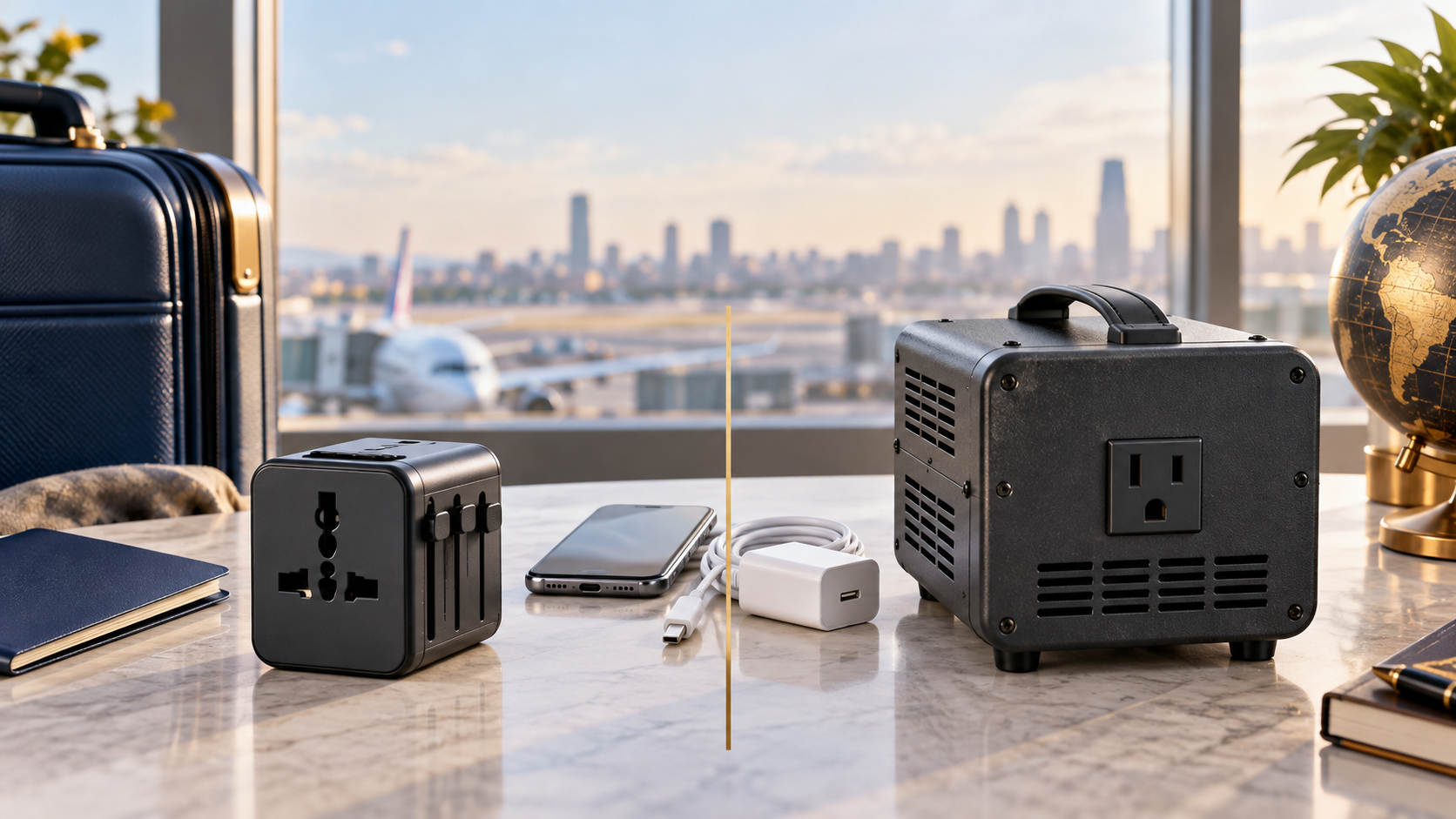
You have booked the trip and packed your charger. Then you notice that your destination uses a different wall outlet. Do you need a travel adapter, a voltage converter, or both?
The answer depends on your device’s input label and the outlet where you will use it. Check those two things before buying anything.
First, know what each device does
A travel adapter changes the plug connection so it fits a different type of wall socket. It does not change the electricity supplied by that socket.
A voltage converter or transformer changes voltage for a device that cannot use the destination’s supply voltage. It must be suitable for that specific device and its power requirements.
This distinction matters most for appliances such as hair dryers, curling irons, and other devices that generate heat. A plug that fits does not mean the appliance is safe to turn on.
The two-minute check before you pack
1. Find the input rating. Look on the device, its charger, or its power brick for a line marked Input.
If it says “100–240V, 50/60Hz,” the charger is designed to accept that range of supply voltages. You may still need a plug adapter that fits your destination’s socket.
If it lists a narrower range, such as “120V, 60Hz,” do not assume a travel adapter is enough. Check the destination’s supply and the appliance manufacturer’s instructions before using it.
2. Check the actual socket at your destination. Countries can use different socket types, and some locations use more than one. Check your accommodation’s information when possible, particularly if you are visiting several countries.
3. Check the plug and power rating. Some adapters do not provide a suitable earth connection for appliances that require one. The appliance must also stay within the adapter’s stated power limit. If either point is unclear, ask the device manufacturer or use an appropriate local appliance.
Which option fits your trip?
Phone or laptop charger labeled 100–240V: You will generally need a compatible plug adapter if its plug does not fit the destination socket. Check the label on the charger, rather than assuming every charger has the same rating.
Single-voltage hair tool: A basic plug adapter is not the solution when the local voltage is incompatible. Check the manufacturer’s guidance before considering a properly rated converter. A hair tool made for the local supply may be the simpler choice.
A grounded appliance: Confirm that the entire connection preserves the grounding the appliance requires. Do not assume a universal adapter does so just because its socket accepts a three-prong plug.
Travel through several countries: A universal adapter may be convenient, but confirm that its specific plug types cover every stop. “Universal” does not mean it fits every outlet.
When a universal adapter is worth buying
If your chargers are compatible with the destination’s voltage and you travel to places with different sockets, one adapter with several plug options can reduce what you pack. For a single destination, a suitable country-specific adapter may be all you need.
One example to compare is the EPICKA TA-105+ universal travel adapter. The manufacturer lists multiple plug options, an AC outlet, and USB ports. It also states clearly that the adapter does not convert voltage. Before buying, check the current product listing against your destination’s socket, your device’s plug, and its power needs.
Check the EPICKA TA-105+ listing on Amazon
As an Amazon Associate, I earn from qualifying purchases.
Product listings can change. Confirm the model shown on Amazon before ordering; if it differs from the TA-105+, use the specifications of the model actually offered.
A quick packing checklist
- Photograph the Input label on each charger or appliance you plan to bring.
- Confirm the socket type and supply voltage at each destination.
- Check whether any appliance requires a grounded connection.
- Compare those requirements with the adapter’s plug compatibility and power rating.
- Leave an appliance unplugged if you cannot confirm that the combination is suitable.
The simplest rule: read the device label first, then choose the plug solution. That small check can save you from buying an adapter that fits the wall but does not meet your device’s needs.
Reference: Electrical Safety First’s travel adapter guidance.