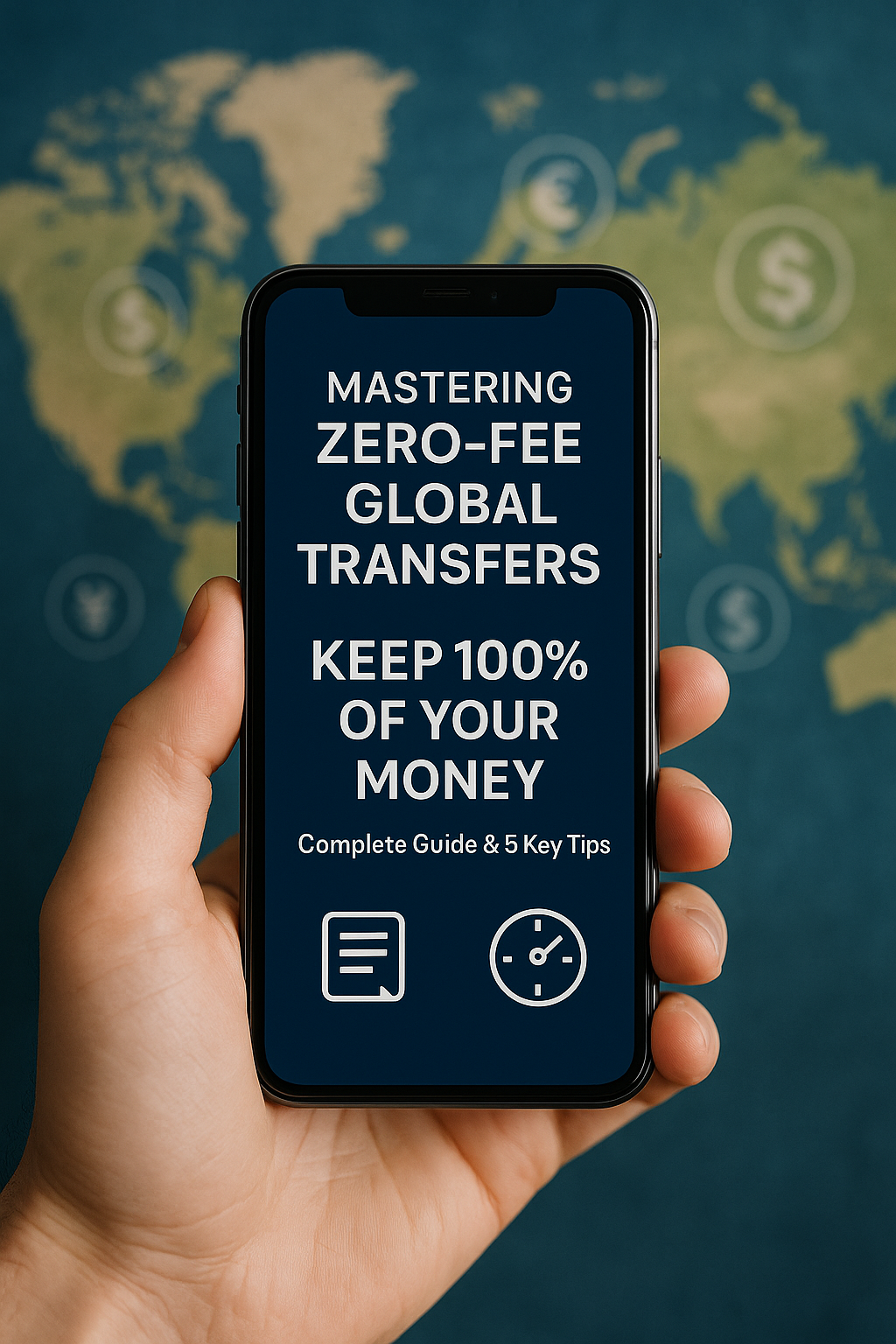
Mastering Zero-Fee Global Transfers: A Complete Guide to Keeping 100% of Your Money

A hand holding a smartphone displaying “Mastering Zero-Fee Global Transfers: Keep 100% of Your Money – Complete Guide & 5 Key Tips” against a blurred world map background with floating currency symbols.

Imagine sending $1,000 overseas and discovering your friend only got $950. That $50 “loss” isn’t magic—it’s hidden fees, poor exchange rates, and middle-bank charges. If you send money regularly—for rent, tuition, or to support family—those costs can total hundreds or even thousands of dollars a year. This guide shows you how to eliminate nearly all extra charges, keep 100% of your funds, and use advanced tactics to save even more.


1. Understand Where Your Money Goes

Flat Transaction Fees

  • Big banks often charge $25–$50 per transfer, regardless of amount.
  • Specialty services may advertise low fees but tack on additional charges later.

Exchange Rate Markups

  • Banks offer an “offered rate” that’s 1–3% worse than the true mid-market rate (the rate you see on Google or XE).
  • That margin is pure profit for them.

Correspondent Bank Fees

  • International transfers via SWIFT often pass through 2–3 intermediary banks, each adding $5–$15.
  • A chain of three can tack on $15–$45 extra.

Receiving Bank Fees

  • The recipient’s bank may deduct $5–$10 as a handling fee before crediting the final account.

Combined, these can reduce your friend’s payout to 85–90% of what you sent.


2. Switch to Fee-Transparent Platforms

Wise (formerly TransferWise) uses a peer-to-peer model:

  • Your USD goes into Wise’s U.S. account.
  • Wise pays out EUR from its European account.
  • No cross-border hops means no correspondent fees.

True Mid-Market Rates

  • Wise applies the exact rate you see online—zero markup.

Small, Upfront Fee

  • Around 0.4% of the transfer amount (varies by currency).
  • You see the breakdown—“Send $1,000 → Receive €900; Fee $4”—before you confirm.

Local Bank Accounts

  • Wise holds accounts in the U.S., U.K., EU, Australia, etc.
  • Transfers happen locally, bypassing expensive international routes.

Need quick tips?
<a href=”/zero-fee-global-transfers-5-key-tips”>Zero-Fee Global Transfers: 5 Key Tips →</a>


3. Getting Started

  1. Sign Up: Go to wise.com or download the Wise app. Enter your email and create a password.
  2. Add Details: Fill in your name, birthdate, address, and reason for transfer.
  3. Verify Identity: Upload your passport or driver’s license and take a quick selfie. Most verifications finish in 1–2 hours.

Once verified, you can send large amounts safely and legally.


4. Advanced Strategies for Extra Savings

1. Rate Alerts & Timing

  • Set a target rate (e.g., 1 USD = 0.92 EUR) in Wise or Revolut.
  • Receive instant alerts and execute transfers automatically.
  • A 0.5% improvement on $5,000 saves you $25 in a single transaction.

2. Batch Payments for Multiple Recipients

  • Prepare a CSV with up to 1,000 recipients.
  • Review and approve all payments in one click.
  • Pay one small percentage fee on the total rather than many fixed fees.

3. Multi-Currency Balances

  • Hold dozens of currencies in one account.
  • Top up when your chosen currency dips below your target rate, then convert later.
  • Smooth out rate fluctuations and maximize purchasing power.

4. Fee-Free Card Spending

  • Use Wise’s debit card to pay at mid-market rates.
  • Always decline dynamic currency conversion (DCC) prompts.
  • Link to Apple Pay or Google Pay to avoid hidden markups.

5. API Integration for Businesses

  • Connect Wise to accounting software (Xero, QuickBooks) or your own system.
  • Automate payroll, vendor payouts, or subscription refunds.
  • Eliminate manual work and maintain an auditable payment trail.

5. Compare Your Options

ServiceFee StructureProsCons
Wise~0.2–0.5%True rate, transparent, fastSmall fee on tiny transfers
Revolut0–1% weekdays (+weekend markup)Free within network, slick UXWeekend markups, limited geos
PayPal2.5–4% currency margin + feesVery popular, instant transfersHigh FX fees, freezing risk
Banks3–5% total costUniversal access, perceived securitySlow, opaque fees

6. Real-World Savings Examples

  • Freelancer in New York → Berlin Contractors
    • Old way: $2,000 transfer → €1,880 after $30 + 2% markup
    • Wise: Fee $8 (0.4%) + mid-market rate → €1,992
    • Result: Saves $22/month; contractor gains €112/month; $264 + €1,344 annual impact
  • Student in Sydney → Family in India
    • Old way: AUD 1,000 → family gets INR 57,000 after AUD 15 + 2.5% margin
    • Wise: Fee AUD 4 + true rate → INR 60,000
    • Result: Family gains INR 3,000/month; INR 36,000/year

7. Your Action Plan

  1. Set Rate Alerts:
    Choose a target exchange rate (e.g., 1 USD = 0.92 EUR) on platforms like Wise or Revolut. Receive instant notifications and lock in savings automatically.
  2. Batch Payments:
    Upload up to 1,000 recipients in a spreadsheet and send all payments at once. Pay a single small percentage fee instead of multiple fixed fees.
  3. Hold Multiple Currencies:
    Keep balances in key currencies (USD, EUR, GBP) and convert in small increments when rates hit your target.
  4. Use a Fee-Transparent Card:
    Pay abroad with a Wise debit card and always decline dynamic currency conversion (DCC) to avoid hidden markups.
  5. Automate with API:
    Integrate Wise with accounting software to schedule recurring transfers, reducing manual work and errors.

Ready to keep 100% of your money?
<a href=”/mastering-zero-fee-global-transfers-complete-guide-keep-100-percent-of-your-money”>Complete Guide 다시 보기 →</a>

By applying these tips, you can reduce your international transfer fee below 0.3%—often to zero. Start today and keep 100% of your funds.
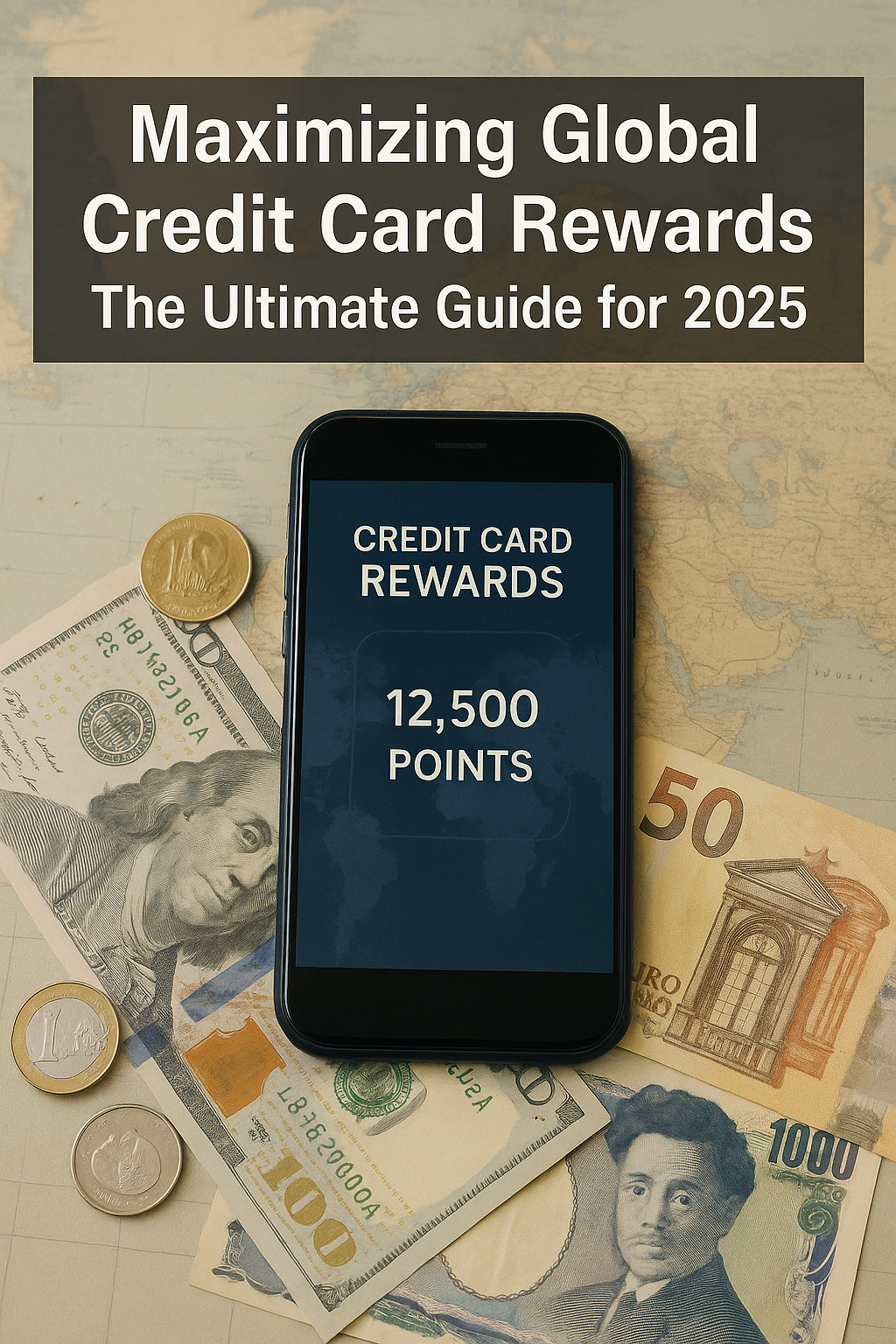
Maximizing Global Credit Card Rewards: The Ultimate Guide for 2025

A high-resolution photo featuring a smartphone displaying credit card reward points surrounded by various international currencies (dollars, euros, yen) on a subtle world map background, with the guide’s title overlaid.

Introduction

In an increasingly cashless and borderless world, credit card rewards have become one of the most lucrative ways to earn valuable perks—whether you’re chasing free flights, statement credits, or luxury hotel stays. In 2025, the competition among issuers is fiercer than ever, with banks and fintech companies dangling sign-on bonuses worth up to $1,000 in travel credits and offering accelerated rewards in niche spending categories. This guide will walk you through the strategies you need to maximize your global credit card rewards, covering everything from selecting the right cards for international usage to advanced redemption tactics that squeeze every last cent of value from your points and miles.

By the end of this article, you’ll understand:

  1. How to choose credit cards optimized for worldwide acceptance and minimal foreign transaction fees
  2. Which spending categories to target for bonus multipliers
  3. Strategies for meeting sign-up bonus requirements cost-effectively
  4. Best practices for transferring points between loyalty programs
  5. Tactics to avoid devaluation and expiration

Let’s get started.


1. Choose Cards Built for International Travel

1.1 No Foreign Transaction Fees

The first rule of global credit cards is simple: never pay foreign transaction fees. These fees typically range from 1.5% to 3% on every purchase made outside your home country. In 2025, top contenders include:

  • Chase Sapphire Reserve® – 3× points on travel (after earning your travel credit), no FX fees
  • Citi Premier® – 3× points on air travel, hotels, and foreign spending, no fees
  • Capital One Venture X – 2× miles on every transaction, plus 10× on Capital One Travel bookings, no fees

Make sure any card you carry abroad explicitly waives FX surcharges.

1.2 Global Network Compatibility

Choose cards that run on Visa or Mastercard networks, which tend to have the broadest acceptance globally. American Express is accepted in many destinations but can be spotty in smaller merchants—so carry at least one Visa or MC as a backup.


2. Target High-Return Spending Categories

2.1 Travel and Dining Multipliers

In 2025, most “premium” travel cards offer elevated returns in travel and dining:

  • 3× to 5× points at hotels, airlines, and sit-down restaurants
  • 2× to 3× points on everyday categories like groceries or transit

Action Step: Consolidate your dining, ride-share, and hotel expenses on one card that offers the highest bonus for that category.

2.2 Rotating and Promotional Categories

Cards like the Chase Freedom Flex℠ and Discover it® series promote quarterly categories where you can earn 5% back on up to $1,500 of spending. Although capped, those categories (e.g., gas stations, online shopping) can yield massive point hauls if you shift your budget accordingly.


3. Unlock Generous Sign-Up Bonuses

3.1 Timing Your Applications

Banks often reset their bonus offers every few months. To maximize your haul:

  1. Stagger applications by at least 90 days to avoid hurting your credit score.
  2. Apply after targeted mailers or referral links—they frequently bump bonuses by another 10,000–20,000 points.

3.2 Meeting Minimum Spend Wisely

Bonuses typically require $3,000–$5,000 spent in the first three months. Rather than buying gift cards or throwing money at bills, consider:

  • Placing regular bills (utilities, insurance premiums) on the new card
  • Prepaying taxes where allowed
  • Purchasing business-related supplies if you own a small enterprise

4. Master Point Transfers and Redemptions

4.1 Transfer Partners and Sweet Spots

Credit card points often have 1:1 transfer ratios to airline and hotel loyalty programs. In 2025, standout partners include:

  • Chase Ultimate Rewards® → United MileagePlus at 1:1
  • Amex Membership Rewards → Air France/KLM Flying Blue at 1:1 (with occasional transfer bonuses)
  • Capital One Miles → Singapore KrisFlyer at 1:1

Sweet Spot Example: A one-way business class ticket from New York to Tokyo on ANA can cost just 75,000 KrisFlyer miles—versus revenue fares north of $3,000.

4.2 Booking Internal Flights and Positioning

Use points for intra-region flights at discounted rates. Instead of paying $200 for a 500-mile flight, many programs charge only 7,500–10,000 miles, freeing up cash for other expenses.


5. Avoid Common Pitfalls

5.1 Devaluations and Expirations

Loyalty programs periodically adjust award charts—and points can expire after 12–24 months of inactivity. To guard against this:

  • Keep at least one transaction on every loyalty program annually.
  • Monitor program emails for devaluation announcements and shift balances when transfer bonuses appear (e.g., 30% extra miles during a promo).

5.2 Credit Score Management

Opening and closing cards impacts your average account age. Maintain a long-standing card (with minimal or no annual fee) to preserve the length of credit history, which accounts for 15% of your FICO score.


6. Crafting Effective CTAs and Driving Traffic

6.1 In-Content Referrals

Embed contextual calls-to-action:

“Ready to start earning 3× points on every dollar you spend? Apply for the Chase Sapphire Reserve® today and get 60,000 bonus points after $4,000 in purchases within three months.”

Link your CTA with a tracked referral or affiliate link to attribute conversions accurately.

6.2 SEO Best Practices

  • Keyword Focus: Target long-tail search terms like “best no foreign transaction fee credit cards 2025”
  • On-Page Elements: Include your keyword in title tags, headers (H1–H3), meta description, and image alt text.
  • Internal Linking: Link to related articles (e.g., “Top 7 VPNs for Secure International Banking”) to distribute authority.
  • User Engagement: Add a “Comparison Table” section with collapsible rows—this keeps readers on the page longer, signaling quality to search engines.

Conclusion

Maximizing global credit card rewards in 2025 requires more than carrying a single rewards card—it demands a coordinated strategy: choosing the right fee-free cards, targeting high-return categories, timing your applications, leveraging transfer partners, and weaving in powerful CTAs. By following the tactics in this guide and coupling them with rigorous SEO and traffic-driving measures, you can transform everyday spending into a stream of valuable points, miles, and credits.

Stay tuned for Part 2, where we’ll dive into “Top 7 VPNs for Secure International Banking and Streaming in 2025.”