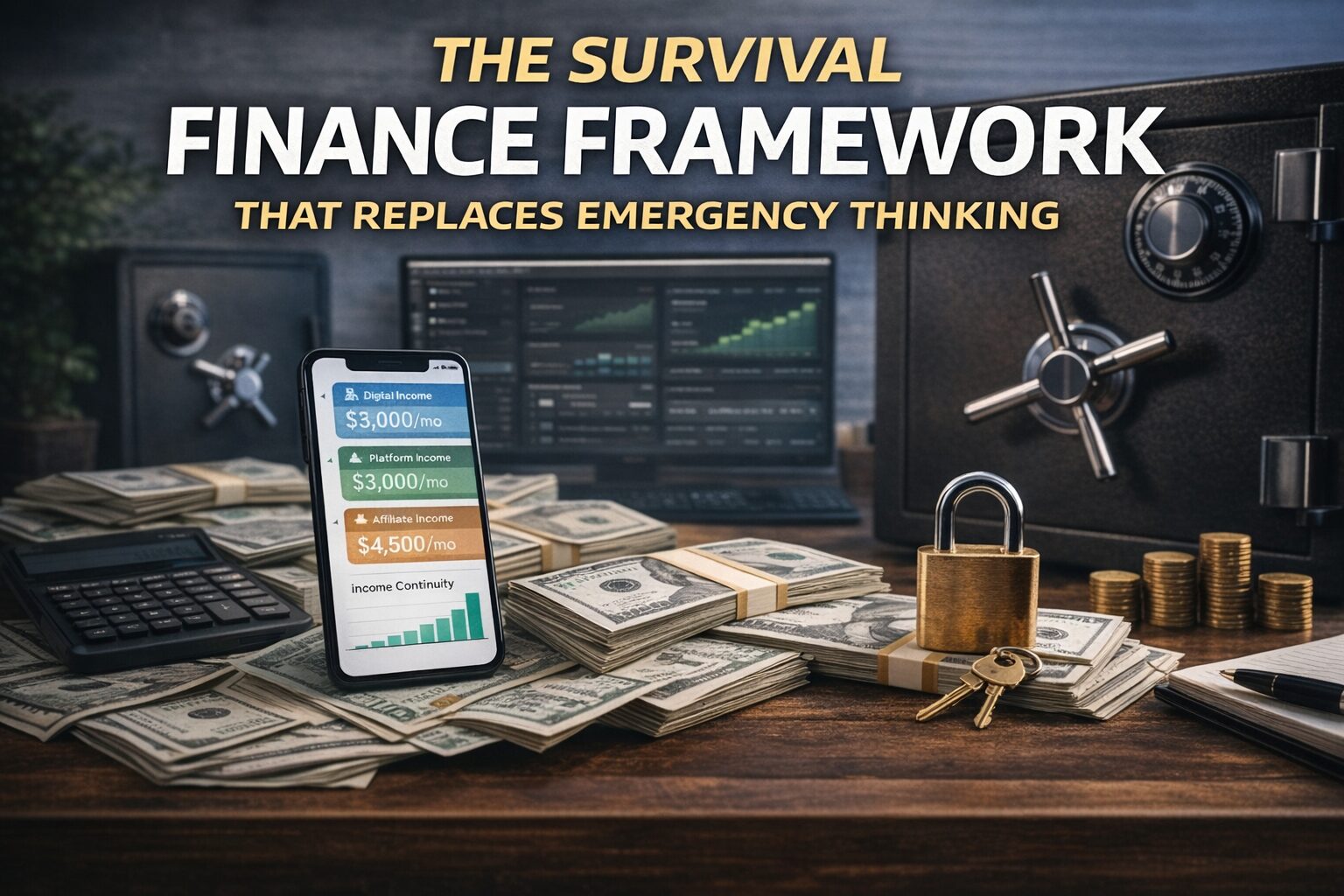
Most people prepare for financial emergencies.
They save “just in case.”
They build “emergency funds.”
They worry about “unexpected situations.”
But people who truly survive financially do not live in emergency mode.
They do not react to crises.
They design systems that prevent crises from happening.
This article explains how to build a financial framework that removes the need for emergency thinking entirely.
Not through luck.
Not through speculation.
Not through risky investments.
But through structural design.
1. Why Emergency Thinking Keeps People Poor
Emergency thinking sounds responsible.
But in reality, it creates long-term weakness.
People in emergency mode:
- Focus on short-term survival
- Delay strategic planning
- Avoid building systems
- Make emotional decisions
- Sell assets too early
- Accept bad financial terms
They are always reacting.
Never controlling.
Financial stability begins when emergencies stop controlling your behavior.
2. The Difference Between Emergency Funds and Emergency Systems
Most people are taught to build emergency funds.
Emergency funds are temporary.
Emergency systems are permanent.
Emergency fund:
- Limited amount
- Can be exhausted
- Requires constant replenishment
- Does not grow
Emergency system:
- Self-renewing
- Income-linked
- Multi-source
- Scalable
- Durable
We do not aim to “store money.”
We aim to “engineer cash flow.”
3. The Core Structure of a Survival Finance Framework
A real survival finance framework has five layers.
Layer 1: Income Continuity
Layer 2: Expense Absorption
Layer 3: Access Preservation
Layer 4: Asset Protection
Layer 5: Expansion Capacity
If any layer is missing, instability appears.
Let us examine each one.
4. Layer 1: Income Continuity System
Income continuity means money keeps coming in regardless of daily activity.
This is the foundation.
Practical construction:
Primary digital income
Secondary platform income
Affiliate pipelines
Content monetization
Licensing income
Your goal is not “high income.”
Your goal is “persistent income.”
If one source weakens, others compensate.
No single point of failure.
5. Layer 2: Expense Absorption Mechanism
Most people collapse financially because expenses hit faster than income.
A survival framework absorbs costs before they cause damage.
Practical methods:
Automatic bill prioritization
Utility buffer accounts
Insurance integration
Service continuity mapping
Subscription control systems
You design your financial system so that:
Housing
Healthcare
Utilities
Communication
Transportation
remain active even during income disruption.
This prevents social and economic isolation.
6. Layer 3: Access Preservation Infrastructure
When people lose access, they collapse.
Access includes:
Banking
Payment systems
Credit platforms
Online services
Verification systems
Legal identities
Loss of access equals loss of participation.
Protection strategy:
Multiple banking channels
Redundant payment accounts
Cross-border access options
Digital identity backups
Document management systems
Never rely on one institution.
7. Layer 4: Asset Protection Architecture
Assets without protection are temporary.
You must defend assets from:
Market volatility
Legal exposure
Tax erosion
Inflation
Administrative risk
Core practices:
Asset diversification
Jurisdiction separation
Tax-efficient structuring
Legal entity buffers
Documentation discipline
This layer keeps wealth alive.
Not just growing.
Alive.
8. Layer 5: Expansion Capacity Engine
A survival system must grow.
Stagnation creates vulnerability.
Expansion means:
Scalable platforms
Reusable content
Automated reinvestment
Compounding channels
Network leverage
Your system must increase capacity over time.
Otherwise, inflation and competition will erode it.
9. How to Build the Framework Step by Step
Now we translate theory into execution.
Step 1: Map All Cash Flows
Document every income and expense.
Step 2: Identify Single Points of Failure
Find where collapse could happen.
Step 3: Create Redundant Channels
Duplicate critical functions.
Step 4: Automate Management
Remove emotional control.
Step 5: Centralize Monitoring
One dashboard for everything.
Step 6: Schedule System Reviews
Quarterly optimization.
This is engineering, not guessing.
10. Replacing Emergency Thinking with System Thinking
Emergency thinkers ask:
“What if something happens?”
System thinkers ask:
“How do I make sure nothing matters if it happens?”
System thinking principles:
Design before action
Structure before speed
Stability before scale
Resilience before profit
This mindset shift changes everything.
11. Practical Daily Management Model
A survival framework requires light daily management.
Not heavy labor.
Daily:
Monitor inflow
Check automation
Review alerts
Weekly:
Optimize content
Rebalance channels
Adjust expenses
Monthly:
System audit
Performance review
Risk update
Minimal effort.
Maximum protection.
12. Common Failure Patterns to Avoid
Pattern 1: Overconcentration
Relying on one platform.
Pattern 2: Overcomplexity
Systems too hard to maintain.
Pattern 3: Emotional Overrides
Changing strategy impulsively.
Pattern 4: Neglect
Ignoring small warnings.
Pattern 5: Delayed Optimization
Waiting too long to improve.
Avoid these, and stability follows.
13. Integrating Digital Business with Survival Finance
Digital platforms are ideal for survival frameworks.
They offer:
Global reach
Scalability
Automation
Low overhead
Best integration points:
Blogs
Video channels
Affiliate systems
Digital products
Licensing networks
Your content becomes infrastructure.
Not just information.
14. The Role of Data and Documentation
Unrecorded systems decay.
Documentation creates durability.
Maintain:
Revenue records
Contract archives
Access credentials
Tax reports
Backup files
Digital order equals financial order.
15. Psychological Stability and Financial Systems
Financial systems protect psychology.
When systems work:
Stress decreases
Decision quality improves
Risk tolerance stabilizes
Long-term planning improves
This creates a positive feedback loop.
Money protects mindset.
Mindset protects money.
16. Long-Term System Evolution Strategy
Your framework must evolve.
Every year:
Upgrade platforms
Improve automation
Expand networks
Refine protection
Increase efficiency
A static system is a dying system.
17. Case-Based Application Examples
Example 1: Content-Based Income Shield
Blog + video + affiliate = multi-layer buffer
Example 2: Platform Risk Defense
Multiple monetization channels prevent collapse
Example 3: Access Redundancy Model
Dual banking + digital wallets
Example 4: Expense Stability System
Utility buffers + service continuity
Example 5: Asset Firewall Structure
Legal + tax + diversification
These are repeatable models.
18. Final Integration Blueprint
A complete survival finance framework includes:
Persistent income
Absorbed expenses
Protected access
Secured assets
Growth engines
If all five exist, collapse becomes structurally impossible.
Conclusion
Financial survival is not about preparing for emergencies.
It is about eliminating them.
When your system is properly built:
Income continues
Expenses are absorbed
Access remains open
Assets are protected
Growth never stops
You do not survive.
You operate.
This is the difference between financial reaction and financial control.
Case Summary List
Multi-platform monetization systems
Automated cost absorption models
Cross-border access networks
Asset protection frameworks
Scalable reinvestment engines
Next Step: Hub Page Introduction
This article completes the Survival Finance Series.
All concepts presented in this series are integrated in the Hub page.
The Hub organizes:
System architecture
Execution guides
Resource frameworks
Update pathways
Expansion models
It serves as the permanent reference center for long-term financial stability.
Reader Engagement Statement
If this series has helped you understand how financial systems truly operate, continue following future framework updates.
This platform focuses on building durable, expandable, and independent financial structures.
Not temporary solutions.
Not speculation.
But systems that work continuously.