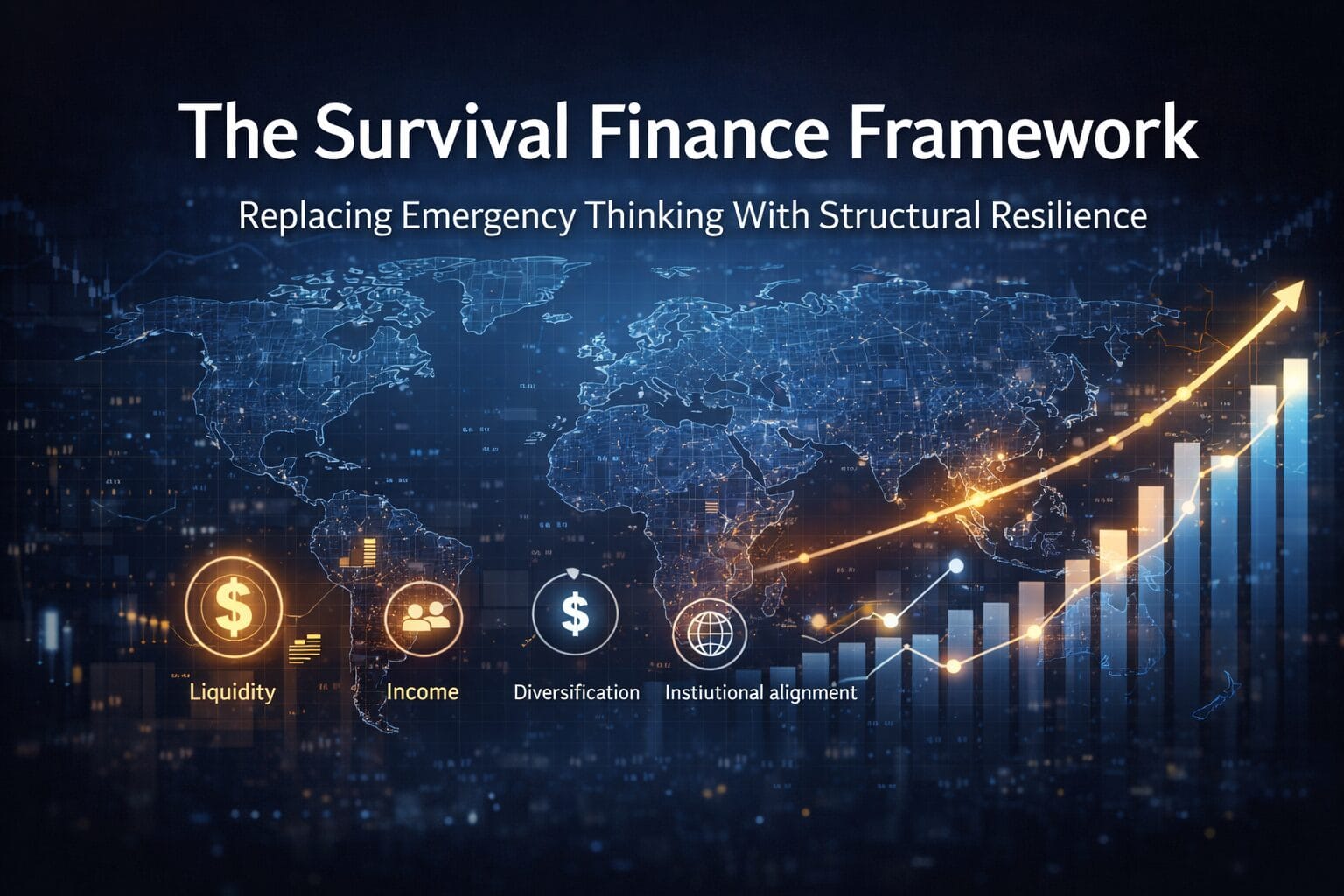
Building a Global System That Prevents Collapse Before It Begins
Most people prepare for emergencies.
Very few people build systems that make emergencies irrelevant.
There is a fundamental difference between reacting to financial shock and designing a structure that absorbs shock automatically.
This series has already explored why income loss does not immediately cause collapse, how invisible systems buffer costs, why essential services rarely disconnect first, how financial access can exist without traditional assets, and why governments avoid pushing individuals into systemic breakdown.
Now we move beyond observation.
This article is not about surviving a crisis.
It is about building a survival finance framework so strong that crisis becomes a temporary inconvenience rather than a life-altering catastrophe.
The goal is not temporary relief.
The goal is structural resilience that compounds into long-term financial dominance.
If built correctly, this framework does not just protect wealth.
It accelerates it.
Body
1. From Emergency Thinking to System Thinking
Emergency thinking is reactive.
System thinking is structural.
Emergency thinking asks:
- What happens if I lose income?
- How long can I survive?
- What costs can I cut?
System thinking asks:
- What structures absorb shocks automatically?
- What access remains even when income pauses?
- What assets continue operating without active labor?
The survival finance framework replaces reaction with architecture.
Instead of building a savings buffer alone, it builds:
- Multi-layer liquidity
- Distributed access points
- Autonomous income channels
- Structural cost absorption
- Institutional alignment
When these elements exist together, collapse probability decreases dramatically.
2. The Five Pillars of the Survival Finance Framework
A scalable survival system rests on five pillars.
Pillar 1: Liquidity Layers
Liquidity is not just cash.
It is tiered access to financial flexibility.
Layer 1 – Immediate Liquidity
Cash equivalents, short-term reserves, accessible funds.
Layer 2 – Structured Liquidity
Credit lines, revolving facilities, approved financing structures.
Layer 3 – Strategic Liquidity
Income-producing assets that can be partially liquidated without destroying core capital.
The objective is not hoarding money.
It is maintaining optionality.
Optionality is survival power.
Pillar 2: Autonomous Income Streams
A survival framework must generate income even when labor pauses.
This includes:
- Content-based digital assets
- Recurring subscription models
- Licensing structures
- Affiliate ecosystems
- Scalable digital products
- Dividend-producing investments
- Royalties and intellectual property
The key principle:
Income must detach from time.
When income is tied only to active work, collapse risk increases.
When income is tied to assets, resilience increases.
Pillar 3: Structural Cost Absorption
Many people attempt to cut costs manually.
A framework absorbs costs structurally.
Examples include:
- Long-term fixed housing structures
- Insurance systems that prevent catastrophic loss
- Utility structures designed for continuity
- Digital infrastructure replacing physical overhead
- Geographic arbitrage
When fixed expenses are structurally optimized, survival becomes mathematically easier.
The less fragile your cost base, the stronger your survival system.
Pillar 4: Institutional Alignment
Governments and institutions rarely allow systemic individual collapse.
Understanding this creates advantage.
Institutions provide:
- Grace periods
- Structured repayment systems
- Regulatory buffers
- Stabilization mechanisms
- Financial restructuring pathways
Instead of fearing systems, resilient individuals align with them.
Alignment reduces volatility.
Pillar 5: Geographic and Platform Diversification
Concentration increases fragility.
Diversification increases durability.
This includes:
- Multi-currency exposure
- Multi-platform income generation
- Cross-border asset allocation
- Digital and physical balance
Survival finance is global by design.
A localized shock cannot destroy a diversified system.
3. The Mathematics of Structural Resilience
To understand long-term stability, consider this model:
If monthly baseline expenses equal $5,000,
and autonomous income equals $6,500,
then survival margin = $1,500.
If margin is reinvested into income-producing assets,
income expands without increasing labor.
Over time:
$6,500 → $8,000 → $12,000 → $20,000
Once margin compounds, survival turns into dominance.
The framework is not static.
It expands.
4. Designing for $1M+ Annual Stability
A $1M annual target requires architecture.
Example breakdown:
- Digital infrastructure income: $300,000
- Intellectual property assets: $200,000
- Strategic investment yield: $250,000
- Platform ecosystem revenue: $150,000
- Advisory or licensing structures: $100,000
Total: $1,000,000+
The objective is not one massive source.
It is multi-source structural strength.
Each stream supports the others.
5. Replacing Panic with Predictability
Financial panic stems from uncertainty.
Predictability stems from systems.
When you know:
- Your baseline liquidity coverage
- Your recurring income floor
- Your cost absorption mechanisms
- Your access to institutional buffers
Stress reduces dramatically.
Survival becomes calculated, not emotional.
6. Transitioning from Survival to Strategic Expansion
A well-built survival framework does more than protect.
It creates leverage.
Once collapse probability is minimized,
risk tolerance increases.
Calculated risk produces growth.
Growth produces scale.
Scale produces structural wealth.
This is the shift:
Emergency → Stability → Leverage → Expansion
Conclusion
Survival finance is not about fear.
It is about architecture.
When liquidity layers, autonomous income, structural cost absorption, institutional alignment, and diversification operate together, collapse becomes unlikely.
Instead of living in emergency mode, you operate in expansion mode.
Resilience is not passive.
It is engineered.
Build the framework once, strengthen it continuously, and the system works for decades.
Survival then transforms into strategic advantage.
Case List
Case 1 – Digital Infrastructure Builder
Built multiple autonomous content platforms generating recurring revenue.
When active income paused, revenue remained stable.
Expanded margin into higher-yield assets.
Case 2 – Diversified Asset Strategist
Maintained multi-currency exposure and digital asset streams.
Regional disruption had limited impact.
Income stability preserved purchasing power.
Case 3 – Institutional Aligned Entrepreneur
Structured financing relationships in advance.
Used grace structures strategically during downturn.
Preserved capital while competitors liquidated assets.
Common thread:
System before crisis.
👉 If You’ve Read This Far, the Next Layer Begins Below
The survival finance framework prevents collapse.
But preventing collapse is not the final objective.
The next stage transforms resilience into scalable global advantage.
Next Post Preview
The Global Survival Finance System
– Integrating Liquidity, Income, Diversification, and Institutional Alignment Into One Unified Architecture
The next article consolidates the entire series into one global structural blueprint designed for long-term financial dominance.
Subscription Call to Action
If your objective is temporary safety, emergency savings may be enough.
If your objective is structural wealth and global resilience, you need systems.
Subscribe and continue building a framework that does not merely survive volatility—but converts it into opportunity.
Long-term wealth is not accidental.
It is engineered.