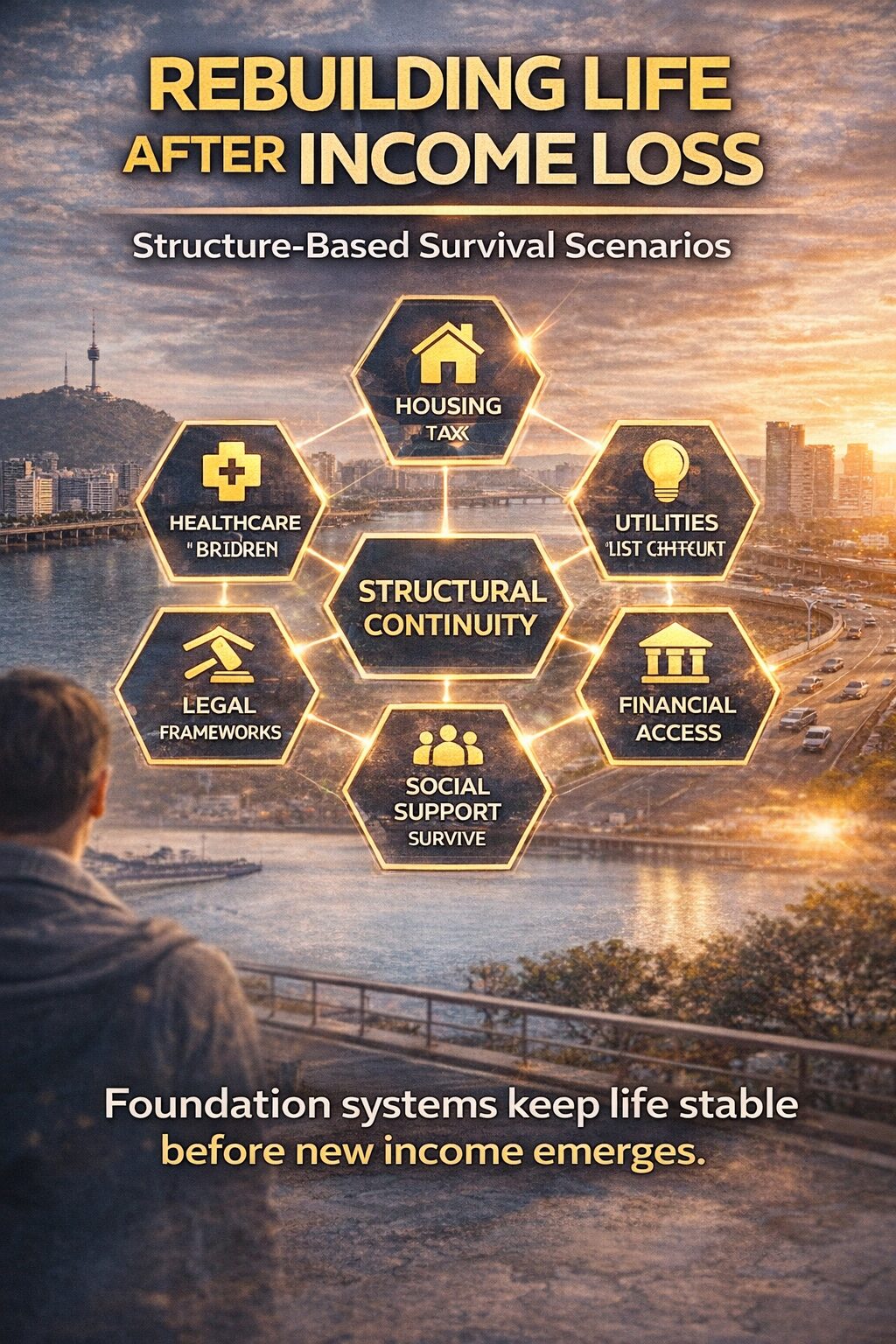
Structure-Based Survival Scenarios
When income disappears, fear often arrives before reality.
People imagine eviction, medical collapse, financial isolation, and social disappearance.
But what actually happens is far more subtle — and far more powerful.
Modern life is not held together by paychecks.
It is held together by systems designed to preserve continuity when paychecks fail.
This article reveals how life is rebuilt after income loss, not through luck or emergency funds, but through invisible structures that quietly keep people connected to housing, healthcare, infrastructure, and financial access.
This is not a story of survival through struggle.
It is a story of survival through design.
The Architecture Beneath Income
Most people believe money is the foundation of life.
In reality, money is only a signal inside a much larger operating system.
The true foundation consists of:
Legal identity
Housing frameworks
Healthcare systems
Utility infrastructure
Communication networks
Financial access layers
These do not belong to employers.
They do not belong to markets.
They belong to society itself.
When income stops, this foundation does not disappear.
It takes over.
The First Shift After Income Loss
When a person loses income, three immediate changes occur inside the system.
First, cost exposure is reduced.
Healthcare moves deeper into social coverage.
Housing becomes protected by legal frameworks.
Utilities shift from market enforcement to continuity protection.
Second, access remains intact.
Medical services remain open.
Financial accounts remain active.
Communication networks stay connected.
Third, time is created.
The system assumes income loss is a transition, not an ending.
This is why collapse does not occur.
Why Modern Systems Delay Failure
Failure is dangerous for societies.
When people collapse, infrastructure strains, healthcare breaks, and social stability erodes.
So modern systems are built to slow everything down.
They create buffers.
They create cost absorption.
They create access without payment.
These are not acts of kindness.
They are acts of engineering.
A person who remains housed, connected, and medically supported is far less costly than one who falls out of the system.
Continuity is cheaper than collapse.
Scenario Layer One
The End of Work
A career ends.
The paycheck stops.
But the person remains fully embedded in society.
Their address still exists.
Their healthcare is still active.
Their utilities still flow.
Their financial identity remains.
Nothing essential disappears.
Work was a layer.
Life is the platform.
Scenario Layer Two
The Closure of a Business
A business closes.
Revenue vanishes.
But the individual remains connected to the same systems.
Medical care continues.
Housing remains legally protected.
Communication systems stay active.
Financial access remains open.
The system does not punish exits.
It absorbs them.
Scenario Layer Three
Unstable Income
Many people live without predictable earnings.
Yet their lives remain stable.
Why?
Because stability is not provided by income.
It is provided by infrastructure.
Infrastructure does not measure earnings.
It measures presence.
If you are present, you are supported.
The Invisible Survival Grid
Behind every modern life is a survival grid that never shuts down:
Healthcare
Housing
Utilities
Transportation
Communication
Financial systems
Legal frameworks
Income flows through this grid.
Life rests upon it.
When income stops, the grid remains.
Why People Do Not Disappear
People fear that without money they will vanish from society.
But society does not run on money alone.
It runs on records, systems, and connections.
As long as those remain, the person remains.
And they do.
Conclusion
Income loss feels dramatic because it is visible.
What disappears can be seen.
What remains is invisible — and far more powerful.
Housing remains.
Healthcare remains.
Infrastructure remains.
Financial access remains.
Social participation remains.
This is not luck.
It is the result of systems designed to keep people inside society even when their earnings fall away.
Modern survival is not built on constant income.
It is built on continuity of connection.
When one layer collapses, the others carry the weight.
This is how life is rebuilt — not from nothing, but from what was always there.
Case List
A professional steps away from a long career.
Their income pauses, but their home, healthcare, and communication systems continue without interruption.
A business owner exits a venture.
Revenue stops, yet financial accounts, medical services, and legal identity remain fully active.
A worker moves between industries.
Income fluctuates, but access to infrastructure never disappears.
A caregiver leaves paid work to support family.
Despite income change, housing, utilities, and healthcare remain stable.
Each scenario looks uncertain from the outside.
Inside the system, continuity is already built in.
Next Article
The next page is the central hub of the entire series.
It connects all layers — from income loss to hidden support systems, from cashless survival to financial access, and from life transitions to long-term stability.
The hub reveals the full survival map that holds everything together.
Call to Read
Life is not protected by paychecks.
It is protected by systems.
When you understand those systems, income loss becomes a transition — not a collapse.
Explore the full series to see how modern survival truly works.