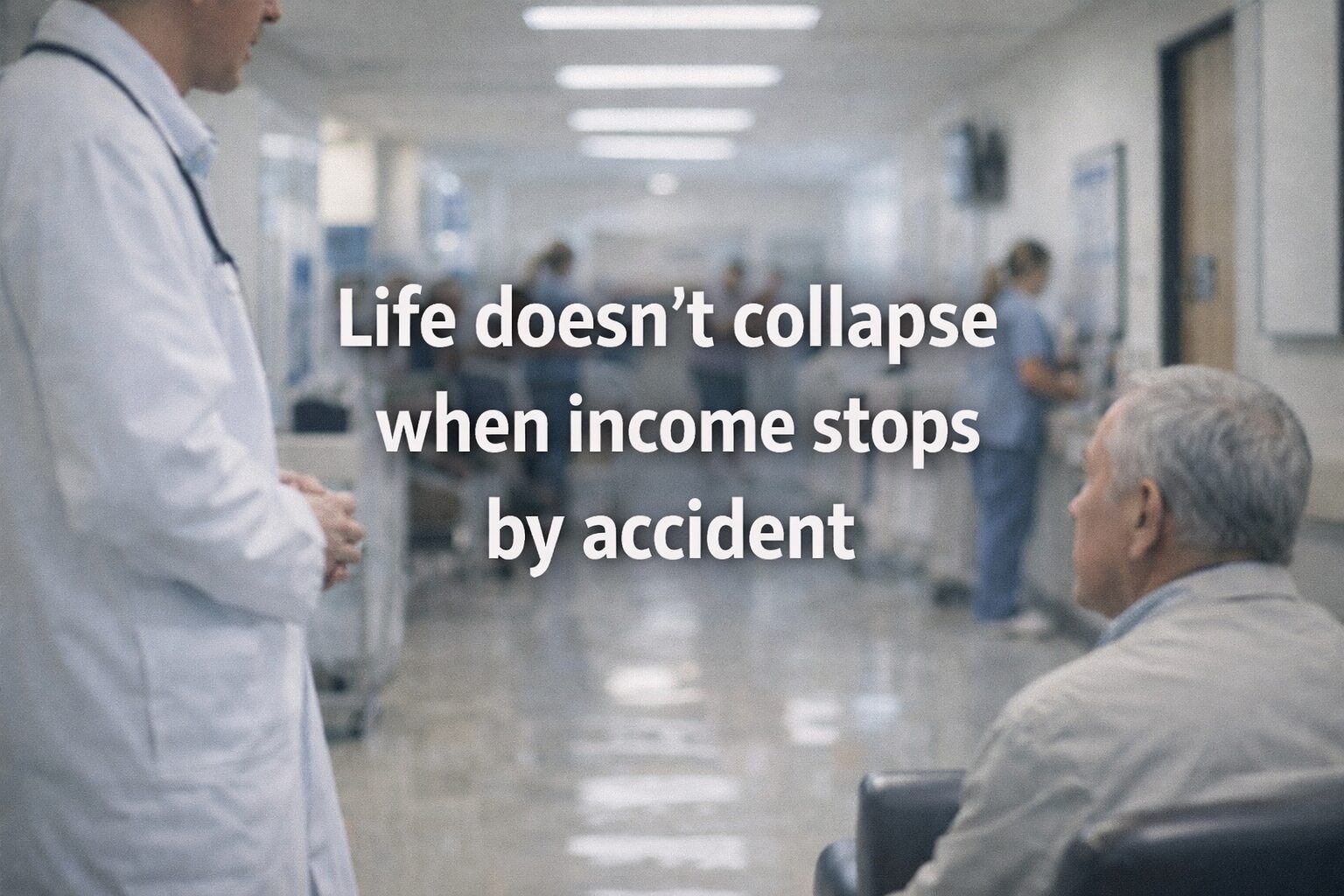
The Hidden Survival Design of Modern Financial Systems
The Fear That Appears When Income Disappears
When income stops, fear arrives immediately.
Not the abstract fear of uncertainty,
but a very concrete one:
“How long can I survive without money?”
People assume that income is the single pillar holding life together.
Without it, everything must collapse — housing, healthcare, utilities, dignity, stability.
This belief feels logical.
Money appears to be the fuel that keeps systems running.
Yet in reality, modern societies are not designed to collapse the moment income disappears.
Life does not stop instantly.
Services do not shut down immediately.
Access does not vanish overnight.
This is not an accident.
It is not kindness.
It is not generosity.
It is design.
This article explains why life continues even when income stops —
not through personal resilience or emergency savings,
but through invisible systems that absorb shock long before collapse becomes visible.
Section 1: Income Is Not the Foundation of Modern Life
Income feels central because it is visible.
It arrives regularly, disappears dramatically, and directly affects personal decisions.
But income is not the structural foundation of modern life.
Instead, modern systems operate on continuity principles, not transaction principles.
Most essential systems are not designed to function on a pay-or-collapse model.
They are designed to prioritize stability over efficiency.
This distinction changes everything.
Housing systems, healthcare systems, utilities, banking access, and public services
are built to delay failure, not accelerate it.
Why?
Because instant collapse is expensive — not just for individuals, but for systems themselves.
Section 2: Collapse Is a Systemic Risk, Not a Personal Outcome
A single individual collapsing may seem insignificant.
Millions collapsing is catastrophic.
Modern governments, financial institutions, and service networks understand this clearly.
When income loss leads to immediate collapse:
- Emergency costs surge
- Health systems overload
- Debt defaults accelerate
- Social instability increases
- Administrative costs multiply
Preventing collapse is cheaper than repairing it.
As a result, modern systems are engineered to slow down failure, not punish it.
This is why:
- Services disconnect gradually
- Access degrades in stages
- Support structures activate automatically
- Time is created before pressure peaks
Time, not money, is the first resource provided.
Section 3: Survival Systems Work Before You Notice Them
One of the most misunderstood aspects of modern finance is this:
Survival systems activate before people recognize they are in danger.
These systems do not wait for emergencies.
They operate continuously in the background.
They reduce pressure before individuals perceive relief.
Examples include:
- Cost absorption mechanisms
- Deferred obligations
- Priority access preservation
- Structural grace periods
- Risk pooling across populations
Most people mistake this for “personal coping.”
In reality, it is systemic buffering.
Section 4: Why Essential Services Rarely Disconnect First
When people fear income loss, they imagine instant shutdown:
- No healthcare
- No housing
- No utilities
- No access
But essential services are intentionally the last systems to disconnect.
This is not moral policy.
It is infrastructure logic.
Disconnecting essentials triggers cascading failures:
- Health emergencies increase
- Public safety risks rise
- Administrative burdens explode
- Long-term costs skyrocket
Therefore, essential systems are protected from rapid disconnection.
They are surrounded by layers of delay, review, absorption, and adjustment.
This design is global — appearing in different forms across countries, cultures, and economies.
Section 5: The Illusion of “Immediate Financial Failure”
People often believe they are closer to collapse than they truly are.
This illusion is created by:
- Anxiety-driven assumptions
- Incomplete information
- Highly visible edge cases
- Media narratives focused on extremes
In reality, most systems do not operate on edge cases.
They operate on probability, averages, and risk containment.
Failure is managed, not triggered.
This is why:
- Access degrades gradually
- Support appears indirectly
- Pressure builds slowly
- Recovery windows exist
Collapse is not the default outcome.
It is the exception.
Section 6: Financial Access Without Stability
Another critical misunderstanding is the belief that income is required for access.
In modern systems:
- Access is separated from performance
- Eligibility is separated from productivity
- Participation is separated from income flow
This separation exists because removing people entirely is more dangerous than keeping them inside systems at minimal cost.
Banks, utilities, healthcare providers, and governments prefer controlled inclusion over exclusion.
Access does not mean privilege.
It means containment.
Section 7: Why Governments Avoid Forcing Personal Failure
Governments do not fear poverty.
They fear instability.
Personal failure becomes dangerous when it turns systemic.
This is why:
- Social systems focus on continuity
- Recovery pathways exist
- Protection triggers activate quietly
- Failure is slowed, not accelerated
This approach is visible across political ideologies and economic models.
It is not compassion.
It is structural self-preservation.
Section 8: The Real Currency Is Time, Not Cash
Money solves problems quickly.
Time prevents them from becoming catastrophic.
Modern survival systems are time-generating machines.
They:
- Delay consequences
- Spread impact
- Absorb shock
- Maintain access
- Protect continuity
People who understand this stop panicking early.
They make better decisions.
They avoid irreversible mistakes.
Time allows strategy.
Panic destroys it.
Section 9: Why Most People Misinterpret Stability
Stability is often mistaken for strength.
In reality, stability is usually managed fragility.
Systems do not expect everyone to succeed constantly.
They expect fluctuation.
They are designed for interruption, not perfection.
This is why:
- Income interruptions do not immediately destroy lives
- Financial stress does not instantly remove access
- Systems tolerate inconsistency
Understanding this reframes fear into structure.
Section 10: The Survival Finance Perspective
Survival finance is not about wealth accumulation.
It is about understanding what prevents collapse.
It asks different questions:
- What absorbs cost when money stops?
- What delays pressure?
- What maintains access?
- What protects continuity?
People who understand survival finance stop measuring safety by income alone.
They begin measuring it by system position.
Conclusion: Life Continues Because Collapse Is Not the Goal
Modern life is not held together by your income.
It is held together by systems designed to prevent rapid failure.
These systems are invisible when things are stable
and misunderstood when things feel uncertain.
But they exist.
Life continues because collapse is expensive.
Access remains because exclusion is dangerous.
Time is created because panic is destructive.
Understanding this does not eliminate risk.
It eliminates unnecessary fear.
And fear, more than income loss, is what causes irreversible decisions.
Case Overview: Where These Systems Appear
- Healthcare access maintained despite instability
- Housing continuity through layered protection
- Utility services operating under delay frameworks
- Financial access preserved without performance
- Gradual adjustment instead of instant failure
These are not exceptions.
They are design outcomes.
Next Article Preview
In the next article, we explore what replaces money when cash flow weakens:
“Invisible Systems That Absorb Costs Before You Notice”
This is where survival becomes structural —
and where most people realize they were never as close to collapse as they believed.
Subscription Invitation
This series does not teach how to earn more.
It explains why life continues even when earning stops.
If you want to understand the systems that quietly protect continuity
and learn how to navigate uncertainty without panic,
follow this series as it unfolds.
Understanding structure changes everything.