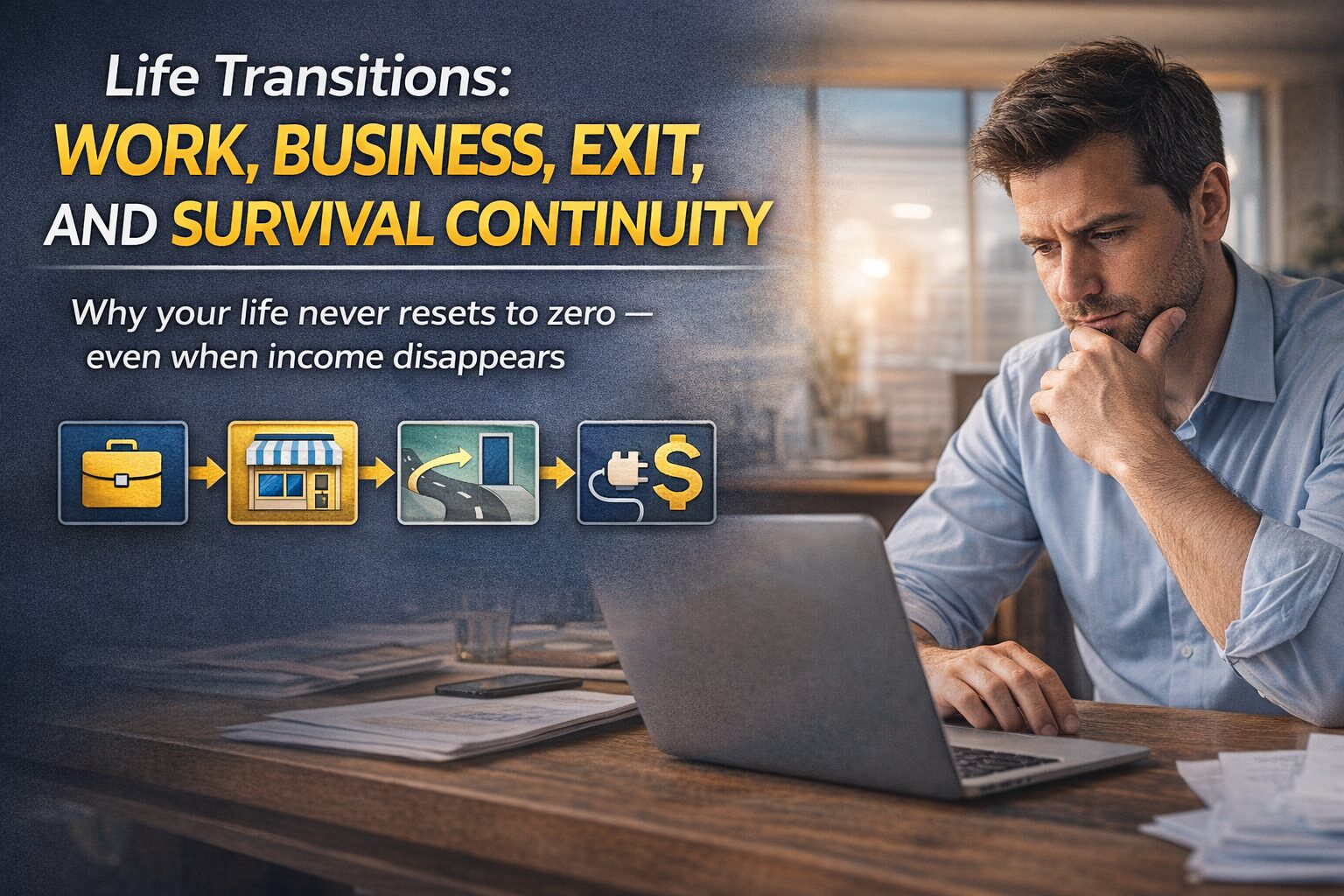
Why your life never resets to zero — even when income disappears
Most people believe that when a job ends, a business shuts down, or income stops, life “starts over.”
That belief is one of the most expensive financial illusions in modern society.
Your life does not reset when income changes.
Your position inside the system changes.
And that distinction determines whether someone collapses — or quietly survives and eventually rebuilds.
This article explains the invisible structure that allows human life to continue through career breaks, business exits, shutdowns, and income loss — even when cash appears to vanish.
1. Why income transitions feel like collapse
When people lose income, what they actually feel is not poverty.
They feel disconnection.
They suddenly lose:
- A payroll stream
- A sense of identity
- A predictable cash rhythm
- A visible financial anchor
The mind interprets this as “I am falling.”
But in reality, something very different is happening.
Modern systems are not designed to collapse when income stops.
They are designed to absorb and redirect.
The mistake is assuming income is the system.
It is not.
Income is only one input into a much larger survival engine.
2. The hidden architecture behind every working life
Behind every paycheck sits a layered system:
- Health coverage
- Housing protection
- Utility access
- Credit eligibility
- Social safety nets
- Legal status
- Financial identity
- Service continuity
When income stops, most of this does not disappear.
It quietly shifts into maintenance mode.
The system does not shut down.
It simply switches gears.
That is why people do not immediately lose housing.
That is why healthcare does not instantly disappear.
That is why utilities stay connected.
That is why accounts remain open.
What collapses is not life.
What collapses is the illusion of independence.
3. Why businesses, jobs, and careers are temporary shells
Jobs, businesses, and freelance income are not survival systems.
They are delivery vehicles.
They deliver money into a structure that already exists.
When the delivery vehicle breaks, the structure remains.
People confuse:
- The truck (income)
with - The highway (system)
When the truck stops, the highway does not vanish.
It is still there — waiting for the next vehicle.
4. The difference between exit and erasure
There is a crucial difference between:
- Exiting a role
and - Being erased from a system
Modern societies are designed to prevent erasure.
You may exit:
- A job
- A company
- A contract
- A business
- A profession
But you remain inside:
- Healthcare networks
- Housing systems
- Financial identities
- Utility grids
- Legal frameworks
- Social programs
That is survival continuity.
5. Why life does not reset to zero
If life truly reset when income stopped, societies would collapse.
Instead, something far more sophisticated happens.
Costs do not remain fixed.
Access does not disappear.
Protection does not shut off.
Systems step in.
Expenses shrink.
Coverage activates.
Support networks expand.
Thresholds adjust.
The system stretches.
That stretch is what allows people to breathe during transitions.
6. Structural continuity across work, business, and exit
Consider the three major transitions people experience:
Leaving employment
You lose a paycheck.
You do not lose your healthcare system.
You do not lose your identity.
You do not lose your accounts.
You do not lose your legal presence.
Closing a business
You lose revenue.
You do not lose your financial footprint.
You do not lose your access to services.
You do not lose your social infrastructure.
Taking a career break
You lose momentum.
You do not lose the platform.
In all cases, the same thing remains:
The support structure.
7. Why the system allows people to survive invisibly
People assume survival must look dramatic.
It does not.
Survival looks like:
- Bills shrinking
- Services staying on
- Support quietly appearing
- Costs being absorbed
- Time being bought
Most survival is not cash.
It is systemic friction reduction.
The system removes pressure so that humans can recover.
That is the true function of modern safety networks.
8. Why panic destroys more wealth than income loss
When people panic, they:
- Close accounts
- Cancel protections
- Abandon systems
- Liquidate assets
- Destroy credit
- Break continuity
They don’t fall.
They jump.
The system was holding them.
They stepped off.
9. The people who rebuild fastest are not the richest
They are the most structurally connected.
They:
- Keep insurance
- Maintain financial identity
- Preserve legal standing
- Stay inside systems
- Remain eligible
- Remain visible
So when new opportunities arise, the system reconnects them.
10. Preparing for the next layer while income is paused
Income loss is not a void.
It is a repositioning window.
This is when people:
- Re-skill
- Re-structure
- Re-route
- Re-enter
The system keeps them alive while this happens.
That is not failure.
That is designed recovery.
11. Why survival continuity is the foundation of wealth
Wealth is not built by those who never fall.
It is built by those who fall without being erased.
Structural continuity is what allows capital, credit, skill, and opportunity to compound over a lifetime.
The system does not reward uninterrupted income.
It rewards unbroken existence inside the system.
Conclusion
Your job is not your life.
Your business is not your existence.
Your income is not your survival.
They are merely vehicles.
The system beneath you is what keeps you alive, connected, and able to rebuild.
When income changes, you do not disappear.
You simply move to a different lane on the same road.
Case Structures
- Individuals who leave jobs but remain fully insured and housed
- Entrepreneurs who exit businesses yet stay financially connected
- Workers in transition who remain inside healthcare, utilities, and identity systems
- People who rebuild because their structural access never disappeared
Next Article Preview
Rebuilding Life After Income Loss (Structure-Based Scenarios)
How people move through system layers and quietly return to stability — without money, deadlines, or desperation.
Subscribe & Explore
To build long-term financial resilience, you must understand the systems that protect you when income changes.
Explore more structure-based survival and capital insights on this site.