Top 5 Best Credit Cards for International Travel in 2025

Health in Korea 365 blog, providing tips and resources for foreigners living in Korea

Choosing the right credit card for international travel can save you hundreds of dollars in fees and maximize your rewards.
With so many options available, it’s crucial to pick a card that offers no foreign transaction fees, excellent travel perks, and strong global acceptance.

Here are the Top 5 Best Credit Cards for International Travel in 2025 you should seriously consider.

1. Chase Sapphire Preferred® Card

Why It’s Great:

  • No foreign transaction fees
  • 2x points on travel and dining
  • Flexible point redemption through Chase Ultimate Rewards
  • Strong travel protections including trip cancellation insurance and primary rental car insurance

Annual Fee: $95

Ideal For: Travelers who want flexible rewards and comprehensive travel protections without a high annual fee.


2. Capital One Venture Rewards Credit Card

Why It’s Great:

  • No foreign transaction fees
  • 2x miles on every purchase, every day
  • Global Entry/TSA PreCheck® credit
  • Simple redemption: miles can be used to erase travel purchases

Annual Fee: $95

Ideal For: Travelers who want easy-to-understand rewards and maximum simplicity.


3. American Express® Gold Card

Why It’s Great:

  • No foreign transaction fees
  • 4x points at restaurants worldwide
  • 3x points on flights booked directly with airlines or Amex Travel
  • Premium dining benefits through Amex partnerships

Annual Fee: $250

Ideal For: Frequent travelers who prioritize dining experiences and premium travel benefits.


4. Chase Sapphire Reserve®

Why It’s Great:

  • No foreign transaction fees
  • 3x points on travel and dining
  • $300 annual travel credit
  • Priority Pass™ Select membership (airport lounge access)

Annual Fee: $550

Ideal For: Frequent international travelers who want luxury perks and maximum rewards.


5. Capital One Venture X Rewards Credit Card

Why It’s Great:

  • No foreign transaction fees
  • 10x miles on hotels and rental cars through Capital One Travel
  • 5x miles on flights booked through Capital One Travel
  • Airport lounge access included
  • $300 annual travel credit

Annual Fee: $395

Ideal For: Adventurous travelers looking for luxury experiences at a more affordable premium card fee.


Final Thoughts

If you plan to travel internationally in 2025, picking the right credit card is as important as booking your flight.
Each card listed here offers a powerful combination of savings, rewards, and protections.
Choose the one that best fits your travel style — and make every trip even more rewarding.

In the next article, we’ll cover how to maximize your credit card rewards while traveling abroad — don’t miss it!
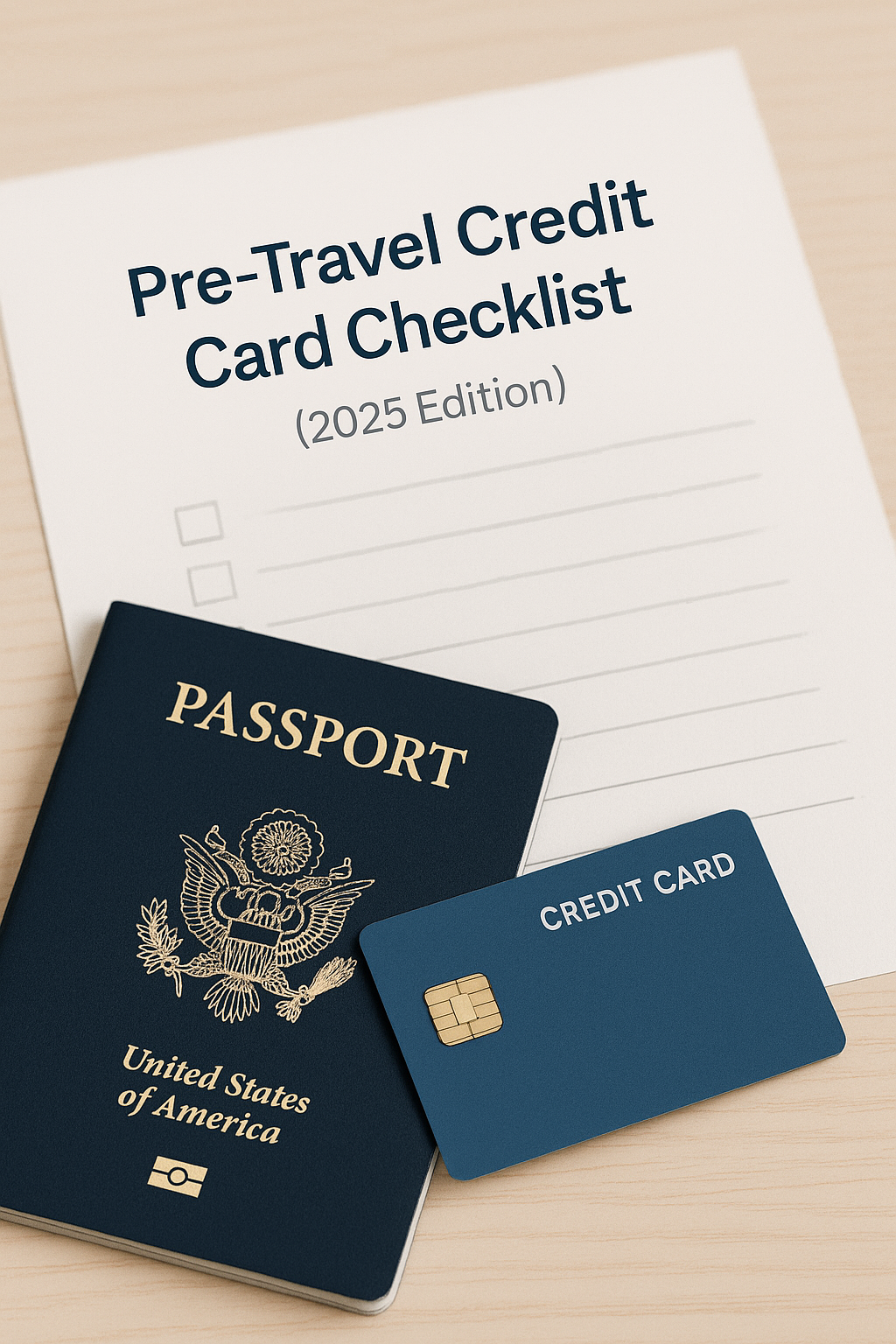

Ultimate Pre-Travel Credit Card Checklist (2025)

Travel tips for foreigners visiting Korea, offering health and wellness advice

Preparing your credit card before traveling abroad is just as important as packing your passport. A few simple steps can save you from hidden fees, card declines, or even financial emergencies overseas.
Use this ultimate checklist to ensure your credit card is 100% travel-ready for 2025.

1. Confirm Your Card Is Travel-Friendly

Does your card have 0% foreign transaction fees?
Is it widely accepted worldwide (Visa or Mastercard)?
Does it offer travel protections like trip insurance or emergency assistance?

If your card falls short in any of these areas, consider applying for a better one before your trip.


2. Notify Your Bank of Your Travel Plans

Set a travel notice online or via your bank’s app.
Provide the countries and dates you’ll be abroad.
Update your email and mobile number to a reachable contact.

This helps prevent your card from being blocked for suspicious activity.


3. Set Up Mobile Banking and Alerts

Download your bank’s mobile app.
Enable instant transaction alerts by SMS or app notifications.
Check your ability to lock/unlock your card remotely.

Real-time notifications can help you detect fraud immediately.


4. Check Spending Limits and Available Credit

Review your current balance and credit limit.
Ensure enough available credit for emergencies or unexpected expenses.
Consider requesting a temporary credit limit increase if needed.

Having extra available credit can be a lifesaver during long trips.


5. Understand Your PIN and Cash Access Options

Set a 4-digit PIN if you plan to use your card at ATMs.
Confirm whether your credit card allows cash advances (and understand the fees).
Prefer using a debit card for ATM withdrawals to avoid high credit card cash advance fees.

Some countries, like those in Europe, often require a PIN even for small credit card purchases.


6. Double-Check Billing Addresses and Expiration Dates

Make sure your billing address on file is current.
Verify your card expiration date won’t pass during your travels.
Request a replacement card early if it’s expiring soon.

Many international transaction systems verify your billing address, so any mismatch could cause declines.


7. Carry Backup Payment Options

Pack at least two different cards (preferably from different issuers).
Bring a debit card for ATM withdrawals.
Carry a small amount of local currency as backup.

Relying on a single card can be risky if it’s lost, stolen, or blocked.


8. Review Foreign ATM and Dynamic Currency Conversion (DCC) Policies

Know your card’s foreign ATM fees and preferred ATM networks.
Always choose to pay in local currency — avoid DCC traps.
Save a list of partner banks abroad that might offer fee-free withdrawals.

Understanding these policies beforehand will save you a surprising amount in fees.


Final Tip

Before you board the plane, go through this checklist carefully.
Taking just an hour to prepare your credit card can prevent weeks of financial stress during your trip.

In our next article, we’ll share the best credit cards for international travelers in 2025 — stay tuned!

Ultimate Tips for Managing Money While Staying in Korea (2025 Master Guide)

2025global travel tips providing essential health and currency exchange information

Introduction

Managing your money wisely while staying in Korea—whether for a short trip or a long-term stay—is essential to maximizing your experience and avoiding unnecessary financial stress. In this ultimate guide, we share the best strategies to ensure you stay financially smart, secure, and efficient during your time in Korea.

Set Up a Solid Payment System Early

As soon as you arrive in Korea, set up a payment system that covers daily expenses easily.

  • Credit Cards: Bring a card with no foreign transaction fees and reliable global acceptance (Visa or Mastercard preferred).
  • T-Money Card: Purchase and load a T-Money card immediately. It’s essential for subways, buses, taxis, and even convenience stores.
  • Mobile Wallets: Install and activate apps like Apple Pay, Samsung Pay, or Google Pay for quick and secure transactions.

Establishing your payment base early minimizes confusion later.


Avoid Cash Dependency

Korea is extremely card- and mobile-friendly. Relying heavily on cash is not only inconvenient but also risky.

  • Use your card or mobile payment for most purchases.
  • Reserve cash only for markets, small restaurants, or rural areas.
  • Keep cash holdings low to minimize theft or loss risk.

In urban Korea, carrying large amounts of cash is unnecessary.


Monitor Exchange Rates Smartly

Smart money management means timing your exchanges wisely.

  • Track exchange rate trends a few days before your trip.
  • Exchange only essential cash at airports where rates are worse; do major exchanges in the city.
  • Compare ATM withdrawal costs vs. cash exchange at banks.

Even a 2–3% better rate makes a noticeable difference over time.


Use Budget Tracking Apps

Maintaining visibility over your expenses is crucial.

  • Mint: Real-time transaction tracking with bank sync.
  • Spendee: Intuitive budget planning and expense categorization.
  • Money Manager App: Popular in Korea for simple manual entry and analysis.

Using a budgeting app ensures that daily spending doesn’t spiral out of control.


Stay Aware of Hidden Fees

Hidden fees can quietly drain your funds if you’re not careful.

  • Always decline Dynamic Currency Conversion (DCC) at ATMs and card readers.
  • Confirm if your card refunds international ATM fees.
  • Check if your bank imposes foreign transaction fees despite being “global.”

Stay proactive in verifying your financial terms before each transaction.


Emergency Backup Plans

Preparation is the best insurance against unexpected issues.

  • Carry a second credit/debit card stored separately from your main wallet.
  • Reserve a small amount of emergency cash (around $100–$200).
  • Know your bank’s 24/7 international contact line in case of card loss or freezing.

Having a backup plan minimizes panic and keeps you moving smoothly.


Conclusion

Smart financial management in Korea is not about spending less—it’s about spending smarter.
By setting up reliable payment systems, avoiding hidden fees, tracking your expenses, and preparing for emergencies, you will protect your finances and enjoy every moment in Korea without financial stress.

Prepare well, spend wisely, and make your Korean experience not only memorable but financially brilliant.

Future Trends in Global Payments – What’s Next After 2025?

2025 global travel tips providing essential health and currency exchange information

Introduction

The world of payments is undergoing a massive transformation, and this evolution is only accelerating. After 2025, global payment systems will be faster, smarter, more secure, and more decentralized than ever before. Travelers, businesses, and everyday consumers must stay ahead of these changes to optimize how they move money across borders and within countries. In this guide, we explore the major trends shaping the future of global payments—and what you can do to prepare.

Rise of Digital Wallets

Digital wallets are no longer a niche product; they are becoming the primary method of payment around the world.

  • Apple Pay, Google Pay, Samsung Pay: These mobile wallets are replacing physical cards for millions of users.
  • Cashless Society: Several countries, including South Korea and Sweden, are pushing toward a society where cash is rarely used.
  • Multi-currency Wallets: Future digital wallets will likely manage multiple currencies seamlessly, making travel and international shopping even more convenient.

Owning and mastering at least one global digital wallet will soon become a necessity rather than an option.


Expansion of Mobile-First Payments

The shift from plastic cards to mobile devices is unstoppable.

  • QR Code Payments: Especially dominant in Asia, QR-based systems allow instant payments via smartphone cameras.
  • NFC Contactless Payments: Near-field communication allows tapping your phone or smartwatch to pay without touching keypads or terminals.
  • Integration into Daily Life: Mobile payments are extending to small businesses, hospitals, universities, and even taxis.

In the post-2025 world, mobile payments will become the default method even for micro-transactions.


Growth of Cryptocurrency Payments

While cryptocurrency has faced regulatory challenges, its role in global payments continues to expand.

  • Bitcoin and Stablecoins: Major companies and platforms are starting to accept Bitcoin, USDC, and USDT for transactions.
  • Cross-Border Utility: Crypto payments offer faster, cheaper, and more transparent transactions than traditional banking systems.
  • New Wallet Solutions: Companies like Coinbase, Binance, and others are building crypto wallets that seamlessly connect to real-world spending.

Those who understand and utilize crypto payment systems will have significant advantages in flexibility and global access.


Cross-Border Payment Innovations

Traditional international money transfers are slow, expensive, and complex—but change is coming fast.

  • New Systems: RippleNet, Wise (formerly TransferWise), and other fintech disruptors are creating real-time, low-cost global payment networks.
  • Instant Settlements: Blockchain technology enables near-instant cross-border money movement with minimal fees.
  • Global P2P Transfers: Peer-to-peer global transfers will become as easy as sending a text message.

This shift will democratize international finance, removing barriers for individuals and small businesses alike.


Expected Changes in Korea’s Payment Landscape

South Korea, already a leader in digital finance, will continue to innovate rapidly after 2025.

  • Expansion of Mobile Wallets: Broader adoption of services like Naver Pay, Kakao Pay, and Apple Pay.
  • Multilingual Payment Platforms: Enhanced support for English, Chinese, Japanese, and other languages to accommodate international visitors.
  • AI-Driven Financial Services: Personalized payment recommendations, fraud detection, and dynamic exchange rate optimization through AI.

South Korea’s payment ecosystem will become more accessible, personalized, and globally integrated.


Conclusion

The future of global payments will be defined by speed, convenience, and borderless access.
To thrive in this new environment, individuals must master digital wallets, mobile-first strategies, crypto flexibility, and real-time global transfers.

Those who prepare today will not only save money but also gain a massive strategic advantage in the global economy of tomorrow.

Adapt now, and be ready for the future of money.

Real-World Payment Scenarios in Korea – Travelers, Students, and Business Visitors (2025 Edition)

2025 global travel tips providing essential health and currency exchange information

Introduction

Not all visitors to Korea spend money the same way. A traveler’s needs differ from those of an international student or a business visitor. To truly optimize your money while in Korea, you must adapt your payment strategy to your specific situation. In this guide, we’ll break down practical, real-world payment tactics for three key groups: tourists, students, and business travelers.

Traveler Payment Strategy

Focus: Hotels, Restaurants, Shopping

As a traveler, your major expenses will center around accommodations, dining, entertainment, and shopping.

  • Credit Card Priority
    Use a no-foreign-transaction-fee credit card for hotels, major restaurants, department stores, and tourist attractions. Korea’s payment infrastructure is highly card-friendly in these sectors.
  • Small Cash Reserve
    Keep around 100,000 KRW ($75) on hand for small markets, street food, taxis (especially in rural areas), and public transportation when necessary.
  • T-Money Card for Transportation
    Purchasing and topping up a T-Money card at a convenience store will make subway and bus rides cheaper and more convenient.
  • Tax Refunds for Tourists
    For purchases over 30,000 KRW at tax-free stores, save your receipts. You can reclaim VAT at the airport before departure.

Student Payment Strategy

Focus: Housing, Utilities, Mobile Bills

International students staying long-term in Korea need a stable and sustainable payment setup.

  • Monthly Housing Payments
    • If paying for a dormitory, a credit card or bank transfer is usually accepted.
    • For private apartments, cash payments are often expected; setting up a Korean bank account is advisable.
  • Utilities and Mobile Phones
    • Korean SIM cards can be pre-paid or post-paid. Most post-paid plans require a Korean bank account.
    • Utility bills (electricity, water, gas) are often paid via Korean bank auto-transfer or convenience store payment.
  • Day-to-Day Expenses
    • Most cafes, restaurants, and bookstores accept international cards (Visa, Mastercard).
    • T-Money card for transportation is essential.
  • Online Shopping
    Many Korean e-commerce sites accept global payment systems, but creating a Korean PayPal or bank-linked payment method can make life much easier.

Business Visitor Payment Strategy

Focus: Hotels, Meals, Transport, Business Expenses

Business travelers typically have higher-value transactions and may require documentation for expense reimbursement.

  • Premium Credit Cards
    Use premium Visa or Mastercard credit cards that offer strong travel insurance, purchase protection, and reward points.
  • Hotel and Dining
    Always request itemized receipts for hotel stays and business dinners to simplify company reimbursement processes.
  • Business Taxis and Airport Transfers
    Taxis, KTX high-speed trains, and airport limousine buses accept cards. Receipts are available on request—be sure to collect them.
  • Expense Management Apps
    Use apps like Expensify or Concur to scan and organize receipts immediately to avoid end-of-trip confusion.

Common Payment Tips for Everyone

  • Save Receipts
    Especially important for tax refunds, business expenses, and dispute resolutions.
  • Pay in Korean Won
    Always opt for payment in KRW, not USD, when given the option at checkout to avoid Dynamic Currency Conversion (DCC) fees.
  • Mix Cards and Cash Wisely
    Maintain a balance: major expenses by card, small daily purchases with cash.

Conclusion

Whether you’re a tourist, a student, or a business visitor, customizing your payment strategy to match your lifestyle is key to maximizing value while in Korea. By knowing when and how to use cash, credit cards, and smart payment systems, you’ll spend less, gain more rewards, and enjoy a smoother experience overall.

Master the art of payment, and make your Korean journey a financially smart one.

How to Save on ATM Withdrawals and Cash Exchange in Korea (2025 Strategy)

international credit cards accepted in korea for easy payments by tourists

Introduction

Although Korea is a highly card-friendly society, carrying a small amount of cash remains essential for certain transactions such as street markets, taxis, and rural areas. However, travelers often lose money through unnecessary fees during ATM withdrawals and currency exchanges. In this guide, we’ll show you how to minimize those losses with smart strategies that every savvy traveler should know.

Saving on ATM Withdrawals in Korea

Use Global ATM Networks

Look for ATMs with logos like Global ATM, Cirrus, or Plus. These machines are optimized for international cards and tend to offer better exchange rates with fewer additional charges.
➔ You can usually find them at major banks (e.g., KB Kookmin Bank, Shinhan Bank) and inside convenience stores like 7-Eleven.

Avoid Dynamic Currency Conversion (DCC)

If an ATM offers to charge you in USD instead of KRW (Korean Won), decline. Always opt for local currency (KRW) to avoid hidden conversion fees and poor exchange rates.

Choose Cards with ATM Fee Reimbursement

Several U.S. banks offer credit or debit cards that reimburse international ATM fees:

  • Charles Schwab Bank High Yield Investor Checking Account: Unlimited worldwide ATM fee rebates.
  • Fidelity Cash Management Account: No ATM fees anywhere globally.
  • SoFi Checking and Savings: Refunds ATM fees at international ATMs.

If you have one of these cards, you can withdraw cash without worrying about extra costs.


Airport vs. City Currency Exchange: Which Is Better?

Why You Should Avoid Airport Exchange Counters

Airport currency exchange booths are extremely convenient but notoriously expensive. Rates can be 5–10% worse compared to city-based banks or specialized money changers.

If you must exchange at the airport, limit it to a minimal amount—just enough for initial transportation (like subway fare or a taxi ride).

Where to Get the Best Rates in the City

For the best rates, visit:

  • Major banks such as KB Kookmin Bank, Woori Bank, and Hana Bank.
  • Licensed currency exchange shops in tourist areas like Myeongdong or Hongdae (often better than banks for cash).

Always compare rates and ask about service fees before finalizing your exchange.


Optimal Timing for Exchange

  • Exchange on weekdays (Mon–Fri): Banks are fully operational, and better rates are available.
  • Avoid weekends and holidays: Banks are closed, and exchange counters may charge higher fees.
  • Monitor exchange rates: Even a small shift of 1–2% can make a big difference for larger sums.

Tip: Some Korean banks offer online reservation systems for currency exchange at preferred rates. You can book online and pick up your cash at a branch or airport kiosk.


Best Cash vs Card Strategy in Korea

The smartest way to manage your money in Korea is to minimize the cash you carry and rely mostly on cards.

  • Cash: Carry around 100,000–200,000 KRW ($75–$150) for small vendors, taxis, and emergencies.
  • Card: Use a no-foreign-transaction-fee credit card for hotels, restaurants, shopping, and transportation.

This method keeps you protected against theft or loss, while maximizing rewards from card payments.


Conclusion

In 2025, smart travelers to Korea don’t simply exchange money—they optimize every dollar.
By using global ATM networks, choosing fee-reimbursing cards, avoiding airport traps, and balancing cash with card usage, you can stretch your budget further and travel with confidence.

Plan ahead, act smart, and make every cent work for you while exploring Korea.

Best Credit Cards for Americans to Use in Korea (2025 Guide)

international credit cards accepted in korea for easy payments by tourists

Introduction

Traveling to Korea is an exciting adventure, but managing your money abroad can quickly turn stressful without the right tools. One of the smartest moves you can make before departing is choosing a credit card that works efficiently in Korea. The right card can save you from hidden fees, offer valuable rewards, and ensure hassle-free transactions wherever you go. In this guide, we will break down the essential features you need, the top recommended U.S. cards for Korea, and smart usage strategies to maximize your financial advantage while traveling.

Key Requirements for the Best Card in Korea

When selecting a credit card for use in Korea, not just any card will do. Here’s what you must prioritize:

  • No Foreign Transaction Fees
    Cards that waive foreign transaction fees can save you around 3% on every purchase—a cost that adds up fast on a trip abroad.
  • Strong Travel Rewards
    Look for cards that offer extra points or cashback on international travel, dining, and transportation purchases.
  • Global Acceptance
    In Korea, Visa and Mastercard dominate the acceptance network. American Express and Discover are less widely accepted, especially outside of Seoul.
  • Fraud Protection and Emergency Support
    Access to 24/7 fraud alerts, emergency card replacement, and global customer service is crucial in case anything goes wrong.

These four features are non-negotiable if you want to avoid unnecessary expenses and complications during your trip.


Top 5 Recommended U.S. Cards for Korea (2025)

1. Chase Sapphire Preferred® Card

  • No foreign transaction fees
  • 2x points on travel and dining worldwide
  • Excellent travel protections and broad Visa acceptance

2. Capital One Venture Rewards Credit Card

  • No foreign transaction fees
  • 2x miles on every purchase
  • Easy-to-use travel portal and strong global customer service

3. American Express Gold Card (Use with caution)

  • High rewards on dining worldwide
  • Limited acceptance in Korea, mainly in tourist areas and upscale hotels

4. Bank of America® Travel Rewards Credit Card

  • No foreign transaction fees
  • Unlimited 1.5 points per dollar spent on all purchases
  • Simple flat-rate rewards system

5. Wells Fargo Autograph℠ Card

  • No foreign transaction fees
  • 3x points on travel, dining, and gas stations
  • Visa network ensures reliable acceptance across Korea

Each of these cards brings specific strengths, but remember: acceptance matters. Always carry at least one Visa or Mastercard-backed card in Korea.


Why You Should Avoid Certain Cards

While planning for your trip, it’s equally important to know which cards to leave at home:

  • Discover: Very limited acceptance. Most Korean merchants, especially outside major cities, do not recognize Discover cards.
  • American Express (AMEX): Though better than Discover, AMEX is often restricted to major hotels, luxury stores, and some tourist-focused venues.

Relying solely on these cards can leave you in a bind, especially for everyday purchases like transit cards, small cafes, or convenience stores.


Practical Usage Tips in Korea

  • Always Pay in Korean Won (KRW)
    When offered a choice at checkout, select payment in KRW instead of USD. Dynamic Currency Conversion (DCC) usually includes hidden fees and poor exchange rates.
  • ATM Withdrawals
    If you must withdraw cash, look for Global ATMs inside major banks or 7-Eleven stores. Check if your card issuer refunds international ATM fees.
  • T-Money Integration
    Some credit cards (especially Visa-based) can be linked to Korean T-Money systems for subway and bus payments. Otherwise, purchasing a physical T-Money card for public transit is a smart move.
  • Mobile Payments
    While Apple Pay and Google Pay are growing in Korea, they are still not universally accepted. Carrying a physical card remains the safest option.

Conclusion

The best financial strategy for Americans visiting Korea in 2025 is simple:
Use a Visa or Mastercard credit card with no foreign transaction fees, optimize rewards through smart spending categories, and keep minor cash for small vendors. By preparing the right card setup, you’ll not only save money but also experience Korea without unnecessary financial worries.

A little preparation goes a long way—travel smarter, spend smarter, and enjoy Korea with full peace of mind.


(Optional) Quick FAQ

Q1: Can I use my U.S. credit card everywhere in Korea?
A: In major cities, yes. In rural areas, cash is still preferred, so keep a small amount of KRW on hand.

Q2: Should I tell my bank I’m traveling to Korea?
A: Yes, always set a travel notice to avoid transaction blocks or fraud alerts.

Q3: Is it better to use credit cards or cash in Korea?
A: Credit cards for major purchases, but always have cash for street markets, public transportation, and small vendors.

Future-Proof Your Global Payments: What’s Next After 2025?

foreign currency exchange in korea focusing on US dollars for travelers

Introduction: Why You Need to Plan Beyond 2025

By 2025, most international spenders have learned to avoid foreign transaction fees and use smart fintech tools.
But the global financial system is evolving rapidly, and what works today may soon be outdated.
From digital currencies to real-time payments, the future of global payments is already taking shape.
This guide will help you understand the next wave of changes—and how to prepare your personal and business finances for what’s coming next.

The Global Shift: Key Trends Shaping Payments After 2025

Here are the most important payment trends that will define the post-2025 era:

  • Central Bank Digital Currencies (CBDCs)
    Countries like China, the EU, and the US are actively developing state-backed digital currencies. These may reduce reliance on traditional banks and transform cross-border transactions.
  • Real-Time Payments (RTP) and Instant Settlements
    Fintech platforms are racing to enable instant cross-border transfers with no delays, using blockchain or AI-driven systems.
  • Digital Wallet Ecosystems
    Apple Pay, Google Wallet, and other smart wallets are expanding to support multiple currencies, loyalty programs, and even crypto assets in one place.
  • Decentralized Finance (DeFi) and Web3 Payments
    Peer-to-peer, permissionless payment protocols are gaining traction—offering full control without intermediaries.

The End of Traditional Banking for Global Payments?

As technology improves, more users are bypassing banks for international transactions.
Why?

  • High fees, delays, and outdated interfaces
  • Lack of transparency in exchange rates
  • Limited access to global services for freelancers, digital nomads, and global entrepreneurs

Instead, people are moving toward:

  • Multi-currency fintech platforms (Wise, Revolut, N26)
  • Borderless bank accounts
  • AI-based finance advisors and smart budgeting tools

Smart Strategies to Future-Proof Your Global Payments

To prepare for the next phase in financial globalization:

  1. Diversify Your Tools
    Don’t rely on one card or bank. Use a mix of fintech platforms, wallets, and global-friendly accounts.
  2. Open Multi-Currency Accounts
    Keep funds in local currencies where you frequently spend or earn money.
  3. Monitor Digital Currency Developments
    Learn about CBDCs and crypto regulations in your country of residence and destination countries.
  4. Use Payment Aggregators
    Platforms like Stripe or Airwallex combine invoicing, currency conversion, and real-time payment features.
  5. Secure Your Data
    As digital payments grow, protecting your identity and financial data becomes critical.

What to Watch: Payment Trends Worth Tracking

  • Stablecoins for daily use (USDC, EUROC, etc.)
  • Cross-border tax automation & compliance tools
  • Mobile-first, bankless finance ecosystems
  • Voice-activated or AI-powered transactions

Conclusion: Don’t Just Adapt—Lead the Shift

The global payments system is not just changing—it’s accelerating.
If you wait until changes are complete, you’ll always be reacting.
Start future-proofing now by adopting flexible, tech-friendly, and globally recognized financial tools.

Remember:
Global financial freedom isn’t just about spending less—it’s about being one step ahead.

Real-World Scenarios: How to Pay Smart While Traveling, Studying, or Running a Business Abroad

2025 global travel tips Providing essential health and currency exchange information

Introduction: Stop Losing Money to Hidden Fees Abroad

Whether you’re booking a hotel, paying tuition, or receiving payment from international clients, the way you handle global payments matters more than ever.
In 2025, exchange rate markups, transaction fees, and outdated payment methods are still quietly draining wallets.
This guide breaks down three real-life scenarios—travel, study, and business abroad—and provides practical, proven strategies to protect your money in each case.

Scenario 1: Smart Spending for International Travelers

Common Problems

  • Airport currency exchange with poor rates
  • Foreign transaction fees on credit cards
  • Dynamic currency conversion traps at checkout

What Smart Travelers Do

  • Use a zero-foreign-fee card (Visa/Mastercard) and always pay in the local currency
  • Avoid airport exchange booths, and instead use local ATMs with low-fee cards like Charles Schwab, Revolut, or Wise
  • Monitor exchange rates using apps like XE or Wise and pre-load balances when rates are favorable
  • Bring a backup card in case one fails (or is blocked)

Bonus Tip: For long-term travel, set up virtual multi-currency accounts to minimize ATM reliance.


Scenario 2: Financial Tactics for International Students

Common Problems

  • High international wire fees from parents or sponsors
  • Currency conversion losses on tuition and rent payments
  • Delays in receiving funds due to slow bank processes

What Smart Students Do

  • Use Wise or Revolut to receive monthly allowances with low conversion fees
  • Set up multi-currency receiving accounts (USD, EUR, KRW, etc.)
  • Preload tuition or rent using bulk transfer when exchange rate is strong
  • Track spending with real-time finance apps to manage living costs efficiently

Bonus Tip: Negotiate with landlords or institutions to accept payments in your home currency (some do!).


Scenario 3: Payment Optimization for Global Business & Freelancers

Common Problems

  • PayPal or bank transfers with high transaction and currency fees
  • Delays in getting paid from global clients
  • Invoicing in only one currency

What Smart Entrepreneurs Do

  • Use Wise Business, Revolut Business, or Payoneer for multi-currency billing
  • Create invoices in client’s native currency to remove conversion resistance
  • Consolidate global income in one platform to control exchange timing
  • Use currency alerts to convert when rates are most favorable

Bonus Tip: Use borderless accounts to get local bank details (like a US routing number) without living there.


Summary: Smart Global Payment Strategies by Role

RoleTools & Tactics
TravelersZero-FX cards, local ATMs, currency monitoring apps
StudentsWise/Revolut, preloading rent, budget tracking
EntrepreneursMulti-currency invoicing, global accounts, rate timing

Conclusion: The Right Payment Strategy Saves You Real Money

In the global economy of 2025, how you pay is just as important as what you pay for.
From travelers avoiding poor rates to students minimizing tuition conversion fees and business owners maximizing profit margins—smart payment choices make a tangible difference.

Don’t settle for default payment systems.
Build a strategy tailored to your role—and start keeping more of your money wherever you go.

Top 5 Zero-Fee International Payment Cards in 2025

International credit cards accepted in korea for easy paymets by tourists

Introduction: Why Zero-Fee Cards Matter More Than Ever

International purchases—whether made while traveling, studying abroad, or shopping online—often come with hidden costs.
Foreign transaction fees, currency conversion margins, and dynamic currency conversion charges can silently drain your money.
In 2025, choosing the right payment card is more than just convenience—it’s a personal finance strategy.
This guide introduces five of the best global credit and debit cards that offer zero foreign transaction fees, competitive exchange rates, and traveler-friendly perks.

How Foreign Transaction Fees Work (And Why They Matter)

Most people are unaware of how much they lose every time they swipe a card overseas:

  • Foreign Transaction Fee (1–3%)
    This is added on top of the purchase amount by your card issuer or network (Visa, Mastercard, etc.).
  • Currency Conversion Markup (often hidden)
    Banks may offer rates that include a hidden markup of 1–2% from the mid-market rate.
  • Dynamic Currency Conversion (DCC)
    Some merchants let you pay in your home currency at checkout—but this often comes with a poor exchange rate and higher fees.

Even on small purchases, these costs add up quickly—especially for travelers, digital nomads, and international shoppers.


Top 5 Zero-Fee Cards for International Payments in 2025

1. Capital One Venture X (USA)

  • No foreign transaction fees
  • Excellent travel rewards
  • Global Visa acceptance
  • Strong travel protections and airport lounge access

2. Revolut Metal (Global)

  • Mid-market exchange rates (no markup on weekdays)
  • Up to $1,000/month fee-free exchange
  • Works as a prepaid card across 140+ countries
  • Budgeting and saving tools built in

3. Chase Sapphire Preferred (USA)

  • No FX fees
  • 2x points on travel and dining
  • Trusted for global travel
  • Strong purchase protection benefits

4. Wise Debit Card (Global)

  • Real exchange rate with minimal transparent fee
  • Supports 50+ currencies
  • Ideal for freelancers, remote workers, and students
  • Virtual and physical card options

5. American Express Gold International (Selected Markets)

  • No foreign transaction fees
  • Bonus points on travel & food
  • Concierge service for global users
  • Note: Amex acceptance may be limited in some countries

How to Choose the Right Card for You

Before selecting a card, consider these key factors:

  • Acceptance: Visa and Mastercard have the widest global coverage
  • Exchange Rate: Cards like Wise and Revolut offer near real-time market rates
  • Annual Fee: Some high-tier cards waive fees if spending minimums are met
  • Cashback & Rewards: Choose cards aligned with your spending habits (e.g. travel, groceries, dining)
  • Other Features: Airport lounge access, travel insurance, lost luggage coverage, and customer service quality

Strategic Tips for International Card Use

  • Avoid ATM withdrawals if your card charges extra fees
  • Always choose to pay in the local currency
  • Monitor real-time exchange rates using apps like Wise or XE
  • Use virtual cards for online shopping on unfamiliar sites

Conclusion: Turn Everyday Spending into a Smart Currency Strategy

In 2025, international spending doesn’t have to mean paying extra.
By choosing a card that eliminates foreign transaction fees and offers strong exchange rates, you can save hundreds of dollars every year.
Use this guide as your starting point—and treat your payment method as part of your global financial plan.

Smart card choices = smart money strategy.