Cross-Border Negotiation Scripts — Exact Words That Close International Deals

Two business professionals in a meeting, one presenting a document while another listens, symbolizing cross-border negotiation strategies.

Why Global Negotiations Fail

Many consultants and freelancers lose international deals not because of price or quality—but because of words.

  • In the U.S., clients want confident, ROI-focused language.
  • In Europe, precision and fairness dominate.
  • In the Middle East, relationships and honor matter more than speed.
  • In Asia, subtlety and long-term trust are essential.

If you don’t adapt your negotiation scripts to the culture, you leave money on the table—or lose the deal entirely.

This guide gives you ready-to-use phrases, scripts, and templates to close global deals while protecting margins.


Main Body – The Language of Global Negotiations

1. Universal Structure of a Strong Negotiation Script

Every effective script has three layers:

  1. Anchor the Value – link fee to ROI, not hours.
  2. Frame the Options – give choices (tiers, outcomes).
  3. Close with Confidence – no hesitation, no apology.

Example Universal Script

“This proposal is designed to deliver [X outcome]. Based on industry benchmarks, the expected value is [ROI]. Here are three options you can choose from. Most clients select the middle option as it balances cost and impact.”


2. U.S. Clients – Direct, ROI-Focused

Americans value clarity, speed, and ROI.

Key Phrases

  • “This will generate at least 5x ROI.”
  • “Here’s the performance benchmark.”
  • “Which option feels like the best investment for your team?”

Email Template

Subject: Proposal — Outcome & ROI Focused

Hi [Name],
Based on your target of [X], here’s the structured proposal.

  • Option A: [Basic]
  • Option B: [Standard]
  • Option C: [Premium]
    Most U.S. clients choose Option B as it maximizes ROI while staying cost-efficient.

3. European Clients – Fairness and Process

Europeans (esp. Germany, Scandinavia, UK) prioritize fairness, compliance, and long-term structure.

Key Phrases

  • “This ensures fairness for both sides.”
  • “The structure complies with EU standards.”
  • “I’ve documented all deliverables for transparency.”

Meeting Script

“To ensure fairness and compliance, I’ve itemized all deliverables. Any adjustments will be processed via a Change Order. This protects both of us from misunderstandings.”


4. Middle Eastern Clients – Relationships and Honor

In Dubai, Saudi, Qatar—trust and honor matter more than paperwork.

Key Phrases

  • “Your success is my success.”
  • “I am committed to serving your long-term vision.”
  • “This agreement is built on trust and fairness.”

Negotiation Flow

  • Begin with small talk (family, local culture).
  • Position yourself as a partner, not vendor.
  • Then present contract.

If you jump straight to terms, you’ll lose trust.


5. Asian Clients – Subtlety and Long-Term Trust

In Japan, Korea, Singapore—negotiations are about patience and harmony.

Key Phrases

  • “I want to ensure this creates long-term value.”
  • “We can adjust pace based on your internal process.”
  • “Our priority is a stable partnership, not just a one-time deal.”

Email Template (Japan Example)

Subject: Partnership Proposal

Dear [Name],
Thank you for considering this collaboration. I’ve structured the proposal to support your long-term strategy. I welcome any adjustments you feel are appropriate.

Politeness and flexibility beat aggressiveness.


6. Industry-Specific Scripts

  • Tech (SaaS, IT): “This feature reduces churn by 20%. That’s worth $500k/year. Our fee is $50k, which is 10% of that value.”
  • Marketing & Creative: “This campaign is expected to deliver $1M in sales. Our fee is $80k, or 8% of projected returns.”
  • Legal/Compliance: “This retainer ensures compliance with EU data laws. Without it, penalties may exceed €200k.”
  • Construction/Engineering: “Scope adjustments will be managed via Change Orders to avoid disputes.”

7. Advanced Tactics – Objection Handling Scripts

Objection: “Your price is too high.”

  • U.S. Response: “Compared to the ROI, the price is small. Would you like me to show benchmarks?”
  • EU Response: “I’ve priced this based on fairness and compliance standards.”
  • Middle East Response: “Quality is remembered long after price is forgotten.”
  • Asia Response: “I want to ensure this fits your long-term strategy. We can adjust scope, not value.”

8. Global Case Studies

  1. California SaaS Consultant → German Client
    Used fairness framing → closed €120k deal.
  2. Dubai Marketing Agency → Saudi Bank
    Started with relationship-building → secured $500k retainer.
  3. Singapore Designer → Japanese Fintech
    Used harmony-first email → signed $80k/year contract.
  4. London Copywriter → U.S. Startup
    Anchored ROI at 10x → won $25k project in 1 week.
  5. Toronto Law Firm → EU Pharma
    Framed compliance risk → closed €200k retainer.

9. Practical Checklist

Before Negotiation

  • Research cultural norms.
  • Prepare ROI anchors.
  • Build at least 3 pricing tiers.

During Negotiation

  • Mirror client’s communication style.
  • Use fairness / ROI / trust frames as appropriate.
  • Never drop price—adjust scope instead.

After Negotiation

  • Send summary email.
  • Document all terms.
  • Push contract for signature via DocuSign/PandaDoc.

Conclusion – Words Create Wealth

The difference between a $5k and $50k contract is often one sentence.
By mastering negotiation scripts tailored to cultural and industry contexts, you protect margins, close deals faster, and position yourself as a global partner—not just a vendor.

Contracts don’t close on logic alone. They close on confidence, fairness, and trust—expressed through exact words.


Case Study Recap

  1. California → Germany: fairness closed €120k.
  2. Dubai → Saudi: relationship-first $500k retainer.
  3. Singapore → Japan: harmony email $80k/year.
  4. London → U.S.: ROI anchor closed $25k.
  5. Toronto → EU Pharma: compliance retainer €200k.

👉 Next Article Preview

In the next part, we’ll cover:

“Late Fees, Collections & Dispute Resolution — How to Get Paid On Time Without Burning Bridges.”

You’ll discover how to enforce payment discipline, insert late-fee clauses, and use soft but firm collection tactics that keep client respect intact.

Scope & Change Orders — The Anti-Scope-Creep System That Protects Your Margins

Business professionals reviewing a contract document with highlighted change order clauses, symbolizing scope control in global projects.

The Hidden Profit Killer in Global Deals

Every consultant and freelancer has lived this nightmare:
The contract is signed, deliverables are clear, but two weeks later the client says:

  • “Can we just add one more feature?”
  • “This extra report shouldn’t take much time, right?”
  • “Could you also train our team while you’re at it?”

This is scope creep—the silent assassin of profitability. A $100,000 project can become a $150,000 workload for the same fee. Unless you build anti-scope-creep systems—clear scope definitions, airtight change orders, and structured negotiations—you will bleed hours, margins, and energy.

This article is your ultimate manual. It’s not theory—it’s scripts, clauses, and case studies you can deploy today to protect margins in cross-border contracts.


Main Body – The Architecture of Anti-Scope-Creep Protection

1. Why Scope Creep Destroys Global Consultants

  • Hidden Costs: You end up financing the client’s indecision.
  • Margin Erosion: Profits shrink with every “quick tweak.”
  • Stress & Burnout: Projects drag on endlessly.
  • Reputation Risk: Boundaries blur, clients lose respect.

Without protection, global contracts turn into open-ended favors.


2. Defining Scope with Surgical Precision

The first weapon is clear deliverables. Vagueness is the enemy.

Weak Scope (Bad Example)

“Consultant will provide marketing strategy.”

Strong Scope (Good Example)

“Consultant will deliver: (a) 20-page digital marketing strategy report, (b) one 60-minute virtual presentation, (c) two rounds of revisions limited to strategy report text.”

Always define what’s included, how many revisions, and in what format.


3. Change Orders — Your Profit Lifeline

A Change Order is a mini-contract for new work.

Copy-Paste Clause

“Any work beyond the defined Scope shall be documented in a written Change Order, specifying additional fees, deliverables, and timelines. No extra work shall be performed without signed approval.”

This gives you leverage: no signature, no work.


4. Advanced Change Order Models

  • Scope Buffer Clause: “Contract includes up to 10% flexibility for minor adjustments. Any change beyond this buffer requires a formal Change Order.”
  • Dynamic Scope Pricing: “Additional work is billed at $250/hour, with minimum blocks of 10 hours, payable in advance.”
  • Escrow-Linked Orders: “All Change Orders must be funded in escrow prior to commencement.”

These prevent endless “free favors.”


5. Negotiation Psychology – Turning Pushback Into Upsell

Clients often resist paying for changes. Here’s how to flip it.

Script 1 – Framing as Fairness

“This ensures fairness. The original scope was priced based on specific deliverables. New requests add value, so it’s only fair we adjust.”

Script 2 – Framing as Priority

“A Change Order secures resources immediately for your new request. Without it, we risk delays.”

Script 3 – Framing as Partnership

“Change Orders keep the project structured, so you get results faster and cleaner.”

Instead of “extra cost,” sell it as structure, speed, and fairness.


6. Industry-Specific Applications

  • SaaS Development (U.S./India):
    Every new feature request → logged in Jira → Change Order generated.
  • Marketing Agencies (Europe):
    Added ad campaigns beyond contract → billed via fixed-rate Change Orders.
  • Construction Projects (Middle East):
    Standard kill fees + Change Orders → legally binding, enforced in court.
  • Creative Work (Asia):
    Extra design iterations = billed as Change Orders at fixed per-page fee.

7. Country-Specific Case Studies

  1. New York Consulting Firm → Fortune 500
    Client demanded 5 “bonus workshops.” Consultant invoked Change Order, billed $50k extra.
  2. Berlin Marketing Agency → Retail Chain
    Added influencer campaign outside scope. Agency billed €20k via Change Order.
  3. Dubai IT Firm → Government Ministry
    Scope creep of 200+ hours stopped by Escrow-linked Change Orders. Collected $70k extra.
  4. Singapore UX Designer → Fintech Startup
    Startup wanted 3 extra design iterations. Designer billed $6k via revision clause.
  5. London PR Agency → Middle East Bank
    Bank asked for urgent media training. Agency invoiced £15k Change Order—paid in advance.
  6. Argentina Software Team → U.S. Startup
    Scope creep risk from unstable founder. Protected via hourly Change Order clause: $80/hour.
  7. Toronto Copywriter → EU Client
    Client asked for translations beyond scope. Billed €5k Change Order.
  8. Sydney Architect → Government Project
    Scope shifted mid-project. Architect billed AUD 200k in Change Orders.
  9. India SaaS Consultant → African Telecom
    Telecom requested unexpected integration. Consultant billed $25k Change Order upfront.
  10. California Videographer → Global NGO
    NGO wanted extended edits. Videographer billed $12k Change Order.

8. Tools & Platforms for Scope Control

  • Notion / Asana / Jira: Track deliverables vs. new requests.
  • DocuSign / PandaDoc: Generate and sign Change Orders instantly.
  • Upwork / Escrow.com: Enforce prepaid Change Orders.
  • Harvest / Toggl: Time-tracking for billing out-of-scope hours.

Use digital tools to remove excuses and enforce transparency.


9. Practical 3-Stage Checklist + Red Flag Warnings

Before Contract

  • Define deliverables in measurable terms.
  • Limit revisions (e.g., max 2 rounds).
  • Insert Change Order clause.

During Project

  • Log all client requests.
  • Tag each as “in-scope” or “out-of-scope.”
  • Require signature + payment for Change Orders.

After Project

  • Audit project logs.
  • Bill all approved Change Orders.
  • Archive records for disputes.

Red Flags to Watch

  • Clients who say “It’s just a small request.”
  • Clients who avoid signing Change Orders.
  • Clients who pressure for free extras early.

Spot them early, enforce boundaries ruthlessly.


Conclusion – Discipline Creates Profit

Scope creep is not a client problem—it’s a system problem. If you allow blurred boundaries, you lose. If you enforce Change Orders, you win.

The consultants and freelancers who scale to high six-figure contracts aren’t just talented—they’re disciplined. They use scope precision, formal Change Orders, and firm negotiation to ensure every hour is paid, every deliverable respected, and every profit margin protected.

Margins are made in the contract, not the work.


Case Study Recap

  1. New York firm → $50k from workshops.
  2. Berlin agency → €20k influencer add-on.
  3. Dubai IT → $70k Escrow Change Orders.
  4. Singapore UX → $6k extra designs.
  5. London PR → £15k urgent training.
  6. Argentina SaaS → hourly creep control.
  7. Toronto copywriter → €5k translation fee.
  8. Sydney architect → AUD 200k Change Orders.
  9. India SaaS → $25k integration fee.
  10. California videographer → $12k edit expansion.

👉 Next Article Preview

In the next part, we’ll explore:

“Cross-Border Negotiation Scripts — Exact Words That Close International Deals.”

You’ll get word-for-word negotiation templates for U.S., European, Middle Eastern, and Asian clients—phrases that secure higher fees, defend clauses, and close faster.

Retainers, Milestones, and Kill Fees — How to Spread Risk and Secure Predictable Cash Flow

Business contract signing scene with documents, laptop, and handshake symbolizing retainers, milestone payments, and kill fees in international deals.

Why Predictable Cash Flow Outranks Big Numbers

Securing a six-figure deal may look impressive on paper, but if the client cancels halfway, delays payments, or cuts scope, you may end up with nothing but wasted time. In the global freelance and consulting world, the difference between amateurs and professionals isn’t who wins the biggest projects—it’s who builds predictable, protected cash flow.

This article is a field-tested playbook. You’ll learn how to lock in guaranteed monthly retainers, structure milestone payments that keep you cash-flow positive, and enforce kill fees that protect your time and opportunity cost. With real examples from the U.S., EU, Middle East, and Asia, plus copy-paste clauses and negotiation scripts, you’ll be equipped to secure revenue even in volatile global markets.


Main Body – Cash Flow Structures That Protect and Scale

1. Retainers — Building Your Safety Net

A retainer is a monthly fee paid in advance to secure your availability. It transforms you from “vendor” to “strategic partner.”

Key Benefits

  • Predictable baseline income.
  • Long-term relationship (reduces churn).
  • Priority positioning with the client.

Copy-Paste Clause

“Client agrees to pay Consultant a monthly retainer of $7,500, payable on the first of each month, which secures Consultant’s availability for up to 25 hours. Additional work shall be billed at $300/hour.”

Even if they don’t fully use it, you’re compensated for holding capacity.

Real-World Retainer Types

  • Rolling Retainer: Adjusts each month based on usage.
  • Evergreen Retainer: Auto-renews unless terminated.
  • Hybrid Retainer: Base fee + performance bonus (popular in marketing & SaaS).

2. Milestones — Breaking Down Risk

For larger projects ($50k–$500k), milestones ensure you’re paid as you deliver.

Example Breakdown

  • Deposit (20%) – Project initiation.
  • Milestone 1 (20%) – Research and prototype.
  • Milestone 2 (30%) – Execution.
  • Milestone 3 (20%) – Testing.
  • Final (10%) – Delivery and acceptance.

Copy-Paste Clause

“Payments shall be released upon completion of each milestone, within seven business days of acceptance. Consultant reserves the right to pause work if payment is delayed.”

You never extend credit to the client—you’re always cash-positive.


3. Kill Fees — Protecting Against Sudden Terminations

Global clients often cancel projects due to politics, budget cuts, or M&A. Without kill fees, you may lose months of work.

Copy-Paste Clause

“If the Client terminates this Agreement for reasons unrelated to Consultant performance, Client shall pay a kill fee equal to 30% of the remaining contract value.”

Advanced Kill Fee Models

  • Tiered Kill Fee:
    • Termination in first 30 days → 50%
    • Termination mid-project → 30%
    • Termination near completion → 20%
  • Opportunity Cost Fee: Fixed fee ($10k) if project canceled after contract execution.

These enforce fairness—you block your calendar, they must respect that.


4. Hybrid Payment Structures — The Ultimate Protection

The strongest contracts blend all three.

Example Hybrid Deal

  • $4,000 monthly retainer (baseline).
  • $60,000 project split into 4 milestones.
  • 25% kill fee on remainder.

Guarantees baseline income + milestone payouts + termination safety net.


5. Negotiation Psychology – Turning Resistance Into Agreement

Clients often resist upfront retainers or kill fees. You must frame them as risk-sharing, not extra cost.

Script for Retainers

“This fee secures my calendar and ensures you get priority over other clients. Without it, I’d risk overbooking and you’d risk delays.”

Script for Milestones

“Phased payments reduce your exposure—you only pay as results are delivered. It’s safer for both sides.”

Script for Kill Fees

“This isn’t about charging more. It’s about fairness. If you cancel, I can’t resell the reserved time. This clause simply shares the risk.”

Always pitch as client benefit first.


6. Country-Specific Case Studies

U.S. – Legal Industry

  • A New York law firm charges $25k/month retainers with success bonuses. Clients prefer predictability, lawyers secure stability.

Europe – SaaS Contracts

  • A Berlin SaaS hired consultants on €120k deal. Payments split into 5 milestones. When project froze at milestone 3, consultants had already secured €70k.

Middle East – Banking Projects

  • Dubai consultants signed $250k contract. Added 30% kill fee. When client canceled due to merger, consultants still collected $75k.

Asia – Startup Environments

  • Indian SaaS companies use hybrid models: small retainers ($2k/month) + milestone-based rollout. Protects cash flow in high-risk ecosystems.

7. Industry-Specific Examples

  • Creative Agencies: Retainer for availability + milestone for campaign rollout.
  • IT & Development: Escrow-based milestones (Upwork, Escrow.com).
  • Construction/Engineering: Tiered kill fees common in government contracts.
  • Freelancers (Design/Copy): Rolling retainer ($2k/month) + kill fee ($5k).

8. Tools & Platforms for Enforcement

  • Escrow.com: Ensures milestone payments are pre-funded.
  • Upwork Direct Contracts: Auto-enforces kill fees and deposits.
  • Clarity.fm & Contra: Retainer billing built-in.
  • PandaDoc & DocuSign: Digital contracts with payment clauses embedded.

Tech platforms help you enforce what clients may try to dodge.


9. Practical 3-Stage Checklist

Before Contract

  • Ask: “How will payments be structured?”
  • Demand at least 20% upfront or monthly retainer.
  • Add kill fee clause—non-negotiable.

During Project

  • Pause work if milestone unpaid.
  • Document deliverables formally.
  • Keep invoices aligned with contract language.

After Project

  • Conduct payment audit.
  • Apply kill fee if termination occurs.
  • Archive contract for future disputes.

Conclusion – Stability Is Wealth

The goal isn’t chasing the biggest contract numbers. It’s building predictable, enforceable, compounding revenue. Retainers give you a baseline. Milestones guarantee progressive payout. Kill fees protect against worst-case scenarios.

Without them, you’re at the mercy of client politics and market chaos. With them, you become a professional who is always paid—on time, fairly, and sustainably.


Case Study Recap

  1. U.S. law firm → retainers + success bonuses.
  2. Berlin SaaS → milestone structure prevented loss.
  3. Dubai consultants → kill fee saved $75k.
  4. Indian SaaS → hybrid model stabilized risk.
  5. London agency → retainer + milestone combo doubled stability.

👉 Next Article Preview

In the next part, we’ll cover:

“Scope & Change Orders — The Anti-Scope-Creep System That Protects Your Margins.”

You’ll learn how to create airtight change-order systems, prevent “free labor creep,” and negotiate additional fees without damaging client trust. This is the critical skill that keeps your margins intact in long-term international contracts.

FX-Indexed & Inflation Clauses — Protecting Global Contracts from Currency Volatility

A city skyline with financial charts overlay, symbolizing currency exchange and inflation protection in international contracts.

The Silent Killer in Cross-Border Deals

Cross-border contracts are full of hidden risks. Most freelancers and agencies focus on scope, deadlines, and deliverables. But the real danger often lies in what seems invisible: the value of the money itself.

  • Currency swings can wipe out 10–20% of your fee overnight.
  • Inflation can erode long-term retainers into dust.
  • Clients in unstable economies may unintentionally underpay simply because their local currency collapsed.

Without FX and inflation clauses, you are speculating on global markets without realizing it.

This guide is your step-by-step practical manual. You’ll get ready-to-use clauses, negotiation scripts, case studies, and tools that prevent your profits from disappearing in volatile markets.


Main Body – The Mechanics of FX & Inflation Protections

1. Why Fixed Fees Fail in Global Contracts

Imagine signing a $100,000 project with a client in Europe. At signing, €1 = $1.10. By the time they pay, €1 = $1.00. That’s a $9,000 loss just from currency shifts.

Or consider a $10,000 retainer in Argentina. With 40% inflation, your real income is only $6,000 after a year.

Fixed fees in unstable environments = guaranteed margin erosion.


2. FX-Indexed Clauses — Locking to a Stable Base

The simplest fix is to peg payments to a stable currency (USD, EUR, GBP).

Copy-Paste Clause

“All payments under this Agreement shall be calculated in USD. For invoices issued in other currencies, conversion shall be based on the exchange rate published by [ECB/Bloomberg] on the date of invoice. If fluctuation exceeds ±3% compared to the contract signing date, fees shall be adjusted accordingly.”

How It Works:

  • Choose a base currency.
  • Define the official source.
  • Set a tolerance band (3–5%).

Keeps both sides fair: small changes are ignored, big swings trigger adjustment.


3. Inflation Clauses — Protecting Long-Term Deals

In high-inflation economies (Turkey, Argentina, Nigeria), fixed retainers quickly lose meaning.

Copy-Paste Clause

“Fees shall be adjusted annually in line with the Consumer Price Index (CPI) published by [Central Bank/IMF]. Adjustments shall be automatic at the start of each renewal period.”

Why It Works

  • Objective reference: CPI is official, not negotiable.
  • Automatic: prevents re-negotiation battles.
  • Predictable: clients can plan budgets.

4. Hybrid Protection (FX + Inflation)

For maximum safety in unstable economies, combine both.

Copy-Paste Clause

“All fees are denominated in USD. If payments are made in local currency, conversion shall follow [ECB/IMF rate]. Additionally, annual adjustments will be applied using the CPI published by [Central Bank].”

Even if inflation + FX both hit, you’re covered.


5. Advanced Variations Used by Multinationals

  • Dual-Currency Clause: “Payments may be made in USD or EUR. Client shall choose the currency most favorable at time of payment.”
    → Reduces disputes, offers flexibility.
  • FX Collar Clause: “No adjustment for FX movements within ±5%. Adjustments apply only beyond this band.”
    → Prevents nitpicking small fluctuations.
  • Quarterly Reset Clause: “Exchange rate shall be reviewed quarterly and fees adjusted automatically.”
    → Best for long, phased projects.

6. Negotiation Psychology — How to Present Without Fear

Clients may resist “complex clauses.” Position them as fairness tools.

Script 1 — ROI Language

“This ensures the value of our agreement remains constant. If your currency strengthens, you pay less. If it weakens, you pay slightly more. Fair on both sides.”

Script 2 — Risk Sharing

“It’s not about charging extra. It’s about preventing either of us from losing out due to market forces neither of us control.”

Script 3 — Long-Term Stability

“With this clause, you can forecast costs accurately. No surprises for either side.”

The trick: Sell it as stability, not complexity.


7. Practical Tools for FX & Inflation Protection

  • Wise (ex-TransferWise): Lock in FX rates when invoicing.
  • OFX: Long-term FX forward contracts for businesses.
  • Revolut Business: Multi-currency accounts + spot conversions.
  • Payoneer: Collect payments in client’s currency, convert when favorable.
  • IMF Data / Trading Economics: Reliable CPI & inflation data for contract references.

8. Country-Specific Case Studies

Argentina – High Inflation

  • Consultant signed $10k annual retainer. Added CPI clause. Inflation hit 50%. Adjusted fee became $15k. Without it → consultant lost 1/3 income.

Turkey – Currency Devaluation

  • Dubai agency billed Turkish client $100k/year. Pegged to USD with CPI clause. TRY collapsed 40%. Clause protected full $100k.

EU – Moderate Volatility

  • Singapore freelancer billed €50k. Added ±5% FX adjustment. Saved $6k when EUR fell.

Brazil – Inflation + FX Combo

  • European marketing firm contracted BR startup. Used hybrid (USD + CPI). Over 3 years, preserved €200k in value.

9. Practical Step-by-Step Checklist

Before Contract

  • Decide base currency (USD/EUR).
  • Research client country inflation history.
  • Pre-calculate ±5% FX impact.

During Negotiation

  • Explain as fairness, not profit.
  • Offer choice: FX clause, inflation clause, or both.
  • Provide examples with numbers.

After Signing

  • Monitor IMF/ECB data quarterly.
  • Trigger adjustments only beyond threshold.
  • Keep transparent records.

Conclusion – Protecting Value Is Non-Negotiable

You cannot control inflation. You cannot control FX markets. But you can control your contracts.

By embedding FX and inflation clauses, you:

  • Guarantee predictable income.
  • Prevent silent margin erosion.
  • Build trust with clients by being transparent and fair.

The professionals who scale to six-figure international deals are those who protect profits as carefully as they deliver value.


Case Study Recap

  1. Argentina consultant → CPI clause saved 50% income.
  2. Dubai agency → Turkish deal protected against devaluation.
  3. Singapore freelancer → FX clause preserved $6k.
  4. EU firm → Brazilian startup, hybrid clause preserved €200k.
  5. U.S. IT firm → Argentina government, hybrid clause kept $250k safe.

👉 Next Article Preview

In the next installment, we’ll cover:

“Retainers, Milestones, and Kill Fees — How to Spread Risk and Secure Predictable Cash Flow.”

You’ll learn how to design contracts that guarantee monthly stability, prevent cancellations, and ensure you’re always compensated—even if projects get killed. This is how top global consultants secure recurring, low-risk revenue streams.

Global Value-Based Pricing — How to Anchor, Tier, and Capture Maximum Profit in International Contracts

Skyline of New York financial district at sunset with overlaid title “Outcome-Based & Tiered Financial Structures,” symbolizing global pricing and contract strategies.

Why Value-Based Pricing Is the Only Global Survival Strategy

Across the world, professionals and agencies are still stuck in outdated pricing: hourly billing, cost-plus models, or flat fees pulled out of thin air. These models leave money on the table and create endless disputes. In the U.S. and Europe, clients don’t ask “how many hours will it take?”—they ask, “what’s the result, and what’s the upside?”

If you want to thrive as a global freelancer, consultant, or business owner, you must master value-based pricing. This is not theory. It is the difference between a $5,000 contract and a $50,000 contract for the exact same work.

In this guide, you’ll learn how to:

  • Anchor fees against client ROI.
  • Design three-tier proposals that close faster.
  • Insert copy-paste clauses that lock in outcome-based rewards.
  • Guard your margins with scope-change protections.
  • See how real global players—from Singapore to Dubai—use these tactics to multiply earnings.

By the end, you’ll have a blueprint you can paste directly into proposals, contracts, and client conversations.


Main Body – The Mechanics of Value-Based Pricing

1. Core Shift: Selling Outcomes, Not Hours

Traditional consulting logic: bill hours × rate.
Global logic: charge a percentage of the transformation you deliver.

Scenario:

  • Old model: 40 hours × $100/hour = $4,000.
  • Value model: Client gains $200,000 in sales → your cut is $20,000.

Action Step

In discovery calls, replace “time estimate” with ROI discovery:

“If we work together, what would success look like in measurable numbers?”


2. Anchoring Strategies That Multiply Fees

Anchoring means setting the client’s mental reference point.

Practical Example:

  • Tell a SaaS founder: “Industry benchmarks show similar campaigns generate $1M ARR. My fee is $50k—just 5% of your expected upside.”
  • Tell a retail logistics manager: “Reducing warehouse costs by $200k annually means my $30k fee is 15% of those savings.”

When you anchor against numbers they already expect, your fee becomes negligible.

Negotiation Script

“If you invest $20k and see $200k in return, does that sound like a fair trade?”


3. Designing Tiered Proposals

Clients fear one-price offers. The global sweet spot is three options.

Basic Plan (low anchor): strategy only, no execution.
Standard Plan (sweet spot): strategy + execution, limited revisions.
Premium Plan (anchor high): everything + advisory, unlimited revisions.

Presentation Technique

When pitching:

“I’ve laid out three packages. Most of my global clients choose the middle option, which balances cost and impact.”

Result: 70% will pick the middle, which has your best margin.


4. Outcome-Based Clauses: Copy-Paste Language

Protect your upside by tying fees to measurable results.

Revenue Clause Example:

“Consultant fee shall be $20,000 plus 8% of revenue increase above baseline, verified monthly via GA4.”

Cost-Savings Clause:

“Fee shall include $10,000 base + 5% of verified annual savings on energy costs.”

Bonus Clause:

“If conversion rate increases by 50% within 90 days, consultant earns additional $10,000.”

These clauses align incentives and help you charge multiples of what you would have billed hourly.


5. Guarding Against Scope Creep

Global clients often expand demands mid-project. Unless you protect yourself, your margins collapse.

Protective Clause Template:

“Any requests outside original deliverables shall be documented in a Change Order. Additional fees will be agreed prior to execution.”

Practical Move:
Stop the project when extra tasks appear. Politely say:

“Happy to do this—let’s draft a Change Order for it.”


6. Global Case Studies

  • Singapore Consultant → U.S. SaaS Firm
    Signed $80k base + 8% ARR uplift. SaaS grew $2M ARR. Consultant pocketed $240k bonus.
  • Dubai Marketing Agency → German Auto Brand
    Offered 3 tiers: €50k, €120k, €250k. Client chose €120k (middle). 60% profit margin achieved.
  • Remote Copywriter → U.K. Fintech
    Anchored $15k fee against $3M funding round. Client saw $15k as negligible. Closed deal in 24 hours.
  • Middle East IT Integrator → European Bank
    Drafted cost-savings clause: $100k base + 10% of savings. Bank saved $1M. Consultant earned $200k.
  • Canadian Law Firm → Multinational Client
    Added success bonuses: $200k retainer + $50k bonus per favorable settlement. Revenue doubled in one year.

7. Practical Tools and Checklists

  • Before Call Checklist:
    • What revenue/savings is the client targeting?
    • What ROI benchmarks can you reference?
    • Which 3-tier packages fit their scale?
  • Proposal Checklist:
    • Always include ROI anchor.
    • Always show 3 tiers.
    • Always add outcome-based clause.
    • Always insert scope-change clause.

Tape this checklist to your desk. Use it every time.


Conclusion – Transforming How You Sell Globally

Value-based pricing isn’t just a tactic—it’s a mindset. When you align fees with outcomes, you stop being a vendor and become a profit partner. Global clients reward that shift with bigger contracts, longer retainers, and loyalty.

If you want to move from small-time projects to six-figure international deals, value-based pricing is your foundation. Once you master it, every negotiation becomes an opportunity to capture true market value.


Case Study Recap

  1. Singapore SaaS consultant → ARR bonus windfall
  2. Dubai agency → tiered proposal close
  3. U.K. fintech copywriter → ROI anchor success
  4. IT integrator → cost-savings fee structure
  5. Canadian law firm → success-bonus expansion

👉 Next Article Preview

Next, we’ll cover:

“FX-Indexed & Inflation Clauses — Copy-Paste Language That Protects You from Currency Volatility.”

Global contracts collapse every year because professionals ignore exchange rates and inflation. In the next part, you’ll learn exactly how to draft airtight clauses that hedge against volatility, keep your margins safe, and convince clients this is in their own interest. Missing this means losing profits silently every month.

Offshore Wealth Architecture Series Hub — From Foundations to Master Blueprint

“City skyline with overlay diagram showing 8 interconnected parts of the Offshore Wealth Architecture series.”

Why This Series Matters

Wealth without architecture is fragile. It may look large, but without segregation, governance, compliance, and liquidity systems, one shock can undo decades of work. This is why the world’s most resilient families and entrepreneurs design their fortunes through offshore structures, holding stacks, and governance frameworks that balance growth with protection.

This hub collects the entire 8-part series on Wealth Architecture into a single roadmap. Each article is a standalone guide, but together they form a comprehensive curriculum on how to build structures that survive audits, litigation, banking scrutiny, and succession challenges.


The 8-Part Wealth Architecture Series

Part 1 — Why Offshore Structures Matter: Wealth Architecture 101

Explains why offshore structures exist, how they function as risk shields and governance frameworks, and why structure beats size in protecting wealth. Includes an asset-flow diagram and an actionable Wealth Architecture Checklist.

Part 2 — Trusts Deep Dive: Roles of Protector, Trustee, Beneficiary

Unpacks the mechanics of trusts, focusing on the division of control and ownership. Explains discretionary powers, the role of protectors, and how to avoid “settlor overreach” that collapses legitimacy.

Part 3 — Private Foundations: Governance, Transparency, and the Trust Alternative

Shows how foundations serve as a civil-law alternative to trusts, governed by councils and bylaws. Compares trust vs foundation, highlights transparency requirements, and maps succession continuity.

Part 4 — Holding Company Stacks: SPVs and Ring-Fencing in Action

Explains why SPVs, HoldCos, IPCos, and FinCos must be separated. Maps intercompany agreements, royalties, and dividend flows. Shows how ring-fencing protects against contagion and audits.

Part 5 — Banking & Multi-Currency Systems: Accounts, Custody, and Treasury Architecture

Covers the plumbing of global cash—multi-currency buckets, settlement rails, custody segregation, and treasury SOPs. Includes a 90-day treasury plan and FX spread controls.

Part 6 — Compliance Guardrails: UBO Transparency, Substance, and Governance

Details the guardrails that make structures respectable—UBO registers, economic substance, governance cadence, and audits. Includes jurisdictional comparisons and compliance playbooks.

Part 7 — Case Studies: Success and Failure in Wealth Structures

Analyzes real-world successes and collapses. From SPV resilience to settlor overreach, from bank approvals to governance failures, these examples show what works—and what destroys wealth.

Part 8 — Master Blueprint: Designing Wealth Structures for Your Portfolio

Synthesizes all lessons into a one-page master framework. Teaches you how to map your portfolio, design stacks, engineer cashflows, and embed compliance guardrails. Includes a 30-60-90 execution plan and a master checklist.


Core Lessons Across the Series

  1. Segregation beats scale — One SPV per project, IP outside operations, treasury separated from OpCo.
  2. Paper is protection — Contracts, invoices, approvals, and reconciliations are the structure.
  3. Governance is rhythm — Real-time minutes, quarterly boards, and documented cadence build credibility.
  4. Transparency wins — UBO clarity, substance evidence, and audited accounts accelerate banking and financing.
  5. Liquidity is resilience — Multi-banking, FX buckets, custody segregation, and treasury SOPs ensure survival under shocks.
  6. Blueprint thinking — Design every structure as a map with contracts, rails, and governance layers visible.

Final Call to Action

This series equips you with the architecture of resilience—but design must become action.
👉 Download the 1-Page Wealth Structure Blueprint & Execution Checklist and start mapping your own portfolio today.

Download the Blueprint Checklist

Master Blueprint — Designing Wealth Structures for Your Portfolio

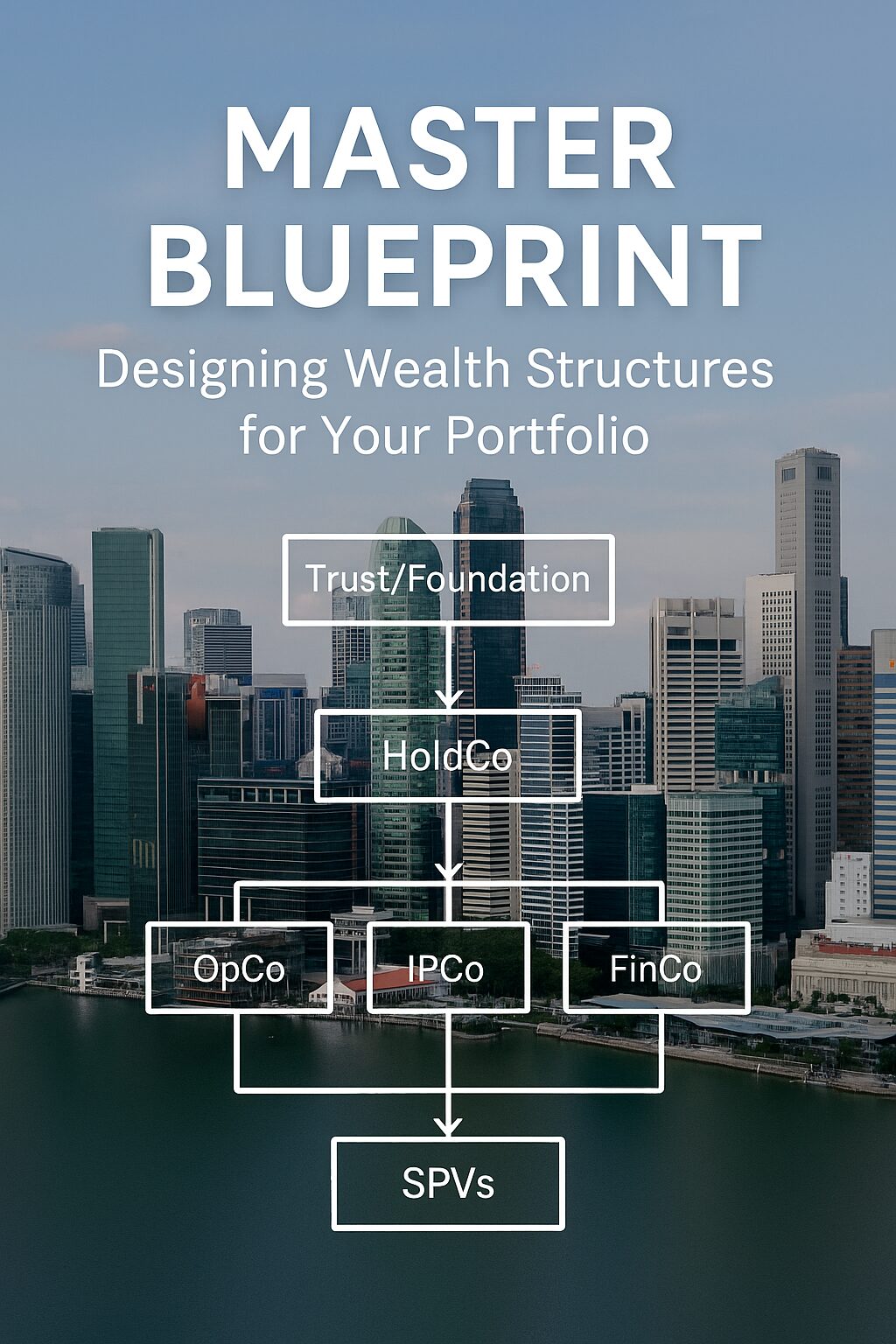
“City skyline with overlay diagram showing Trust/Foundation → HoldCo → OpCo/IPCo/FinCo → SPVs.”

From Theory to Your One-Page Map

After exploring offshore structures, trusts, foundations, holding stacks, banking systems, compliance guardrails, and case studies, you now hold the pieces of a global puzzle. But information without integration is noise. The final step is to synthesize these lessons into a master blueprint—a design that matches your assets, income flows, jurisdictions, and family goals.

This article delivers a practical framework: how to map your portfolio, select the right entities, calibrate governance, and build a living architecture that can survive scrutiny while enabling growth. By the end, you will have a one-page structure diagram and an execution checklist—a master blueprint you can adapt to any situation.


Main Body

1) Start With a Portfolio Map

Objective: Match each asset and income stream to a structural box.

Categories to map:

  • Active business income: operating companies, professional service firms, consultancies.
  • Passive income: dividends, royalties, rents, investment portfolios.
  • Crown jewels: intellectual property, trademarks, brands, patents.
  • Real estate: personal residences, investment properties, development projects.
  • Financial assets: custody accounts, ETFs, hedge funds, private equity.
  • Philanthropy: charitable commitments, family foundations, CSR projects.

Deliverable: One spreadsheet tab where each line is an asset with columns for location, ownership, income, risks, goals.


2) Choose the Governance Spine

The spine decides the integrity of the system. Options include:

  • Trust: Strong for common-law families, succession, and asset segregation.
  • Private Foundation: Ideal for civil-law environments, council governance, transparency.
  • Hybrid: Trusts + Foundations + Companies layered for flexibility.

Rule: Pick one as the anchor, then design companies and SPVs around it.


3) Design the Holding Stack

Principle: Risk separation and cashflow clarity.

Recommended layers:

  • HoldCo (parent): Owns subsidiaries.
  • OpCos: Run businesses, employ staff, interface with customers.
  • IPCo: Holds intellectual property, licenses it back.
  • FinCo: Runs treasury, FX, custody, intercompany lending.
  • SPVs: Each project in its own box.

Deliverable: A diagram showing arrows: HoldCo → OpCo/IPCo/FinCo → SPVs.


4) Engineer Cashflow Pathways

Money flow must be visible, logical, and documented.

Routes to define:

  • Royalties: OpCo → IPCo.
  • Management/service fees: OpCo → HoldCo/FinCo.
  • Loan repayments: SPV → FinCo.
  • Dividends: Subsidiaries → HoldCo → Trust/Foundation.
  • Distributions: Trustee/Foundation Council → Beneficiaries.

Checklist: Every arrow has a contract, invoice, approval, payment proof, reconciliation.


5) Banking & Treasury Setup

Without liquidity, charts fail.

Best practice:

  • At least two banks per corridor.
  • Multi-currency buckets: USD, EUR, GBP, plus local anchors.
  • Custody segregation: title correct, DvP settlement.
  • Treasury SOP: dual approvals, spread caps, reconciliation calendar.

Deliverable: One-page rail book with corridors, banks, cut-offs, SLAs.


6) Compliance Guardrails

Guardrails make the structure respectable.

Core guardrails:

  • UBO map certified and updated.
  • Economic substance proportionate to activity.
  • Governance cadence: monthly, quarterly, annual.
  • Audited accounts: even if voluntary.
  • Document room: DMS indexed, evidence packs ready.

Checklist: Five yes/no tests every quarter—UBO current? Substance real? Minutes up to date? Intercompany reconciled? Evidence pack <24h?


7) Risk Playbooks

Resilience is measured under stress.

Drills to plan:

  • Bank freeze → activate secondary rails.
  • Litigation → prove segregation, produce minutes.
  • Tax audit → hand over contracts, invoices, reconciliations.
  • Family dispute → trust/foundation governance continues.
  • FX shock → execute forward ladder, batch conversions.

Deliverable: Crisis SOP with triggers, owners, escalation paths.


8) Diagnostics Dashboard

Run your structure like an operating business.

Metrics to track:

  • Contagion score (risk isolation).
  • Liquidity mobility (time to move funds).
  • FX hygiene (spread vs cap).
  • Compliance velocity (time to produce pack).
  • Governance cadence (minutes filed on time).

Tool: Dashboard from simple Excel/Notion to full TMS.


9) 30-60-90 Master Plan

Days 1–30: Map portfolio, choose governance spine, draft structure chart.
Days 31–60: Incorporate entities, transfer IP, open banks, draft agreements.
Days 61–90: Operate first flows, hold governance meetings, run first drill.

Deliverable at Day 90: a living structure with operating rhythm, not just paper.


10) The One-Page Master Blueprint

At the end, compress everything into a single diagram + checklist:

  • Top: Trust or Foundation.
  • Middle: HoldCo with OpCo/IPCo/FinCo.
  • Bottom: SPVs per project.
  • Side: Custody, banking rails.
  • Arrows: Cashflows with contracts.
  • Footer: Governance cadence + compliance guardrails.

This one-page map is your north star—show it to bankers, advisors, or family councils.


Conclusion — From Chaos to Clarity

Wealth survives not by luck but by design and discipline. The master blueprint converts complexity into clarity: every asset in a box, every cashflow documented, every governance step on a calendar.

This is not theory—it is the operating system of resilience. By applying this blueprint, you transform fragile wealth into a living architecture that can survive audits, litigation, banking shocks, and family transitions.


Case Studies (Summary Above Preview)

  • Success: Family used blueprint to centralize IP, diversify banking, and respond to tax audits—structure upheld.
  • Success: Entrepreneur created one-page map; bank onboarding approved in days.
  • Failure: Family with no blueprint had assets scattered; disputes collapsed estate.
  • Failure: Group skipped compliance guardrails; accounts closed after hidden UBO discovered.

Next Article Preview

Wealth Architecture Toolkit — Ready-to-Use Templates and Checklists
In the next stage beyond this series, we will publish a practical toolkit: downloadable contracts, checklists, treasury SOPs, governance calendars, and structure diagrams. This will let you execute immediately without reinventing the wheel—turning knowledge into action and resilience.

Case Studies — Success and Failure in Wealth Structures

“Corporate boardroom and financial district with overlay text: Success vs Failure in Wealth Structures.”

Why Case Studies Are the Ultimate Teacher

Every strategy looks flawless on a whiteboard. It is only under litigation, audits, banking reviews, and family disputes that a wealth structure proves its worth—or collapses. Real-world case studies are the sharpest way to learn because they reveal how design decisions, documentation habits, and governance discipline make or break outcomes.

This article compares successes and failures across trusts, foundations, holding stacks, SPVs, and banking systems. The goal is not theory but pattern recognition: to identify the red flags that doom structures and the resilience markers that save them.


Main Body

1) Why Case Studies Matter

  • Pattern recognition: Success leaves clues; failure leaves warnings.
  • Credibility: Banks, regulators, and investors respect real-world tested systems.
  • Practicality: Examples convert abstract governance into day-to-day operating rules.

2) Success Case — Litigation Shield via SPV Ring-Fencing

Design:

  • Developer structured each real estate project in its own SPV under a HoldCo.
  • Intercompany agreements documented management fees, royalties, and loans.
  • Board minutes approved funding and dividend flows.

Shock:

  • One SPV faced multi-million litigation for construction defects.

Outcome:

  • Liability quarantined. Other SPVs operated normally. HoldCo unaffected.
  • Bank financing for new projects continued uninterrupted.

Lesson:
One project = one box = one firewall. Ring-fencing works only when SPVs are capitalized, invoiced, and governed.


3) Success Case — IP Secured in IPCo

Design:

  • Global consumer brand registered trademarks in IPCo.
  • IPCo licensed IP to OpCos via royalty agreements.
  • Royalties documented, priced, and paid monthly.

Shock:

  • OpCo in Latin America sued over defective product.

Outcome:

  • Plaintiffs could not touch IPCo’s trademarks.
  • Brand value intact; refinancing secured.

Lesson:
Never park crown jewels (IP) in operating entities. IP belongs in IPCo with contracts and invoices as evidence.


4) Success Case — Foundation Continuity in Succession

Design:

  • Entrepreneur established a private foundation with a council (family + independent).
  • Foundation owned HoldCo; bylaws lodged with regulator.

Shock:

  • Founder died unexpectedly.

Outcome:

  • Council continued governance seamlessly.
  • No probate, no freezes, no disputes.

Lesson:
Foundations shine when succession and governance continuity are critical.


5) Success Case — Bank Review Passed via Clean Compliance

Design:

  • Group maintained certified UBO registers, audited accounts, and governance calendar.
  • Document room organized by category, with naming convention and DMS access.

Shock:

  • Major global bank launched compliance review.

Outcome:

  • Evidence pack produced in 24 hours.
  • Relationship upgraded; credit facilities expanded.

Lesson:
Evidence velocity is credibility. If you can produce full packs in 24h, banks trust you.


6) Failure Case — Settlor Overreach in Trust

Design:

  • Settlor appointed himself protector with veto over all trustee decisions.
  • Letter of wishes written as binding orders.

Shock:

  • Creditors challenged trust in court.

Outcome:

  • Court ruled settlor still controlled assets. Trust disregarded.
  • Assets seized.

Lesson:
Oversight ≠ control. Protector powers must be narrow or trust collapses.


7) Failure Case — Paperless Intercompany Flows

Design:

  • HoldCo collected “service fees” without contracts or invoices.
  • OpCos transferred cash arbitrarily.

Shock:

  • Tax audit.

Outcome:

  • Payments reclassified as taxable distributions.
  • Penalties imposed.

Lesson:
Cash without contracts = evidence of sham. Paper is the structure.


8) Failure Case — Hidden UBO

Design:

  • Nominee directors and shareholders used to conceal real owner.
  • No certified registers or consistent filings.

Shock:

  • Bank inquiry + regulator cross-check.

Outcome:

  • Accounts closed; entities struck off.

Lesson:
UBO concealment is fatal. Transparency beats secrecy every time.


9) Failure Case — Phantom Governance

Design:

  • Entities incorporated but no board meetings ever held.
  • Minutes backdated only when demanded.

Shock:

  • Family dispute led to litigation.

Outcome:

  • Court disregarded entities. Assets treated as personal.

Lesson:
Backdated minutes = death. Governance must be real-time.


10) Failure Case — Banking Single Point of Failure

Design:

  • Entire group used one bank for all corridors.
  • No secondary rails tested.

Shock:

  • Bank compliance review froze accounts for 30 days.

Outcome:

  • Payroll missed; vendors unpaid; contracts lost.

Lesson:
One bank = one choke point. Always maintain secondary rails.


Conclusion — Patterns of Resilience and Collapse

The line between resilience and collapse is usually thin but predictable:

  • Resilient structures: segregate risks, document flows, respect governance cadence, and disclose transparently.
  • Collapsed structures: concentrate risks, skip paperwork, overreach control, or hide ownership.

Case studies prove that the difference is not luck but discipline. By internalizing these patterns, you can design structures that survive pressure tests instead of crumbling at the first shock.


Case Studies Recap (Summary List)

  • Success: SPV ring-fencing quarantined litigation.
  • Success: IPCo protected global trademarks.
  • Success: Foundation council ensured smooth succession.
  • Success: Clean compliance pack won bank review.
  • Failure: Settlor overreach destroyed trust protection.
  • Failure: Paperless flows reclassified as taxable.
  • Failure: Hidden UBO caused de-banking.
  • Failure: Phantom governance led to veil piercing.
  • Failure: Single-bank dependency froze entire group.

Next Article Preview

Master Blueprint — Designing Wealth Structures for Your Portfolio
In the final article of this series, we will synthesize all prior lessons into a one-page master blueprint. You will see how to map your assets, income sources, and jurisdictions into a bespoke structure that balances resilience, compliance, and liquidity. The deliverable will include a portfolio mapping framework and a step-by-step execution checklist so you can translate strategy into reality.

Compliance Guardrails — UBO Transparency, Substance, and Governance

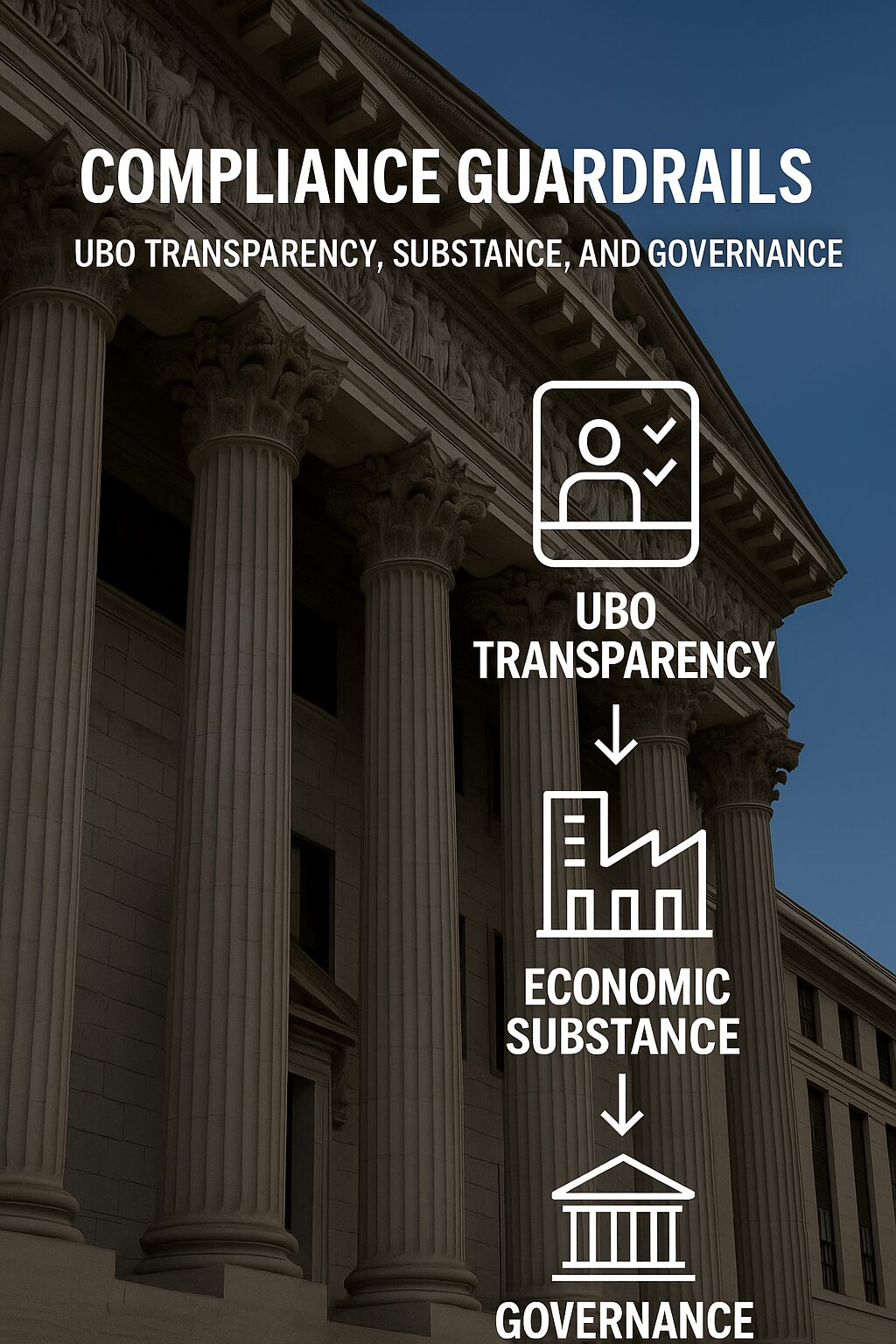
“Financial district or court building with overlay text: UBO Transparency, Economic Substance, Governance.”

Why Compliance Guardrails Define Survival

Every sophisticated offshore structure, no matter how elegantly drawn, lives or dies by one question: Will regulators, banks, and courts respect it as real?

Without guardrails, the structure is a castle built on sand: one regulatory inquiry, one tax audit, or one bank KYC review can dismantle decades of planning. But with UBO transparency, economic substance, and governance evidence, structures survive pressure tests and even gain credibility in negotiations, financing, and partnerships.

This article is not about paperwork for its own sake. It is about compliance as competitive advantage—the brakes and steering that let you drive wealth safely at scale.


Main Body

1) UBO Transparency — The Era of No Secrets

UBO (Ultimate Beneficial Owner) identification has become a universal requirement. Regulators, banks, and counterparties all expect clarity.

Global landscape:

  • EU/UK: Central UBO registers; some public, others regulator-only. Court rulings (e.g., EU privacy challenges) mean partial disclosure, but core data remains accessible.
  • US: Corporate Transparency Act (CTA) requires BOI (Beneficial Ownership Information) reporting to FinCEN from 2024 onward.
  • Asia (Singapore, Hong Kong): Private registers maintained with regulators; available to law enforcement and banks.
  • Offshore (BVI, Cayman): Beneficial ownership registers filed confidentially; linked to international cooperation agreements.
  • Middle East (UAE): UBO disclosure mandatory for companies in free zones and mainland; non-compliance can lead to license suspension.

Best practice:

  • Maintain a UBO pack: certified passport, proof of address, ownership diagram, and signed minutes.
  • Update within 7 days of any ownership change.
  • Ensure UBO filings are consistent across all jurisdictions—banks spot mismatches immediately.

2) Economic Substance — Proving Reality Beyond Paper

Why substance matters: Tax authorities and regulators target “brass-plate” companies that exist only on paper.

Substance tests include:

  • Core Income-Generating Activities (CIGA): In BVI, Cayman, Jersey, companies must show real decision-making, local employees, or managed service contracts.
  • Presence metrics: Local directors, registered office, physical space proportionate to activity.
  • Decision evidence: Minutes showing key decisions taken in jurisdiction.

Jurisdiction examples:

  • BVI/Cayman: Mandatory annual reporting to prove CIGA.
  • Singapore: Board meetings must be held locally to qualify for tax residency.
  • Luxembourg/Netherlands: Expectation of local directors with expertise, not rubber stamps.
  • UAE: ESR (Economic Substance Regulations) reporting for certain activities; non-compliance leads to fines or deregistration.

Practical guide:

  • Do not overbuild (a small SPV does not need 10 employees).
  • But never underbuild (a billion-dollar FinCo cannot be a PO box).
  • Match scale of substance to scale of activity.

3) Governance — Rhythm Over Ritual

Governance credibility comes from cadence, not formality.

Governance calendar (minimum viable rhythm):

  • Monthly: Treasury and compliance check-ins.
  • Quarterly: Board/council meetings, KPIs, intercompany review.
  • Semi-annual: Stress-test drills (bank freeze, tax audit, litigation scenario).
  • Annually: Audit, UBO re-certification, regulatory filings, tax returns.

Evidence:

  • Signed minutes and resolutions.
  • Attendance logs.
  • Agendas circulated in advance.
  • Decision papers attached.

Red flag: Backdated minutes created in panic—courts and auditors spot them instantly.


4) Accounting & Audit — Turning Numbers into Evidence

Without accounts, an entity looks like a puppet. With accounts, it looks like a business.

Best practices:

  • Maintain entity-level accounting with reconciled intercompany flows.
  • Consolidate at HoldCo level for a group view.
  • Even if not legally required, commission voluntary audits—they pay for themselves in credibility.
  • Keep tax memos documenting why positions are reasonable.

Audit readiness checklist:

  • Trial balances per entity.
  • Intercompany reconciliations.
  • Evidence packs (contracts, invoices, bank statements).
  • Board approvals for major flows.

5) Compliance Playbooks — Fast Responses Win

A compliance playbook is a ready-made response manual for predictable events.

Scenarios to prepare:

  • UBO inquiry: Have notarized ownership charts and certified registers.
  • Tax audit: Intercompany agreements, invoices, reconciliations within 48h.
  • Bank freeze: Secondary rails activated; evidence of substance provided.
  • Regulatory inspection: Document index handed over; no scrambling.

Playbook template:

  • Trigger → Responsible owner → Required docs → SLA (hours/days) → Escalation path.

Benefit: Cuts panic, shows regulators you are professional, not evasive.


6) The Document Room — Where Reality Lives

Organize once, reap forever:

  1. Corporate: Charters, bylaws, registers, appointments.
  2. Governance: Agendas, packs, minutes, resolutions.
  3. Compliance: UBO filings, licenses, audits.
  4. Intercompany: Agreements, memos, invoices.
  5. Treasury: SOP, reconciliations, bank proofs.
  6. Tax: Returns, memos, correspondence.
  7. Risk/Drills: Stress-test logs, incident responses.

Use naming convention: YYYY-MM-DD_Item_Version.
Cloud DMS with restricted access + audit logs recommended.


7) Diagnostics — Five Questions That Predict Resilience

Quarterly self-test:

  1. Are UBO registers up-to-date and certified?
  2. Do entities show substance evidence (staff, premises, contracts)?
  3. Are minutes and resolutions current and linked to decisions?
  4. Can you produce full evidence packs within 24h?
  5. Are intercompany flows reconciled and auditable?

Fail any → remediation plan with deadlines, owners, and board approval.


8) Real-World Audit Scenarios

Scenario 1 — Bank compliance review:
A global bank freezes FinCo’s account for review. Within 48h, client produces UBO map, certified register, audited accounts, substance evidence (local staff contracts, office lease). Account re-opened; relationship strengthened.

Scenario 2 — Tax inquiry in EU:
HoldCo receives tax audit. Intercompany agreements, invoices, reconciliations produced. Result: no adjustment, credibility increased.

Scenario 3 — Litigation in Asia:
Family dispute challenges trust-owned assets. Trustee produces years of minutes, audited accounts, distributions consistent with deed. Court upholds structure.


9) Comparative Jurisdiction Snapshot

JurisdictionUBO RegisterSubstance RequirementAudit/Reporting
EU/UKPublic/regulatorYes, especially for HQ entitiesAnnual accounts required
US (CTA)FinCEN BOI filingVaries by stateDepends on entity
SingaporePrivate register with ACRABoard meetings in SGAnnual return/audit above threshold
BVI/CaymanConfidential registerEconomic Substance LawAnnual ES return
UAEMandatory UBO filingESR reportingAnnual audit in many free zones

10) 30-60-90 Day Compliance Build

Days 1–30:

  • Map UBO, certify documents, file registers.
  • Draft compliance calendar.
  • Stand up DMS.

Days 31–60:

  • Update registers.
  • Seat local directors/staff.
  • Draft intercompany agreements with pricing memos.
  • Upload governance documents.

Days 61–90:

  • Hold board meeting, minute decisions.
  • Run compliance drill (e.g., UBO inquiry).
  • Review reconciliations and filings.
  • Approve compliance budget.

11) Common Failure Modes and Fixes

  • Hidden UBOs → de-banking → Fix: disclose, certify, notarize.
  • Shell companies with no substance → struck off → Fix: hire staff, lease office, keep minutes.
  • Stale registers → fines and penalties → Fix: update on change, annual review.
  • Backdated governance → Fix: calendar meetings, real-time minutes.
  • Audit avoidance → court disregard → Fix: prepare voluntary audits.

Conclusion — Compliance as a Value Multiplier

Guardrails transform offshore structures from fragile to resilient. UBO transparency lowers friction. Economic substance shields against “form over substance” attacks. Governance cadence builds credibility. Clean audits prove reality. Playbooks let you respond in hours, not weeks.

These are not costs; they are value multipliers. They improve banking access, financing terms, negotiation power, and survival odds. Without guardrails, your structure will collapse. With them, it becomes antifragile.


Expanded Case Studies

Success — EU Bank Approval Through Clean UBO Map

  • Design: Up-to-date UBO registers, certified chart, notarized docs.
  • Shock: Bank onboarding review.
  • Outcome: Accounts approved in record time.
  • Lesson: Transparency accelerates finance.

Success — Substance Saves Cayman Entity

  • Design: FinCo employed staff, leased office, filed returns.
  • Shock: Tax audit.
  • Outcome: Entity respected; no penalties.
  • Lesson: Real presence beats suspicion.

Failure — Hidden Owner Leads to Account Closure

  • Design: Nominee shareholder hides true UBO.
  • Shock: Regulator cross-check.
  • Outcome: Accounts terminated.
  • Lesson: Concealment is fatal.

Failure — Phantom Governance

  • Design: HoldCo with no board minutes.
  • Shock: Shareholder lawsuit.
  • Outcome: Court pierces veil.
  • Lesson: Evidence of governance is essential.

Failure — Audit Avoidance Backfires

  • Design: Billion-dollar group refuses audits.
  • Shock: Regulator probe.
  • Outcome: Disregarded as sham; forced restructuring.
  • Lesson: Audits are armor, not cost.

Next Article Preview

Case Studies — Real-World Successes and Failures in Wealth Architecture
In the next article, we will walk through detailed case studies of structures under pressure: how some survived bank freezes, tax audits, and litigation, while others collapsed due to poor governance or hidden owners. You’ll see resilience patterns you can adopt immediately—and red flags you must avoid.

Banking & Multi-Currency Systems — Accounts, Custody, and Treasury Architecture

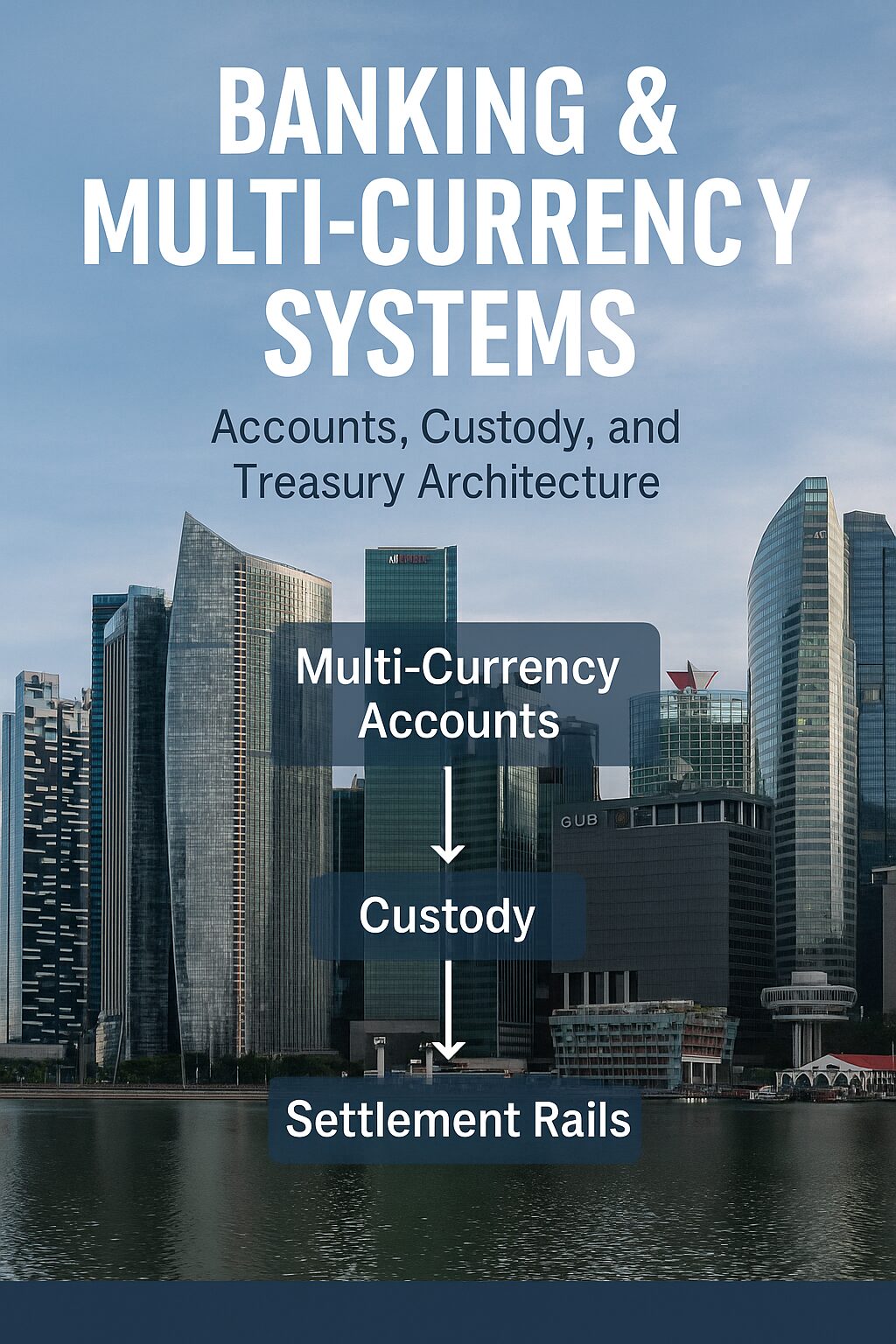
“Financial district skyline with overlay diagram showing Multi-Currency Accounts, Custody, and Settlement Rails.”

The Plumbing That Makes Structures Real

A beautiful entity chart dies in the first banking freeze. Architecture without payments is theatre. What keeps wealth resilient is not just HoldCos, SPVs, or trusts; it’s the multi-currency banking and custody system beneath them—how accounts are arranged, how payments are routed, how FX is handled, how fees and spreads are controlled, and how evidence is produced on demand.
This article is a structure-and-operations blueprint for global cash: account topology, custody segregation, settlement rails, FX policy, PSP/gateway design, reconciliations, controls, redundancy, and a 30-60-90 execution plan. No clauses, no redlines—only governance, cashflow, and operating rhythm engineered for high reliability and scale.


Main Body

1) The Three-Layer Cash Stack

Think in layers—each has its own job and controls.

  1. Operating accounts (OpCo local): receive customer cash, pay vendors/payroll, interface with payment rails.
  2. Treasury hub (FinCo): concentrates liquidity, executes FX, pays intercompany, funds dividends, services group debt.
  3. Custody & reserves: segregated accounts holding marketable securities and strategic cash equivalents, off the operating risk grid.

Rule: The closer to customers and staff, the thinner the capital. The further from operations (treasury/custody), the thicker and safer the buffer.


2) Multi-Currency Bucket Method

Stop treating currency as an afterthought. Use currency buckets to reduce slippage and panic conversions.

  • Core buckets: USD / EUR / GBP / one Asian anchor (e.g., SGD or JPY). Add others only if justified by revenue or cost share.
  • Deposit discipline: Park revenues in the currency earned. Convert intentionally on a schedule for specific uses (dividends, capex, debt service).
  • Spread policy: Publish an internal spread cap (e.g., ≤40 bps over interbank for majors). If a quote exceeds the cap, batch or reroute (secondary bank/PSP).
  • Natural hedging: Aim to fund costs in the same currency as revenues. Where mismatched, use simple forwards with monthly ladders—no hero trades.

KPI: % of outflows covered by in-currency inflows; realized FX spread vs. cap; conversion variance vs. plan.


3) Account Topology — How to Place the Boxes

Per entity:

  • OpCo: at least 2 transactional banks (A/B failover) + PSP settlement accounts.
  • FinCo: multi-currency omnibus + segregated sub-accounts per entity for intercompany clarity.
  • IPCo/RealCo/SPVs: ring-fenced operating + distribution account; no shared vendor payment from treasury.

Per purpose:

  • Collections (incoming), Disbursements (AP/payroll), Tax/Statutory, Dividends, Capex, Reserve (untouchable except by board resolution).
  • Client/escrow where you hold third-party funds: use regulated structures; never co-mingle.

Signatory matrix: Dual approval for wires; payroll whitelisted; new beneficiary cool-off (e.g., 24–48h). Board-approved limits by role.


4) Settlement Rails — Choose, Test, Document

Bank-to-bank: SWIFT (global), SEPA (EUR), ACH (US domestic), Faster Payments (UK), PIX/RTGS (local instant rails where offered).
Card & alt payments: PSPs (Stripe/Adyen/etc.), local acquirers, APMs (iDEAL, POLi, UPI, etc.).
Crypto rails (if used): treat as separate project with risk policy and restricted purposes (not covered here).

Design goals:

  • Redundancy: Two rails per critical corridor (e.g., EUR↔USD SWIFT + SEPA/ACH where legal).
  • Latency: Cut-off calendar by corridor (who, when, last safe hour).
  • Cost: Fee table by rail; use cheapest routing that meets SLA.
  • Evidence: Store payment proofs and bank confirmations in DMS tied to the invoice or board minute.

Rail book: a one-page index listing corridors, rails, SLA, fees, cut-off, ops runbook contact.


5) PSP/Gateway Architecture — Capture, Settle, Reconcile

If you sell online or accept cards, the PSP is your front door for cash.

  • Multi-PSP design: At least two providers per major region. Primary for volume, secondary for failover and price benchmarking.
  • Settlement currency policy: Where possible, settle in the same currency as the charge to avoid PSP FX.
  • Reserve management: Track rolling reserves and release schedules; forecast cash available vs. held.
  • Descriptor control: Clean statements reduce chargebacks.
  • Chargeback workflow: Central inbox, response SLA, evidence pack templates.

Reconciliation: Daily PSP → bank settlement match; weekly fee audit; monthly abandoned funds sweep. Automate with a lightweight TMS or scripts; human spot-checks remain mandatory.


6) Custody & Asset Segregation — Where Wealth Sleeps

Custody is not “a brokerage account.” It is the proof of legal segregation.

  • Title: Accounts titled to the legal owner (e.g., “XYZ Trust, Trustee ABC Ltd.” or “FinCo Ltd. for benefit of…”).
  • Segregation models: Segregated (your assets are separate) vs. omnibus (pooled). Choose segregated where available for core reserves.
  • Asset servicing: Corporate actions, dividend collection, tax reclaim—verify provider SLAs.
  • Settlement risk: Prefer DvP (delivery vs. payment) where applicable.
  • Custodian concentration: No single custodian >60% of reserves; quarterly due diligence (financials, SOC reports, contingency plans).

Custody KPI: Breaks in reconciliation (zero tolerated), corporate action timeliness, counterparty exposure vs. limits.


7) Treasury SOP — The Operating Constitution

Write a 3–5 page SOP everyone can follow.

  • Approvals: Dual-control wires; thresholds; emergency “two-out-of-three” keys.
  • Beneficiaries: Whitelist with cooling-off; separate onboarding for new vendors.
  • FX: Spread cap, approved instruments (spot/forwards only), tenor limits, laddering.
  • Liquidity ladder: Tiers (T0 operating cash, T1 30-day buffer, T2 90-day reserves) with target balances per entity.
  • Close cadence: Daily cash report; weekly FX/fees review; monthly bank fee audit; quarterly policy affirmation by board.
  • Incident playbooks: Bank freeze, gateway outage, major chargeback wave, currency shock.

Store SOP + logs in the DMS; review at least quarterly with minutes.


8) Intercompany Cash — Pricing, Paper, Proof

Cash is structural, not seasonal. Make routes explicit:

  • Royalties (OpCo→IPCo) for brand/tech; defined base (revenue/units), frequency, audit rights.
  • Services/management fees (OpCo↔HoldCo/FinCo) with scope and cost-plus/pricing memo.
  • Loans (FinCo→SPVs/OpCos) with facility letters and schedules.
  • Dividends (OpCo/SPV→HoldCo) under board minutes and solvency tests.

Evidence chain: Contract → invoice → approval → payment proof → reconciliation → board minute. Break one link, and the protection narrative weakens.


9) Data & Systems — Run Treasury Like a Product

You don’t need an expensive TMS on day one, but you do need data hygiene.

  • Minimal stack: Bank APIs/exports + PSP exports + a central ledger (or accounting system) + lightweight scripts/dashboards.
  • Data schema (practical): entity_id, account_id, currency, counterparty, rail, purpose, invoice_id, approval_id, fx_rate, fee, spread_source, evidence_url.
  • Dashboards: Liquidity ladder by entity/currency; FX exposure; fee & spread; aging of unresolved breaks; rail uptime incidents.
  • Alerts: Low balance, spread breach, reconciliation breaks, PSP reserve anomalies.

10) Jurisdiction & Bank Selection — A Decision Matrix

Pick banks by corridor strength, onboarding realism, rail coverage, and survivability.

Matrix factors (score 1–5):

  • Onboarding friction (KYC depth vs. your profile)
  • Rail coverage (SEPA/ACH/Faster/RTGS access)
  • FX pricing transparency
  • Corporate client support (dedicated RM, cut-off extensions)
  • Compliance predictability (clear policies, timely reviews)
  • Balance sheet strength and regulator reputation

Rule of two: For each critical corridor, maintain two active institutions with tested failover.


11) Resilience Playbooks — Drills You Actually Run

  • Bank account review/freeze: Switch to secondary rail; payroll priority; customer comms template; board minute documenting the event.
  • PSP outage: Flip to secondary PSP; cap order acceptance; auto-email customers with alternative payment options.
  • FX shock (>3σ move): Activate hedge ladder; pause non-essential conversions; board briefing within 24h.
  • Chargeback spike: Tighten 3-D Secure; manual review rules; outreach campaign; weekly report to PSP risk team.
  • Cut-off miss: Same-day alternatives per corridor; re-date invoices; notify vendors via template.

Run tabletop drills semiannually; log lessons; update SOP.


12) KPIs & Diagnostics — The Five Signals

  1. Rail redundancy: Every critical corridor has active failover tested in last 90 days.
  2. FX hygiene: Realized spread ≤ cap; ≥70% natural matching; forward ladder in place for mismatches.
  3. Reconciliation integrity: Daily bank and PSP reconciled; outstanding breaks <0.1% of volume.
  4. Cost control: Total payments cost (fees + FX) tracked; YoY improvement target set.
  5. Evidence velocity: Time to produce full payment evidence pack (contract→proof) < 30 minutes.

Amber means schedule fixes with owners and dates; red means board escalation.


13) 30-60-90 Day Execution Plan

Days 1–30 — Map & Mandate

  • Draw account topology per entity & purpose; choose A/B banks per corridor.
  • Approve Treasury SOP (dual control, whitelist, spread caps, ladder).
  • Draft intercompany payment calendar (royalties monthly, dividends quarterly, services monthly).
  • Build the rail book (corridors, SLA, fees, cut-offs, contacts).
  • Start PSP secondary onboarding.

Days 31–60 — Build & Test

  • Open multi-currency accounts; enable APIs/exports; integrate to ledger.
  • Stand up PSP #2 and test live $10 transactions on each method.
  • Move custody core reserves; confirm title/segregation; run a sample corporate action.
  • Execute first planned FX conversions under spread cap; log quotes vs. interbank.
  • Launch daily reconciliation and weekly fee/spread reviews.

Days 61–90 — Operate & Drill

  • Run the bank freeze and PSP outage tabletop drills with timed objectives.
  • Produce first month’s Treasury KPIs; present to board; adjust policy.
  • Lock vendors to whitelists; implement beneficiary cool-off.
  • Publish the liquidity ladder and minimum balances per entity.
  • Close all documentation loops; archive evidence packs per flow.

14) Common Failure Modes (and Direct Fixes)

  • Single bank, single rail: One compliance review stalls payroll.
    Fix: Open secondary rails now; test quarterly with live payments.*
  • Ad-hoc FX: Conversions on demand at poor rates.
    Fix: Calendar conversions; spread caps; batch flows; use forwards for known exposures.*
  • PSP monoculture: One gateway for everything; outage = zero revenue.
    Fix: Multihoming PSPs; region split; retry logic; descriptor control.*
  • Paperless payments: No invoices/approvals; tax authority recharacterizes flows.
    Fix: Contract → invoice → minute → proof → reconciliation, enforced by SOP and audits.*
  • Custody title mismatch: Assets held in wrong legal name.
    Fix: Retitle; custodian letter; DvP policy; quarterly checks.*

Conclusion — Liquidity You Can Trust

Wealth survives when liquidity is mobile, provable, and inexpensive. That requires a multi-currency, multi-rail banking design, a segregated custody layer, and a treasury SOP that turns intent into habit. With currency buckets, spread caps, rail redundancy, PSP multihoming, airtight reconciliations, and drilled playbooks, your structure becomes operationally antifragile. The market can move, a bank can stall, a PSP can blink—your cash still moves, your payroll clears, your evidence prints.


Case Studies (place immediately above the preview)

Success — Dual-Rail Saves Payroll During Bank Review

  • Design: Two banks per corridor; ACH + wire failover; beneficiary whitelist; payroll priority SOP.
  • Shock: Primary bank triggers enhanced review; outbound wires paused.
  • Outcome: Treasury shifts payroll to secondary rail within 90 minutes; zero employee impact.
  • Lesson: Redundancy beats urgency.

Success — FX Cost Cut by 48 bps with Bucket + Calendar Method

  • Design: Currency buckets; weekly conversion window; spread cap; batched PSP settlements.
  • Shock: Revenue mix shifts to EUR; prior ad-hoc conversions would have spiked costs.
  • Outcome: Realized spreads remain within cap; margin preserved despite volatility.
  • Lesson: Purposeful conversions beat reactive swaps.

Success — PSP Multihoming Keeps Checkout Alive

  • Design: Two PSPs; smart routing based on latency/approval; clear descriptors.
  • Shock: Primary PSP regional outage.
  • Outcome: Traffic shifts to secondary; approval rate dips 2% but revenue continues.
  • Lesson: Checkout continuity is a treasury function.

Failure — Custody Title Error Exposed in Audit

  • Design: Securities booked to OpCo trading account.
  • Shock: Litigation at OpCo; auditors request proof of segregation.
  • Outcome: Assets viewed as reachable; emergency retitle costs time and leverage.
  • Lesson: Title lines matter more than logos.

Failure — Paperless Intercompany Reclassified

  • Design: Management fees and royalties moved on “internal understanding.”
  • Shock: Tax examination.
  • Outcome: Payments denied; deemed distributions; penalties assessed.
  • Lesson: Evidence is the cashflow.

Next Article Preview — Compliance Guardrails That Keep Protection Legal

In the next installment, you’ll build the guardrails that prevent your architecture from drifting into risk: UBO transparency, economic substance, audit & reporting cadences, registers, and a year-round compliance calendar that proves reality on demand. We’ll show how to design governance so regulators see a living system, not a shell—and how that legitimacy directly lowers costs, accelerates banking, and protects outcomes when things get loud.