Part 1 – The Shift From Income Earner to Capital Architect

Premium financial visual featuring a global city skyline at sunset, gold bars, stacked currency, and an illuminated world globe network symbolizing multi-jurisdiction capital architecture and sovereign-level wealth structuring.

Most people spend their entire lives optimizing income.

They negotiate salaries.
They increase hourly value.
They build businesses that generate cash flow.

But income is not capital.

Income is transactional.
Capital is structural.

The difference between financial comfort and sovereign-level wealth is not how much you earn — it is how you design capital.

An income earner operates inside a system.
A capital architect designs the system.

This shift changes everything:

  • Tax exposure
  • Risk concentration
  • Asset protection
  • Jurisdictional leverage
  • Global mobility
  • Institutional access

If your financial structure depends on one country, one tax regime, one banking system, one asset class — you are still an income earner, even if your income is high.

This guide explains how to transition from income optimization to capital architecture design.

This is not theory.
This is structural implementation.

Most people stay stuck earning income.

A few people learn to control capital.

But this shift does not happen automatically.

It requires a system.


1. The Structural Difference: Income vs Capital

Income Earner Model

  • Earn → Spend → Invest leftovers
  • Assets held personally
  • Single tax jurisdiction
  • Local banking dependency
  • Risk concentrated in residence country
  • Revenue tied to labor or platform

Capital Architect Model

  • Earn → Allocate through structures
  • Assets held via entities
  • Multi-jurisdiction exposure
  • Banking diversification
  • Risk compartmentalization
  • Capital mobility
  • Asset stack layered strategically

The transition begins with one mindset shift:

Stop asking “How do I earn more?”
Start asking “How do I design capital flow?”


2. Capital Is a System, Not a Balance

Net worth alone does not create dominance.

Capital dominance requires:

  1. Structural control
  2. Legal insulation
  3. Geographic diversification
  4. Tax efficiency
  5. Liquidity positioning
  6. Asset class layering

Without structure, capital becomes exposed.

High income without structure results in:

  • Tax drag
  • Legal vulnerability
  • Estate fragmentation
  • Currency concentration risk
  • Political exposure

The first architectural step is separation.


3. Separate the Layers of Wealth

Every sovereign-level structure has three layers:

Layer 1 – Income Engine Layer

Where revenue is generated:

  • Digital businesses
  • Intellectual property
  • Consulting
  • Investments
  • E-commerce
  • Media assets

This layer is operational and exposed.

Layer 2 – Holding Structure Layer

Where profits are aggregated and protected:

  • Holding companies
  • Offshore entities
  • Asset management vehicles
  • Strategic jurisdiction placements

This layer reduces tax leakage and liability exposure.

Layer 3 – Asset Preservation Layer

Where long-term wealth is insulated:

  • Trust structures
  • Private foundations
  • Multi-currency accounts
  • Precious metal vaulting
  • Global brokerage positioning

Most individuals never move beyond Layer 1.

Capital architects operate across all three.


4. Jurisdiction Is a Strategic Tool

Your country of residence is not required to be your only financial jurisdiction.

Capital dominance requires understanding:

  • Corporate tax differences
  • Dividend withholding treaties
  • Capital gains structures
  • Banking stability rankings
  • Legal asset protection strength
  • Currency risk exposure

Multi-jurisdiction design does not mean complexity for its own sake.

It means optionality.

Optionality creates negotiating power.

Power reduces systemic vulnerability.


5. Tax Efficiency as Structural Leverage

Tax is not an expense problem.

It is a structural problem.

Income earners attempt:

  • Deductions
  • Credits
  • Expense classification

Capital architects design:

  • Entity flow
  • Profit routing
  • Jurisdiction stacking
  • Timing optimization
  • Asset conversion strategies

When tax efficiency is built into structure rather than patched afterward, capital multiplies faster.

Tax efficiency compounds.


6. Risk Is Contained, Not Avoided

Risk cannot be eliminated.

It can be contained.

Structural containment methods include:

  • Separating operational entities from holding entities
  • Using limited liability jurisdictions
  • Diversifying custodians
  • Allocating assets across legal regimes
  • Maintaining currency diversification
  • Avoiding personal concentration risk

Income earners take risk personally.

Capital architects isolate risk structurally.


7. The Asset Stack Framework

A sovereign-level asset stack includes:

  1. Liquid Capital (multi-currency)
  2. Market Exposure (equities, ETFs, private funds)
  3. Hard Assets (real estate, metals)
  4. Intellectual Property
  5. Digital Income Streams
  6. Strategic Equity Stakes
  7. Alternative Capital Positions

The key is allocation design, not accumulation speed.

Each asset must serve one of three roles:

  • Growth
  • Protection
  • Liquidity

When assets overlap purpose without strategy, efficiency drops.

When assets are layered intentionally, capital becomes resilient.


8. Capital Mobility

Mobility equals power.

Capital mobility means:

  • Access to international banking
  • Brokerage accounts in stable jurisdictions
  • Corporate structures that allow cross-border dividend flow
  • Strategic residency positioning
  • Geographic diversification of assets

When capital cannot move, it becomes trapped.

When capital can reposition globally, it becomes dominant.


9. Transition Blueprint: Income Earner → Capital Architect

Step 1: Audit all income sources
Step 2: Identify tax leakage
Step 3: Separate operational and holding exposure
Step 4: Evaluate jurisdictional alternatives
Step 5: Implement entity layering
Step 6: Diversify custodial exposure
Step 7: Build multi-asset stack
Step 8: Install risk containment mechanisms

This is architecture.

Architecture creates durability.

Durability creates scale.

👉 Understanding this shift is not enough.

If you still rely on income alone, nothing changes.

You need to see how capital actually moves and grows.

→ Read next: Global Income System


Conclusion

The shift from income earner to capital architect is not about earning more.

It is about designing structure before scale.

Without architecture:

  • Income rises
  • Exposure rises
  • Tax rises
  • Risk rises

With architecture:

  • Income scales
  • Tax efficiency improves
  • Risk becomes compartmentalized
  • Assets compound structurally
  • Capital gains negotiating power

True wealth dominance begins when you stop working inside financial systems and start designing them.

This is the foundation.

The rest of the series builds upon this structural shift.

This is where most people stop.

They understand the idea but never build the system.

👉 The real transformation happens when income becomes structured capital.

→ Continue here: Offshore Income Structure


Case List

  • Digital entrepreneur restructuring profits through a holding entity to reduce tax drag and increase reinvestment efficiency
  • Consultant transitioning from personal income taxation to entity-based income flow management
  • Investor diversifying brokerage exposure across jurisdictions to reduce counterparty risk
  • Business owner separating operating company from asset-holding company for liability containment
  • High-income professional installing trust structures for long-term asset insulation
  • Digital media owner converting ad revenue into diversified asset stack allocations
  • Cross-border entrepreneur building multi-currency liquidity reserves to mitigate currency volatility

👉 If you’ve read this far, the next level of capital structure design is directly below.


Next Article Preview

Part 2 – Designing Multi-Jurisdiction Capital Structures

We will move from mindset to implementation.

You will learn:

  • How to select strategic jurisdictions
  • How to structure holding companies
  • How to optimize dividend and capital gain flows
  • How to design cross-border efficiency without unnecessary complexity

This is where capital design becomes operational.


Subscribe for Structural Mastery

This series is not about financial theory.

It is about building institutional-grade capital architecture.

If you are serious about:

  • Global tax efficiency
  • Asset protection
  • Sovereign-level positioning
  • Multi-jurisdiction capital flow design
  • Long-term structural wealth expansion

Subscribe and follow this series.

Capital dominance is not built by accident.
It is engineered.

Part 2 continues the architecture.

The Global Passive Income System

Global passive income system with scalable multi-stream revenue architecture and financial growth strategy

Integrated Wealth Architecture Hub

Scalable income is never accidental.
It is engineered through structure, leverage, and integration.

This series is a complete practical blueprint for building a global passive income system capable of producing premium advertising revenue, scalable affiliate income, multiple monetization layers, and structural financial resilience.

Each part strengthens one layer.
Together, they form a unified wealth architecture.


Full Series Navigation

Part 1 – How to Build a Global Passive Income Engine
Part 2 – How to Engineer a Website That Generates Premium Ad Revenue Automatically
Part 3 – How to Build a Self-Sustaining Affiliate Income System That Scales Globally
Part 4 – How to Build One System That Creates Multiple Income Streams
Part 5 – Why Governments Avoid Pushing Individuals Into Collapse
Part 6 – The Survival Finance Framework That Replaces Emergency Thinking


Part 1 – How to Build a Global Passive Income Engine

Every scalable system begins with architecture.

This section explains how to design a passive income engine that operates independently of trends and volatility. It focuses on asset-based monetization, global positioning, and structural compounding logic.

A properly built foundation allows every future expansion layer to multiply rather than reset.

Continue to Part 2 – How to Engineer a Website That Generates Premium Ad Revenue Automatically


Part 2 – How to Engineer a Website That Generates Premium Ad Revenue Automatically

Premium advertising revenue is determined by positioning, not traffic volume alone.

This section focuses on high-value keyword architecture, audience intent engineering, structural ad placement logic, and authority-based content depth.

A website designed correctly becomes a premium revenue asset.

Continue to Part 3 – How to Build a Self-Sustaining Affiliate Income System That Scales Globally


Part 3 – How to Build a Self-Sustaining Affiliate Income System That Scales Globally

Affiliate systems scale when they are engineered as ecosystems rather than promotions.

This section explains how to build trust-based conversion architecture, evergreen recommendation systems, and layered monetization funnels that expand internationally.

Sustainability replaces dependency.

Continue to Part 4 – How to Build One System That Creates Multiple Income Streams


Part 4 – How to Build One System That Creates Multiple Income Streams

True scale begins when one system generates multiple revenue layers.

This section focuses on revenue stacking, brand-centered expansion logic, integrated monetization frameworks, and asset amplification.

Income transitions from linear growth to structural multiplication.

Continue to Part 5 – Why Governments Avoid Pushing Individuals Into Collapse


Part 5 – Why Governments Avoid Pushing Individuals Into Collapse

Understanding macroeconomic incentives provides structural clarity.

Economic systems are designed to preserve stability. Recognizing these incentives allows individuals to position income systems strategically within structural resilience.

Expansion is strongest when stability is understood.

Continue to Part 6 – The Survival Finance Framework That Replaces Emergency Thinking


Part 6 – The Survival Finance Framework That Replaces Emergency Thinking

Emergency thinking limits scale. Structural resilience enables compounding.

This section introduces diversified income buffering, risk absorption architecture, and stability-first expansion design.

Long-term wealth is sustained through structural defense, not reaction.


Conclusion

This series is not about earning income.
It is about engineering a scalable global financial system.

When integrated, these components create:

  • A premium advertising engine
  • A scalable affiliate ecosystem
  • A multi-layer revenue architecture
  • A resilience-based financial model
  • A compounding long-term wealth framework

Income reflects structure.
Structure determines scale.


👉 If you have read this far, the next structural layer of expansion is directly below.


Next Step

The next phase integrates all revenue layers into a unified expansion framework designed for structural scale and premium positioning.


Subscribe for Strategic Continuity

This framework builds progressively. Each part strengthens the architecture.

Subscribe to continue building a global passive income system designed for long-term scale, resilience, and high-value cash flow.

Upgrade the structure.
The income follows.

Part 6-The Survival Finance Framework That Replaces Emergency Thinking

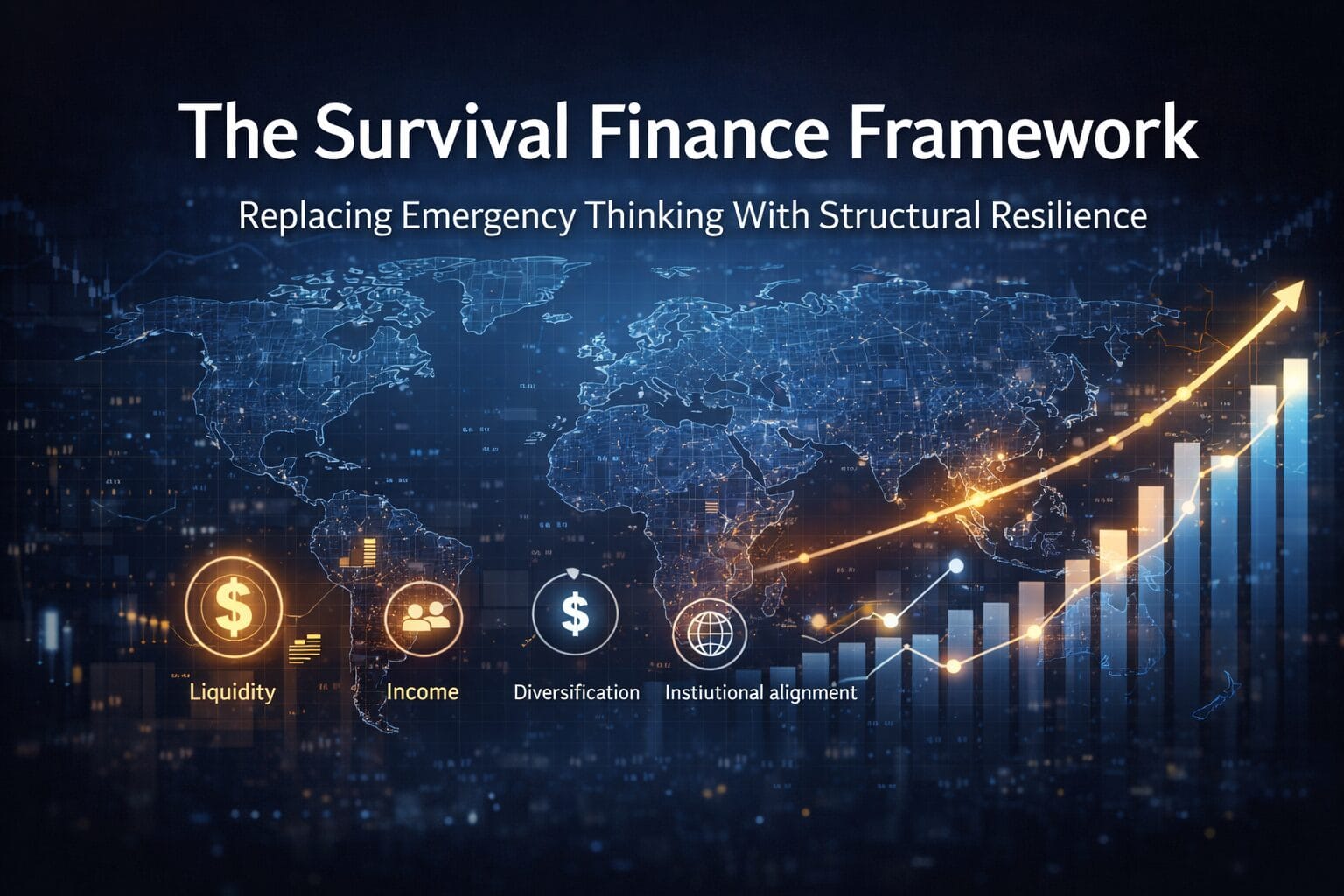
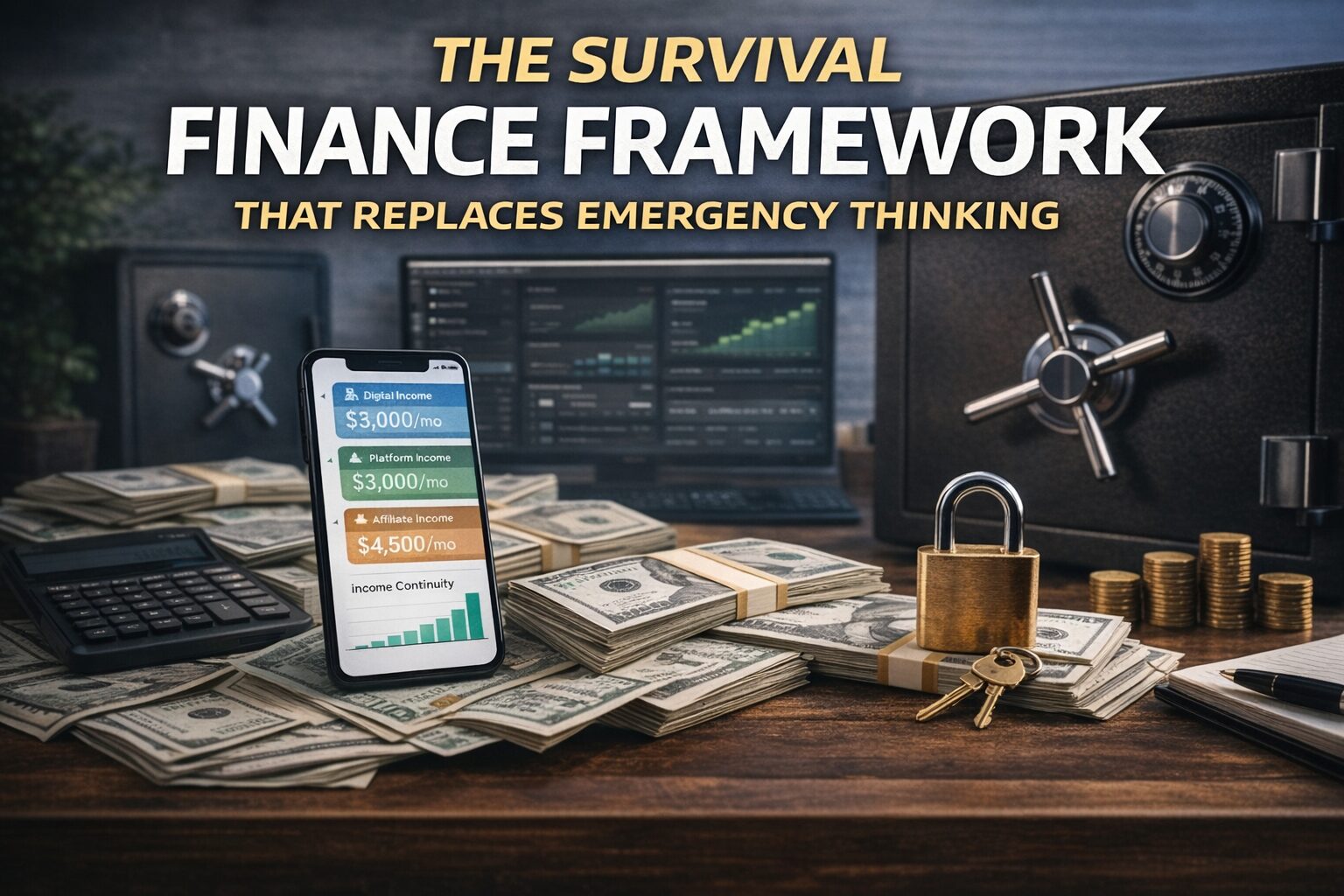
A global financial resilience framework visualization showing liquidity, diversified income streams, institutional alignment, and structural wealth architecture connected to a rising long-term growth chart.

Building a Global System That Prevents Collapse Before It Begins

Most people prepare for emergencies.

Very few people build systems that make emergencies irrelevant.

There is a fundamental difference between reacting to financial shock and designing a structure that absorbs shock automatically.

This series has already explored why income loss does not immediately cause collapse, how invisible systems buffer costs, why essential services rarely disconnect first, how financial access can exist without traditional assets, and why governments avoid pushing individuals into systemic breakdown.

Now we move beyond observation.

This article is not about surviving a crisis.

It is about building a survival finance framework so strong that crisis becomes a temporary inconvenience rather than a life-altering catastrophe.

The goal is not temporary relief.

The goal is structural resilience that compounds into long-term financial dominance.

If built correctly, this framework does not just protect wealth.

It accelerates it.


1. From Emergency Thinking to System Thinking

Emergency thinking is reactive.

System thinking is structural.

Emergency thinking asks:

  • What happens if I lose income?
  • How long can I survive?
  • What costs can I cut?

System thinking asks:

  • What structures absorb shocks automatically?
  • What access remains even when income pauses?
  • What assets continue operating without active labor?

The survival finance framework replaces reaction with architecture.

Instead of building a savings buffer alone, it builds:

  • Multi-layer liquidity
  • Distributed access points
  • Autonomous income channels
  • Structural cost absorption
  • Institutional alignment

When these elements exist together, collapse probability decreases dramatically.


2. The Five Pillars of the Survival Finance Framework

A scalable survival system rests on five pillars.

Pillar 1: Liquidity Layers

Liquidity is not just cash.

It is tiered access to financial flexibility.

Layer 1 – Immediate Liquidity
Cash equivalents, short-term reserves, accessible funds.

Layer 2 – Structured Liquidity
Credit lines, revolving facilities, approved financing structures.

Layer 3 – Strategic Liquidity
Income-producing assets that can be partially liquidated without destroying core capital.

The objective is not hoarding money.

It is maintaining optionality.

Optionality is survival power.


Pillar 2: Autonomous Income Streams

A survival framework must generate income even when labor pauses.

This includes:

  • Content-based digital assets
  • Recurring subscription models
  • Licensing structures
  • Affiliate ecosystems
  • Scalable digital products
  • Dividend-producing investments
  • Royalties and intellectual property

The key principle:

Income must detach from time.

When income is tied only to active work, collapse risk increases.

When income is tied to assets, resilience increases.


Pillar 3: Structural Cost Absorption

Many people attempt to cut costs manually.

A framework absorbs costs structurally.

Examples include:

  • Long-term fixed housing structures
  • Insurance systems that prevent catastrophic loss
  • Utility structures designed for continuity
  • Digital infrastructure replacing physical overhead
  • Geographic arbitrage

When fixed expenses are structurally optimized, survival becomes mathematically easier.

The less fragile your cost base, the stronger your survival system.


Pillar 4: Institutional Alignment

Governments and institutions rarely allow systemic individual collapse.

Understanding this creates advantage.

Institutions provide:

  • Grace periods
  • Structured repayment systems
  • Regulatory buffers
  • Stabilization mechanisms
  • Financial restructuring pathways

Instead of fearing systems, resilient individuals align with them.

Alignment reduces volatility.


Pillar 5: Geographic and Platform Diversification

Concentration increases fragility.

Diversification increases durability.

This includes:

  • Multi-currency exposure
  • Multi-platform income generation
  • Cross-border asset allocation
  • Digital and physical balance

Survival finance is global by design.

A localized shock cannot destroy a diversified system.


3. The Mathematics of Structural Resilience

To understand long-term stability, consider this model:

If monthly baseline expenses equal $5,000,
and autonomous income equals $6,500,
then survival margin = $1,500.

If margin is reinvested into income-producing assets,
income expands without increasing labor.

Over time:

$6,500 → $8,000 → $12,000 → $20,000

Once margin compounds, survival turns into dominance.

The framework is not static.

It expands.


4. Designing for $1M+ Annual Stability

A $1M annual target requires architecture.

Example breakdown:

  • Digital infrastructure income: $300,000
  • Intellectual property assets: $200,000
  • Strategic investment yield: $250,000
  • Platform ecosystem revenue: $150,000
  • Advisory or licensing structures: $100,000

Total: $1,000,000+

The objective is not one massive source.

It is multi-source structural strength.

Each stream supports the others.


5. Replacing Panic with Predictability

Financial panic stems from uncertainty.

Predictability stems from systems.

When you know:

  • Your baseline liquidity coverage
  • Your recurring income floor
  • Your cost absorption mechanisms
  • Your access to institutional buffers

Stress reduces dramatically.

Survival becomes calculated, not emotional.


6. Transitioning from Survival to Strategic Expansion

A well-built survival framework does more than protect.

It creates leverage.

Once collapse probability is minimized,
risk tolerance increases.

Calculated risk produces growth.

Growth produces scale.

Scale produces structural wealth.

This is the shift:

Emergency → Stability → Leverage → Expansion


Conclusion

Survival finance is not about fear.

It is about architecture.

When liquidity layers, autonomous income, structural cost absorption, institutional alignment, and diversification operate together, collapse becomes unlikely.

Instead of living in emergency mode, you operate in expansion mode.

Resilience is not passive.

It is engineered.

Build the framework once, strengthen it continuously, and the system works for decades.

Survival then transforms into strategic advantage.


Case List

Case 1 – Digital Infrastructure Builder
Built multiple autonomous content platforms generating recurring revenue.
When active income paused, revenue remained stable.
Expanded margin into higher-yield assets.

Case 2 – Diversified Asset Strategist
Maintained multi-currency exposure and digital asset streams.
Regional disruption had limited impact.
Income stability preserved purchasing power.

Case 3 – Institutional Aligned Entrepreneur
Structured financing relationships in advance.
Used grace structures strategically during downturn.
Preserved capital while competitors liquidated assets.

Common thread:
System before crisis.


👉 If You’ve Read This Far, the Next Layer Begins Below

The survival finance framework prevents collapse.

But preventing collapse is not the final objective.

The next stage transforms resilience into scalable global advantage.


Next Post Preview

The Global Survival Finance System
– Integrating Liquidity, Income, Diversification, and Institutional Alignment Into One Unified Architecture

The next article consolidates the entire series into one global structural blueprint designed for long-term financial dominance.


Subscription Call to Action

If your objective is temporary safety, emergency savings may be enough.

If your objective is structural wealth and global resilience, you need systems.

Subscribe and continue building a framework that does not merely survive volatility—but converts it into opportunity.

Long-term wealth is not accidental.

It is engineered.

Part 5-Why Governments Avoid Pushing Individuals Into Collapse

Financial-themed image showing a government building, stock market charts, a laptop displaying market data, and stacks of cash with the headline “Why Governments Avoid Pushing Individuals Into Collapse,” symbolizing systemic stability, credit market protection, and macroeconomic resilience.

The Systemic Stability Principle Behind Modern Survival Finance


Financial fear usually begins with a simple thought:

“If my income stops, everything collapses.”

This belief drives emergency decisions, reactive behavior, and often unnecessary financial damage.

However, modern economic systems are not structured to benefit from mass individual collapse.
They are structured to prevent systemic instability.

Governments, central banks, financial regulators, and global institutions operate under a shared objective:

Preserve systemic stability.

Not because of generosity.
Not because of ideology.
But because widespread collapse increases sovereign risk, destabilizes credit markets, weakens currency confidence, and amplifies macroeconomic volatility.

Understanding this structural incentive changes how you design personal finance.

Instead of fearing the system,
you position yourself inside it.

This article explains:

  • Why sovereign systems resist cascading household collapse
  • How macroeconomic stabilization mechanisms influence personal outcomes
  • Where asset protection intersects with policy incentives
  • How to align with systemic behavior instead of fighting it
  • How to engineer personal financial resilience within global economic frameworks

This is not political commentary.
This is strategic financial architecture.


1. Systemic Stability Is the Primary Policy Objective

Governments operate within interconnected systems:

  • Banking liquidity
  • Credit markets
  • Housing markets
  • Labor markets
  • Tax revenue streams
  • Capital flows

When a large portion of individuals collapse financially:

  • Consumer spending contracts
  • Default ratios rise
  • Bank capital buffers weaken
  • Housing prices fall
  • Investor confidence drops
  • Sovereign borrowing costs increase

A wave of individual collapse becomes a macroeconomic threat.

Therefore, public policy prioritizes:

  • Containment
  • Delay mechanisms
  • Liquidity stabilization
  • Structured restructuring
  • Market confidence preservation

This is known as systemic risk management.

If you understand systemic risk incentives,
you stop viewing personal hardship as isolated.

You begin recognizing how stabilization tools operate.


2. Credit Markets Cannot Survive Mass Default

Modern economies are credit-driven.

Mortgages, business loans, revolving credit, municipal bonds, corporate debt —
all depend on confidence and repayment expectations.

If large numbers of households default simultaneously:

  • Risk premiums spike
  • Lending tightens
  • Credit spreads widen
  • Investment slows
  • Asset prices correct sharply

Governments intervene because credit contraction spreads rapidly through financial networks.

Stabilization tools may include:

  • Central bank liquidity facilities
  • Interest rate adjustments
  • Regulatory flexibility
  • Capital requirement modifications
  • Targeted credit programs

These are not “rescue acts.”
They are credit preservation mechanisms.

From an individual standpoint:

Understanding credit system fragility gives leverage.

You protect your credit profile not for spending power,
but for systemic access continuity.

Maintaining access during volatility is survival advantage.


3. Housing Markets as Systemic Shock Amplifiers

Housing represents:

  • Household net worth
  • Bank collateral
  • Construction employment
  • Municipal tax revenue
  • Consumer confidence anchor

Mass foreclosure destabilizes:

  • Banking balance sheets
  • Local economies
  • Political stability

Therefore, housing collapse is rarely immediate.

Instead, systems introduce friction:

  • Notice requirements
  • Negotiation stages
  • Mediation pathways
  • Court procedures
  • Restructuring channels

These layers slow velocity.

Velocity control prevents panic spirals.

The strategic individual:

  • Engages early
  • Negotiates before delinquency deepens
  • Understands legal timelines
  • Preserves communication channels

Time becomes an asset.

In systemic environments, delay is protection.


4. Utilities and Essential Services Operate Under Regulation

Electricity, water, gas, and telecommunications exist inside regulated frameworks.

Immediate disconnection creates:

  • Public health risk
  • Political backlash
  • Administrative overload
  • Legal scrutiny

Therefore, systems include procedural layers.

From a survival finance perspective:

You must understand:

  • Notice periods
  • Grace structures
  • Assistance programs
  • Payment plan frameworks
  • Regulatory appeal channels

Panic accelerates harm.
Structured engagement preserves stability.

Institutional friction works in your favor if you act early.


5. Healthcare Systems Distribute Shock

Healthcare in advanced economies operates through:

  • Public insurance
  • Private insurance
  • Cost-sharing structures
  • Subsidy layers
  • Regulatory caps

Even in market-driven systems, there are buffers.

Hospitals do not prefer immediate denial.
They prefer structured billing.

Insurance companies prefer negotiation over legal escalation.

The strategic framework:

  • Maintain minimum coverage continuity
  • Understand reimbursement structures
  • Preserve negotiation leverage
  • Avoid emotional cancellation decisions

Healthcare collapse rarely occurs instantly.

It escalates through stages.

Awareness reduces vulnerability.


6. Monetary Policy as Shock Absorption

Central banks exist primarily to maintain:

  • Price stability
  • Financial system liquidity
  • Credit flow continuity
  • Currency confidence

Tools include:

  • Interest rate adjustments
  • Open market operations
  • Liquidity injections
  • Emergency lending facilities

When macroeconomic stress rises,
monetary policy often shifts toward stabilization.

This influences:

  • Mortgage rates
  • Refinancing options
  • Debt restructuring viability
  • Asset pricing

Individuals who monitor macro signals:

  • Avoid forced liquidation
  • Preserve optionality
  • Maintain liquidity flexibility

Policy awareness becomes strategic advantage.


7. Asset Protection Within Legal Frameworks

Asset protection is strongest when compliant.

Illicit concealment increases vulnerability.

Structural protection includes:

  • Legal entity separation
  • Jurisdictional diversification
  • Liability segmentation
  • Insurance layering
  • Trust structures where appropriate

Segmentation prevents cascade risk.

If one liability channel weakens,
others remain insulated.

This is structural capital preservation.


8. Liquidity Architecture Prevents Panic

Liquidity must exist in tiers:

Tier 1: Immediate cash
Tier 2: Accessible short-term assets
Tier 3: Medium-term stabilization capital
Tier 4: Long-term growth investments

Without liquidity layering:

Individuals liquidate growth assets under stress.

Forced liquidation destroys capital efficiency.

Liquidity architecture prevents emotional selling.


9. Why Collapse Is Gradual, Not Instant

Financial collapse typically progresses through:

  1. Income disruption
  2. Payment delay
  3. Communication stage
  4. Formal notice
  5. Negotiation phase
  6. Escalation pathway

Each stage includes time.

Time is negotiation leverage.

Governments design processes to prevent systemic panic acceleration.

The informed individual uses process time strategically.


10. Global Financial Architecture Patterns

Across advanced economies, stabilization patterns share similarities:

  • Central bank backstops
  • Regulatory oversight
  • Structured insolvency systems
  • Credit mediation frameworks
  • Consumer protection layers

These systems exist to reduce macroeconomic volatility.

Aligning with structure reduces personal risk exposure.


11. Positioning Strategy for Individuals

To operate within systemic stabilization:

  • Maintain credit continuity
  • Preserve multi-institution banking access
  • Diversify asset classes
  • Separate operational and reserve funds
  • Avoid concentration risk
  • Monitor macroeconomic signals
  • Engage institutions early

Governments stabilize systems.

You stabilize positioning.


12. Reframing Fear into Structure

Emergency thinking asks:

“How do I survive this month?”

Structural thinking asks:

“How do I reduce fragility permanently?”

Fragility decreases when:

  • Cashflow sources diversify
  • Liquidity tiers exist
  • Asset protection structures operate
  • Credit remains functional
  • Institutional awareness increases

The objective is not immunity.
It is resilience.


Conclusion

Governments avoid pushing individuals into collapse
because systemic instability damages sovereign stability.

Mass default increases:

  • Fiscal stress
  • Credit tightening
  • Political volatility
  • Currency risk
  • Market instability

Understanding systemic incentives allows you to align strategy.

You are not fighting the system.
You are positioning within its stabilization mechanics.

Financial resilience is engineered.

When structured properly:

  • Credit remains negotiable
  • Housing remains manageable
  • Utilities remain structured
  • Healthcare remains process-driven
  • Assets remain segmented
  • Liquidity remains layered

Collapse becomes contained disruption — not systemic failure.

That is structural survival finance.


Case List

  • Investor who preserved liquidity tiers and avoided forced asset liquidation
  • Entrepreneur who segmented liabilities to prevent business-to-personal cascade
  • Household that negotiated mortgage restructuring early in the process
  • Professional who maintained credit access through utilization discipline
  • Consultant who diversified banking institutions across jurisdictions
  • Content-based income builder who reduced reliance on active salary
  • Asset holder who combined insurance layering with legal entity structure

Every case shares one theme:

Structure before stress.


👉If you’ve read this far, the integration framework is next

You now understand why systemic collapse is contained.

The final step is building a personal framework that integrates:

  • Income diversification
  • Institutional awareness
  • Credit preservation
  • Asset protection
  • Liquidity architecture

Next Post Preview

The Survival Finance Framework That Replaces Emergency Thinking

The final part connects:

  • Cashflow architecture
  • Policy awareness
  • Risk segmentation
  • Buffer automation
  • Long-term capital strategy

This is where survival becomes strategic design.


Subscribe CTA

If you are building:

  • Long-term capital preservation strategies
  • Global asset protection frameworks
  • Diversified income systems
  • Resilient financial architecture

Follow this series.

The final integration transforms financial defense
into engineered wealth stability.

Part 4-How to Build One System That Creates Multiple Income Streams

A real-life photo of a person working on a laptop at a desk, overlaid with the text “Global Passive Income System” and “One System, Multiple Income Streams,” illustrating a long-term, scalable digital income framework.

Most people approach passive income as a collection of separate tactics.
They start a blog.
They try affiliate marketing.
They experiment with videos, emails, or digital products.

Each attempt is isolated.
Each platform is treated as a new beginning.
And each income stream depends on constant attention to survive.

This is why many income projects collapse the moment effort is reduced.

A Global Passive Income System is built on a completely different logic.
It does not rely on individual platforms.
It does not depend on constant output.
And it does not require restarting every time a channel changes.

Instead, it focuses on building one core system that continuously produces multiple income streams, all feeding from the same foundation.

This article explains how such a system is designed, structured, and expanded in a way that favors long-term, high-value, dollar-based income, without increasing workload proportionally.

⚠️ Most people skip this and regret it later.

👉 Most people fail here because they never see this in action.

If you want to understand what actually works, watch this first:

→ Watch here: https://www.youtube.com/watch?v=59W1JcP0lvU

👉 This is the exact tool used in the video:https://www.amazon.com/dp/B09W2PCTH4?tag=goldnuritv0e-20


Main Body

1. The Fundamental Difference Between Income and a System

Income is an outcome.
A system is a mechanism.

Most people chase income directly.
They focus on clicks, views, or sales.
But income without a system always remains fragile.

A system, on the other hand, produces income as a byproduct.

A Global Passive Income System is defined by three characteristics:

  • It works across borders and currencies
  • It scales without linear labor
  • It compounds over time instead of resetting

This means the system itself becomes the asset.


2. Why “Global” Is Not a Location, but a Structure

Global income does not mean targeting everyone.
It means targeting high-value traffic that advertisers and partners compete for.

High RPM traffic shares common traits:

  • Clear purchasing intent
  • Financial or strategic decision-making context
  • Long-term informational value

When content is structured around these traits, monetization becomes geography-independent.

The system earns in dollars not because of location, but because of value density.


3. One Core Asset, Multiple Monetization Layers

The backbone of this system is a content asset base.

Each core asset is designed to:

  • Solve a real problem deeply
  • Remain relevant over time
  • Support multiple monetization methods simultaneously

Monetization layers include:

  • High-value display advertising
  • Affiliate pathways aligned with decision-making stages
  • Email capture for long-term leverage
  • Digital assets that extend the same logic

The critical point is this:
No monetization layer stands alone.
Each one strengthens the others.


4. High RPM Content Is Engineered, Not Discovered

High RPM is not a coincidence.
It is the result of deliberate structural choices.

High-value content typically:

  • Addresses problems with financial consequences
  • Involves comparison, optimization, or protection
  • Requires trust and time to consume

This naturally increases session duration, advertiser competition, and payout per impression.

The system prioritizes depth over volume and precision over virality.


5. Affiliate Revenue as a Structural Extension

Affiliate income is not a recommendation business.
It is a decision support business.

Effective affiliate integration:

  • Appears after clarity, not before
  • Helps readers choose, not buy
  • Filters out unsuitable users intentionally

This approach reduces volume but increases quality.
Over time, trust compounds and conversion stabilizes.


6. Platform Independence as a Survival Strategy

Platforms change.
Algorithms shift.
Policies evolve.

A Global Passive Income System assumes instability by default.

Therefore, it is designed to:

  • Own the content
  • Control the structure
  • Reuse the logic across platforms

Blogs, video, email, and digital products are distribution layers, not foundations.


7. Time as a Growth Multiplier

Most projects reset daily.
This system compounds.

Every asset:

  • Builds internal links
  • Strengthens topical authority
  • Increases monetization efficiency

Older content does not expire.
It becomes infrastructure.

This is why long-term income favors systems over tactics.


8. Scaling Without Burnout

The system scales through:

  • Reusable frameworks
  • Template-driven expansion
  • Incremental upgrades

New content does not reinvent the wheel.
It extends the system’s reach.

Workload remains controlled while output multiplies.


9. Risk Distribution Built Into the Architecture

Multiple income streams are not created for variety.
They are created for resilience.

Advertising downturns are offset by affiliates.
Affiliate volatility is balanced by owned channels.
Platform risk is diluted through diversification.

The system does not chase certainty.
It designs around uncertainty.


10. From Income Streams to a Lifetime Asset

When executed correctly, the system evolves into:

  • A self-reinforcing content network
  • A monetization engine with minimal friction
  • A transferable, expandable digital asset

Income becomes predictable not because the market is stable, but because the system adapts.


Conclusion

A Global Passive Income System is not built by stacking tools.
It is built by designing one coherent structure that allows multiple income streams to emerge naturally.

The focus is not speed.
The focus is durability.

When the system is strong, income follows.
And when income follows structure, it lasts.


Case List

  • A single article generating advertising and affiliate income simultaneously
  • Evergreen content that increases RPM over time
  • Email sequences extending the value of existing assets
  • Platform-neutral monetization architecture
  • Income stability through layered diversification

👉 If you’ve read this far, the next stage of this system is waiting right below


Next Article Preview

In the next article, we break down the High RPM Blog System.
You will learn how to design content that naturally attracts premium advertisers, increases engagement value, and becomes the core engine of long-term dollar-based income.


Subscription Invitation

This series is structured to work as a complete system.
Each article connects directly to the next layer.

To continue building a system that compounds over time, follow the next step and stay connected to the full framework.

Part 3-How to Build a Self-Sustaining Affiliate Income System That Scales Globally

Person building an affiliate funnel system on a laptop, representing a scalable global passive income structure with multiple income streams

Why Most Affiliate Income Never Becomes Truly Passive

Affiliate marketing is often presented as an easy way to earn online income.
In reality, most affiliate efforts fail to reach stability, let alone scale.

The reason is not traffic.
The reason is not product selection.
The reason is not platform choice.

The real reason is simple:

Most people treat affiliate marketing as a link strategy, not a system.

They focus on:

  • Which product to promote
  • Where to place the link
  • How to increase click-through rate

These questions are not useless, but they are incomplete.

Affiliate income becomes sustainable only when it is built as a decision-flow system, not a sales tactic.

This article explains how to design an Affiliate Funnel Blueprint that:

  • Works without constant content publishing
  • Supports high-value decisions
  • Scales across countries, platforms, and traffic sources

This is not about “selling better.”
This is about structuring decisions so income continues without pressure.


1. What an Affiliate Funnel Really Is

An affiliate funnel is often described as:

Traffic → Click → Purchase

That description is inaccurate.

A real affiliate funnel is a progressive decision environment.

It guides the reader through three distinct stages:

  1. Awareness
  2. Evaluation
  3. Confirmation

When these stages are separated and intentionally connected, affiliate income becomes predictable and stable.

When they are mixed or skipped, income becomes fragile.


2. Stage One: Awareness Content

Attracting the Right Attention Without Selling

The entry point of a strong affiliate funnel is never a product.

It is a problem, friction, or inefficiency the reader already experiences.

Effective awareness content has the following characteristics:

  • No product mention
  • No brand names
  • No pricing discussion
  • No promotional tone

Its only job is to make the reader think:

“This situation applies to me.”

Examples of effective awareness content include:

  • System breakdowns
  • Structural comparisons
  • Common failure pattern analyses
  • Hidden inefficiencies in existing methods

This type of content builds trust and engagement, not revenue.

That is intentional.

Revenue is not the goal of stage one.
Credibility is.


3. Stage Two: Evaluation Content

Teaching Readers How to Decide

Most affiliate systems fail at this stage.

After identifying a problem, many creators jump directly to product recommendations.

This shortcut destroys trust.

People do not move from problem awareness to purchase.
They move from awareness to criteria formation.

Evaluation content answers questions such as:

  • What conditions actually matter?
  • What mistakes should be avoided?
  • What signals indicate long-term value?

This stage is not about persuading.

It is about educating judgment.

Strong evaluation content focuses on:

  • Structural requirements
  • Sustainability conditions
  • Risk factors
  • Scalability constraints

Brand names and prices remain secondary or absent.

When this stage is done correctly, the reader becomes capable of making decisions independently.

That independence is what makes affiliate confirmation effective.


4. Stage Three: Confirmation Content

Where Affiliate Links Actually Belong

Affiliate links belong in only one place in the funnel.

After evaluation is complete.

At this point, the affiliate link serves a single purpose:

“Here is an example that meets the criteria discussed above.”

It is not a recommendation.
It is not a pitch.
It is not urgency-based.

It is confirmation.

Key principles for confirmation content:

  • One link is enough
  • Multiple links reduce trust
  • The link must align directly with stated criteria
  • The surrounding language must remain neutral

In a proper affiliate funnel, the link is an exit, not an entry.


5. Why a Single Article Is Not a Funnel

One of the most common mistakes is trying to compress all three stages into a single article.

This approach creates:

  • Cognitive overload
  • Reduced trust
  • Weak conversion quality

A sustainable affiliate funnel is built using content clusters, not standalone posts.

Each stage has a different role:

  • Awareness content attracts
  • Evaluation content educates
  • Confirmation content verifies

Together, they create a system that continues to work even if individual articles fluctuate in traffic.


6. Why Funnel-Based Affiliate Income Is More Stable Over Time

When affiliate income is system-based rather than post-based, several things change:

  • Income does not depend on one article
  • Traffic volatility has less impact
  • New content strengthens existing revenue instead of replacing it

This stability exists because decisions are distributed across multiple touchpoints.

Readers rarely make meaningful decisions instantly.
They revisit, compare, and reflect.

A funnel respects that process instead of fighting it.


7. Why High-Value Affiliate Offers Require Funnels

High-value decisions are not impulsive.

They involve:

  • Longer evaluation cycles
  • Repeated exposure
  • Trust accumulation

Single-page reviews are structurally weak for this purpose.

Affiliate funnels, on the other hand:

  • Support extended decision timelines
  • Encourage return visits
  • Build layered confidence

This makes them ideal for high-RPM and globally scalable monetization.


8. Operational Rules for a Sustainable Affiliate Funnel

To maintain long-term performance, the following rules must be enforced:

  • Affiliate links are minimized
  • Criteria always precede confirmation
  • Content must remain valuable even if links are removed
  • Updates focus on relevance, not promotion

This ensures resilience against:

  • Platform policy changes
  • Traffic source shifts
  • Market fluctuations

9. Why This System Continues Working With Minimal Maintenance

Once the funnel is established, the creator’s role changes.

Instead of constant publishing, the focus becomes:

  • Checking whether criteria remain valid
  • Ensuring links still function
  • Preserving logical content flow

This level of maintenance supports a structure that operates independently of daily effort.

That is the defining trait of true passive systems.


Conclusion

Affiliate Income Is Not a Tactic — It Is Architecture

Affiliate marketing succeeds when it stops behaving like marketing.

It succeeds when it becomes decision architecture.

The affiliate funnel is not designed to push people toward products.
It is designed to guide them toward clarity.

When clarity exists, conversion happens naturally.

Sustainable affiliate income is not built by adding links.
It is built by designing how people decide.


What Comes Next

The next part of this series connects affiliate funnels with automated traffic systems.

Specifically, it explains how funnel-based affiliate income integrates with video-driven automation.


Reader Continuation

This series is not meant to be read in isolation.

Each part builds a structural layer.

Following the full sequence reveals how individual income streams connect into one unified system.

Part 2-How to Engineer a Website That Generates Premium Ad Revenue Automatically

High RPM blog system dashboard showing automated ad revenue growth and global traffic analytics

Why Most Blogs Stay Poor While a Few Become Digital Assets

Millions of blogs are created every year.
Most of them never generate meaningful income.

Some bloggers publish hundreds of articles.
Some work for years.
Some even master SEO.

Yet their revenue remains unstable.

At the same time, a small group of websites produces consistent, high-level income with fewer posts and less effort.

The difference is not luck.
The difference is structure.

High-income blogs are not built randomly.
They are engineered.

They are designed from the first day to maximize RPM (Revenue Per Mille) and attract premium advertisers.

This article explains exactly how to build such a system.

Not theory.
Not motivation.
Not generic tips.

A complete operational blueprint.

If you follow this system, your blog stops being a hobby and becomes a financial asset.


Section 1: Understanding RPM as a Business Metric

Most bloggers focus on traffic.

Traffic is important.
But traffic alone does not create wealth.

RPM determines wealth.

RPM = Revenue per 1,000 page views

Two websites can receive the same number of visitors and earn completely different incomes.

Why?

Because RPM reflects:

  • Industry value
  • Advertiser competition
  • User purchasing power
  • Content intent
  • Page structure
  • Trust level
  • Conversion potential

High RPM websites are built for advertisers first and readers second.

This does not mean sacrificing quality.
It means aligning value.

When advertisers make money, you make money.


Section 2: Selecting High-Value Niches Only

Never start a blog without niche validation.

Some niches are permanently low income.

Avoid:

  • Entertainment gossip
  • General lifestyle
  • Personal diaries
  • Hobby reviews
  • Meme content

Focus on:

  • Finance
  • Investment
  • Insurance
  • SaaS
  • Legal services
  • Healthcare
  • Real estate
  • Business software
  • Tax planning
  • Wealth management

These industries have unlimited advertising budgets.

Your blog must operate inside these ecosystems.


Section 3: Designing a Profitable Site Architecture

High RPM sites follow a hub-and-spoke model.

Structure:

Main Authority Page

Category Pillars

Supporting Articles

Micro-Topics

Example:

Wealth Management
→ Tax Optimization
→ Offshore Structures
→ Country-Specific Guides

Every article supports another article.

No isolated content.

This structure increases:

  • Page views
  • Session duration
  • Ad exposure
  • Search authority

Section 4: Keyword System for Premium Traffic

Never chase high volume blindly.

Chase commercial intent.

High RPM keywords contain:

  • “best”
  • “compare”
  • “cost”
  • “pricing”
  • “review”
  • “software”
  • “strategy”
  • “consultant”
  • “plan”

Examples:

best tax software for expats
investment portfolio management tools
business insurance comparison
offshore banking account setup

These keywords attract buyers.

Buyers trigger high bids.


Section 5: Content Engineering Framework

Each article must function as a sales funnel.

Use this structure:

  1. Problem definition
  2. Risk explanation
  3. Solution overview
  4. Comparison analysis
  5. Selection criteria
  6. Implementation guide
  7. Optimization tips
  8. Long-term strategy

Never write short content.

Depth equals authority.

Authority equals revenue.


Section 6: Writing for Ad Performance

Your writing style affects RPM.

Rules:

  • Short paragraphs
  • Clear headings
  • Bullet points
  • Scannable layout
  • Logical flow

Avoid:

  • Walls of text
  • Emotional storytelling
  • Irrelevant opinions

Every sentence must support monetization.


Section 7: Ad Placement Strategy

More ads ≠ more money.

Strategic ads = more money.

Recommended positions:

  • After first section
  • After main comparison
  • Before conclusion
  • Sidebar
  • In-content mobile

Never interrupt logic.

Ads must feel natural.


Section 8: Traffic Quality Optimization

Bad traffic destroys RPM.

Good traffic multiplies RPM.

Target countries:

  • United States
  • Canada
  • United Kingdom
  • Australia
  • Germany
  • Netherlands
  • Singapore

Focus on:

  • English-first SEO
  • Technical optimization
  • Page speed
  • Mobile usability
  • Authority backlinks

Section 9: Internal Linking Automation

Internal links create revenue loops.

System:

Pillar Page
→ Supporting Articles
→ Comparison Pages
→ Monetized Hubs

Each visitor should open multiple pages.

Each page multiplies RPM.


Section 10: Content Production System

Build a factory, not a studio.

Create templates.

Example:

  • Title Template
  • Introduction Template
  • Comparison Template
  • Conclusion Template

This enables scale.

Scale creates compounding income.


Section 11: Analytics-Based Optimization

Never guess.

Measure.

Track:

  • RPM per article
  • CTR
  • Time on page
  • Bounce rate
  • Geo-revenue
  • Device revenue

Remove weak content.

Upgrade strong content.


Section 12: Authority and Trust Engineering

Advertisers pay premiums for trust.

Build:

  • Author profiles
  • Case studies
  • Data references
  • Clear navigation
  • Professional branding

Trust increases bidding.


Section 13: Expansion Beyond Ads

Ads are foundation.

Not ceiling.

Expand into:

  • Email funnels
  • Affiliate systems
  • Digital products
  • Consulting
  • Memberships

Ads finance growth.

Growth multiplies income.


Section 14: Long-Term Maintenance System

Every asset requires maintenance.

Schedule:

  • Content audits
  • Keyword updates
  • Link refresh
  • Design upgrades
  • Performance reviews

Stagnation kills RPM.


Conclusion

High RPM Is Engineered, Not Discovered

Successful blogs are designed.

They follow systems.

They respect data.

They think like businesses.

If you implement this blueprint, your website becomes:

  • Scalable
  • Predictable
  • Profitable
  • Transferable

A real asset.

Not a side project.


Case Examples

Case 1: Financial Advisory Blog

Focus: Retirement Planning
Result: Premium finance advertisers

Case 2: SaaS Review Platform

Focus: Business Tools
Result: High CPC software ads

Case 3: Tax Optimization Site

Focus: International Tax
Result: Legal and accounting ads

Case 4: Insurance Comparison Blog

Focus: Policy Analysis
Result: Competitive bidding

Case 5: Healthcare Information Portal

Focus: Treatment Planning
Result: Medical advertisers


Next Part Preview

Part 3: Affiliate Funnel Blueprint

How to Convert Readers into Automated Commission Streams

Next article covers:

  • Funnel psychology
  • Click engineering
  • Global affiliate networks
  • Conversion automation
  • Revenue stacking

Subscribe Call-To-Action

This series is designed to help you build a permanent income system.

Not temporary tactics.
Not trends.

If you want to master global digital monetization, subscribe and follow every chapter.

Your financial independence starts with system design.

Part 1- How to Build a Global Passive Income Engine

Global passive income system showing laptop with world map, online business tools, and digital income strategy concept

If you are looking for how to build a global passive income system, this guide explains a scalable income engine designed to generate consistent cashflow across multiple platforms.

Why Passive Income Is No Longer Optional

In today’s digital economy, relying on a single salary is no longer a sustainable strategy.

Inflation, market volatility, automation, and global competition are reshaping how people earn money. Traditional careers alone cannot guarantee long-term financial stability.

Meanwhile, a new group of individuals is quietly building something different.

They are creating systems.

Systems that work day and night.
Systems that generate income regardless of location.
Systems that grow stronger over time.

This is not about shortcuts.
This is not about luck.

It is about structure.

This series introduces a complete framework for building a global passive income system that operates across borders, platforms, and markets.

In this first chapter, you will learn how to design the foundation of a long-term digital income engine.


Section 1

Understanding the Nature of Global Passive Income

Passive income is often misunderstood.

Many believe it means “earning without effort.”
In reality, it means “earning without constant labor.”

Passive income is the result of front-loaded work and long-term optimization.

True global passive income has three characteristics:

  1. It operates internationally
  2. It is platform-independent
  3. It is scalable

If any of these elements is missing, the system becomes fragile.

A local-only model limits growth.
A single-platform model increases risk.
A non-scalable model caps income.

Your goal is to build a structure that survives market changes and grows with time.


Section 2

The Core Architecture of a Global Income System

Every successful digital income system follows a similar architecture.

It consists of five layers.

Layer 1: Traffic Engine

This is how people find you.

Sources include:

  • Search engines
  • Social platforms
  • Video platforms
  • Email networks
  • Referral channels

Without traffic, nothing works.

Layer 2: Content Hub

This is where trust is built.

Usually:

  • Blog platform
  • Website
  • Resource center
  • Knowledge base

Your WordPress site will serve as this hub.

Layer 3: Monetization Channels

This is how income is generated.

Examples:

  • Advertising
  • Affiliate programs
  • Digital products
  • Subscription models
  • Consulting funnels

Layer 4: Data Optimization

This layer improves performance.

It includes:

  • Analytics
  • Conversion tracking
  • Audience segmentation
  • A/B testing

Layer 5: Automation System

This layer removes manual labor.

Tools include:

  • Email automation
  • Content scheduling
  • Payment processing
  • CRM systems

When all five layers are connected, the system becomes self-sustaining.


Section 3

Why WordPress Is the Central Platform

Among all digital platforms, WordPress remains the most powerful foundation.

Reasons include:

Full Ownership

You control content, data, and monetization.

SEO Advantage

Search engines prioritize structured content.

Plugin Ecosystem

You can build any function without coding.

Monetization Flexibility

Ads, affiliates, products, and subscriptions coexist.

Scalability

Traffic and revenue can grow without platform limits.

WordPress is not just a blogging tool.
It is a business infrastructure.


Section 4

Selecting High-Value Global Niches

Niche selection determines long-term profitability.

High-performing global niches share common traits.

They involve:

  • Money
  • Health
  • Business
  • Technology
  • Legal matters
  • Career growth
  • Investment
  • Insurance

These sectors attract advertisers with large budgets.

When choosing a niche, evaluate three factors:

  1. Market size
  2. Advertising competition
  3. Purchase intent

The ideal niche has all three.

Avoid purely entertainment-based topics.
They generate traffic but weak monetization.


Section 5

Building Authority Through Strategic Content

Authority converts visitors into customers.

It is built through consistent value delivery.

High-authority content follows a structure:

Step 1: Problem Identification

Clearly define the reader’s challenge.

Step 2: Context Explanation

Explain why the problem exists.

Step 3: Solution Framework

Provide a clear method.

Step 4: Practical Application

Offer actionable steps.

Step 5: Resource Connection

Link to tools or services.

This structure increases credibility and conversion rates.


Section 6

Creating Evergreen Revenue Assets

Evergreen content generates income continuously.

Characteristics include:

  • Timeless relevance
  • Recurring demand
  • Search stability
  • Update flexibility

Examples:

  • System guides
  • Comparison reviews
  • Long-term tutorials
  • Resource lists
  • Strategy manuals

Each evergreen article becomes a digital asset.

Over time, these assets form a revenue portfolio.


Section 7

High-RPM Monetization Strategy

RPM (Revenue Per Mille) measures earnings per thousand views.

Global income systems focus on maximizing RPM.

Key methods include:

Premium Ad Networks

High-quality traffic attracts higher bids.

Contextual Affiliate Placement

Links must match reader intent.

Value-Based Product Recommendations

Only promote high-quality services.

Multi-Tier Funnels

Introduce multiple income layers.

Do not rely on one income source.

Diversification stabilizes revenue.


Section 8

Building Conversion-Oriented Pages

Traffic without conversion is wasted potential.

High-conversion pages share common elements:

  • Clear value proposition
  • Minimal distractions
  • Logical layout
  • Social proof
  • Action prompts

Each page should guide users toward one primary action.

This may be:

  • Clicking a link
  • Subscribing
  • Downloading
  • Purchasing

Simplicity increases effectiveness.


Section 9

Data-Driven Growth Management

Growth must be measured.

Essential metrics include:

  • Traffic sources
  • Bounce rate
  • Session duration
  • Conversion rate
  • Revenue per user

Review data regularly.

Identify:

  • High-performing content
  • Underperforming pages
  • Monetization gaps

Optimization is continuous.


Section 10

Automation and Scalability Design

Automation protects time and energy.

Core automation components include:

  • Content scheduling
  • Email sequences
  • Lead magnets
  • Payment processing
  • Customer follow-ups

Scalable systems operate without constant supervision.

This allows you to focus on strategy rather than operations.


Section 11

Risk Management and Platform Independence

Dependence on one platform is dangerous.

Risk reduction strategies include:

  • Multiple traffic sources
  • Independent email lists
  • Self-hosted assets
  • Backup systems

Platform changes should never destroy income.

Your system must be resilient.


Section 12

Long-Term Brand Development

Sustainable income requires brand positioning.

Brand elements include:

  • Consistent tone
  • Professional design
  • Reliable information
  • Transparent policies

Trust increases lifetime customer value.

Brand equity multiplies revenue.


Section 13

Implementation Roadmap

Phase 1: Foundation

  • Domain setup
  • WordPress configuration
  • Core pages creation

Phase 2: Content System

  • Keyword research
  • Editorial calendar
  • Publishing routine

Phase 3: Monetization

  • Ad integration
  • Affiliate programs
  • Product planning

Phase 4: Optimization

  • Data analysis
  • Funnel refinement
  • Performance upgrades

Phase 5: Expansion

  • New channels
  • New markets
  • New products

Follow this sequence to avoid structural failure.


Conclusion

Design Before Growth

Global passive income is not built through random actions.

It is built through deliberate architecture.

Each article is a digital employee.
Each page is a revenue gateway.
Each visitor is a long-term asset.

When systems replace effort, income becomes predictable.

The foundation you build today determines your financial position tomorrow.


Case Examples

Case 1

Technology review platform with multi-country traffic and affiliate integration.

Case 2

Financial education blog monetized through premium advertising and consulting funnels.

Case 3

Software comparison site generating recurring subscription commissions.

Case 4

Business strategy portal combined with email monetization.

Case 5

Investment research site with proprietary tools and premium memberships.


Next Chapter Preview

In the next chapter, we will explore:

High RPM Blog System

You will learn how to maximize advertising and affiliate revenue from every visitor using advanced monetization frameworks.


Subscription Invitation

This series is designed to build long-term digital income systems.

If you want to continue learning how to create scalable global revenue structures, bookmark this site and subscribe for future updates.

Your financial system begins with consistent knowledge.

The Global Survival Finance System Hub

A realistic photo of a global financial workspace with digital income dashboards, gold bars, cash stacks, city skylines, and network graphics representing a survival finance system hub.

Complete Framework for Long-Term Financial Stability

👉 Most people read about finance but never build a system.

That is why nothing changes.

This hub is not a collection of articles.

It is a step-by-step system.

If you want to build a real global income and survival structure,

→ Start here: Tax Residency Strategy

Why This Hub Exists

Most people spend their lives reacting to money problems.

They respond to bills.
They respond to emergencies.
They respond to market changes.
They respond to income disruptions.

Very few people design systems that prevent these problems from appearing.

This hub page exists to change that.

It connects every element of the Survival Finance Series into one unified operating system.

Not theory.
Not motivation.
Not speculation.

This is a practical financial architecture.


Section 1: The Philosophy of Financial System Design

Financial stability is not created by income alone.

It is created by structure.

Without structure, even high income collapses.

With structure, even moderate income survives and grows.

System-based finance focuses on:

Predictability
Redundancy
Automation
Scalability
Documentation

These five principles form the foundation of long-term control.


Section 2: Core Objectives of the Survival Finance System

This framework is designed to achieve five permanent objectives.

Income continuity regardless of activity
Expense absorption before damage occurs
Access preservation under all conditions
Asset protection against erosion
Scalable expansion capacity

Every article in this series supports at least one of these objectives.


Section 3: System Architecture Overview

The Survival Finance System operates through six integrated modules.

Income Engine Module
Cost Stabilization Module
Service Continuity Module
Access Preservation Module
Asset Defense Module
Expansion Engine Module

Each module is independent but interconnected.

Failure in one weakens the others.


Section 4: Module 1 – Income Engine Construction

This module ensures that money keeps flowing.

It is built through:

Content monetization
Platform diversification
Affiliate systems
Licensing structures
Digital product ecosystems

The focus is not on volume.

The focus is on durability.


Section 5: Module 2 – Cost Stabilization Systems

Uncontrolled expenses destroy systems.

This module absorbs costs through:

Priority billing structures
Buffer accounts
Insurance mapping
Subscription governance
Emergency service continuity

The goal is uninterrupted life operation.


Section 6: Module 3 – Service and Infrastructure Continuity

Financial survival depends on service access.

This module preserves:

Housing access
Healthcare continuity
Utility reliability
Communication stability
Transportation availability

Systems are designed to function without active intervention.


Section 7: Module 4 – Access Preservation Architecture

Loss of access equals collapse.

This module protects:

Banking channels
Payment gateways
Verification systems
Legal documentation
Digital identity assets

Redundancy is mandatory.


Section 8: Module 5 – Asset Protection Systems

Assets must be defended.

This module focuses on:

Diversification
Legal buffering
Tax efficiency
Inflation resistance
Administrative discipline

Growth without protection is temporary.


Section 9: Module 6 – Expansion and Compounding Engine

A stable system must grow.

This module enables:

Reinvestment automation
Scalable platforms
Network leverage
Intellectual property reuse
Cross-platform synergy

Growth creates resilience.


Section 10: System Implementation Blueprint

Step 1: Complete Financial Mapping
Document all income, expenses, and dependencies.

Step 2: Failure Point Identification
Eliminate single points of collapse.

Step 3: Redundancy Engineering
Duplicate critical channels.

Step 4: Automation Deployment
Remove emotional management.

Step 5: Centralized Monitoring
Build unified dashboards.

Step 6: Continuous Optimization
Upgrade systems regularly.


Section 11: Long-Term Operational Model

Daily: System monitoring
Weekly: Channel optimization
Monthly: Structural audit
Annual: Full upgrade

Minimal effort.
Maximum control.


Section 12: Risk Management Framework

Risk is managed structurally.

Through:

Platform diversification
Legal compliance
Data backups
Policy monitoring
Contract management

Prevention replaces reaction.


Section 13: Digital Business Integration

Digital platforms become infrastructure.

Blogs
Video channels
Affiliate networks
Digital marketplaces
Licensing platforms

Content transforms into capital.


Section 14: Documentation and Data Discipline

Systems decay without records.

Maintain:

Revenue logs
Access credentials
Contracts
Tax documents
Recovery plans

Documentation ensures continuity.


Section 15: Psychological Stability Engineering

Systems protect psychology.

Stable systems reduce stress.

Reduced stress improves decisions.

Better decisions strengthen systems.

This loop compounds.


Section 16: System Evolution Strategy

Annual upgrades include:

Platform improvements
Automation upgrades
Regulatory adaptation
Market positioning
Network expansion

Static systems decay.


Section 17: Integrated Case Structures

Multi-platform income shields
Cost absorption networks
Access redundancy grids
Asset firewall models
Expansion funnels

These are reusable templates.


Section 18: Series Navigation Hub

Part 1
Why Life Doesn’t Collapse When Income Stops
Income Continuity Systems

Part 2
Invisible Systems That Absorb Costs Before You Notice
Expense Stabilization Architecture

Part 3
Healthcare, Housing, and Utilities
Why Core Services Remain Active

Part 4
Financial Access Without Income, Credit, or Assets
Access Preservation Infrastructure

Part 5
Why Governments Avoid Pushing Individuals Into Collapse
System-Level Risk Management

Part 6
The Survival Finance Framework That Replaces Emergency Thinking
System Design Architecture

Part 7
The Survival Finance Framework That Replaces Emergency Thinking
Long-Term Control and Expansion System


Section 19: Reader Implementation Path

Phase 1: Foundation
Phase 2: Stabilization
Phase 3: Optimization
Phase 4: Expansion
Phase 5: Independence

Follow sequentially.


Section 20: Long-Term Strategic Vision

This system is designed for decades.

Not cycles.
Not trends.

It adapts.

It compounds.

It survives.


Conclusion: From Reaction to Control

Most people react to money.

System builders control money.

This hub exists to create controllers.

Not survivors.

Not gamblers.

But architects.

This system only works if you follow it in order.

Skipping steps breaks the structure.

Most people fail because they try random strategies instead of building a system.

👉 If you are serious about creating a global financial structure,

→ Continue here: How Tax Havens Actually Work


Commitment Statement

This platform is dedicated to building durable financial systems.

Updates, optimizations, and expansions will continue.

This is a living framework.


Subscription Invitation

Follow this platform to receive future upgrades and system enhancements.

Build once.
Benefit permanently.

Part 7-The Survival Finance Framework That Replaces Emergency Thinking Final Integration & Lifetime Control System

A realistic photo of a desk with stacked cash, a smartphone showing digital income dashboards, a secure safe, a lock and keys, and financial charts on a laptop screen, symbolizing a survival finance framework for long-term financial stability.

Most people prepare for financial emergencies.

They save “just in case.”
They build “emergency funds.”
They worry about “unexpected situations.”

But people who truly survive financially do not live in emergency mode.

They do not react to crises.
They design systems that prevent crises from happening.

This article explains how to build a financial framework that removes the need for emergency thinking entirely.

Not through luck.
Not through speculation.
Not through risky investments.

But through structural design.


1. Why Emergency Thinking Keeps People Poor

Emergency thinking sounds responsible.

But in reality, it creates long-term weakness.

People in emergency mode:

  • Focus on short-term survival
  • Delay strategic planning
  • Avoid building systems
  • Make emotional decisions
  • Sell assets too early
  • Accept bad financial terms

They are always reacting.

Never controlling.

Financial stability begins when emergencies stop controlling your behavior.


2. The Difference Between Emergency Funds and Emergency Systems

Most people are taught to build emergency funds.

Emergency funds are temporary.

Emergency systems are permanent.

Emergency fund:

  • Limited amount
  • Can be exhausted
  • Requires constant replenishment
  • Does not grow

Emergency system:

  • Self-renewing
  • Income-linked
  • Multi-source
  • Scalable
  • Durable

We do not aim to “store money.”

We aim to “engineer cash flow.”


3. The Core Structure of a Survival Finance Framework

A real survival finance framework has five layers.

Layer 1: Income Continuity
Layer 2: Expense Absorption
Layer 3: Access Preservation
Layer 4: Asset Protection
Layer 5: Expansion Capacity

If any layer is missing, instability appears.

Let us examine each one.


4. Layer 1: Income Continuity System

Income continuity means money keeps coming in regardless of daily activity.

This is the foundation.

Practical construction:

Primary digital income
Secondary platform income
Affiliate pipelines
Content monetization
Licensing income

Your goal is not “high income.”

Your goal is “persistent income.”

If one source weakens, others compensate.

No single point of failure.


5. Layer 2: Expense Absorption Mechanism

Most people collapse financially because expenses hit faster than income.

A survival framework absorbs costs before they cause damage.

Practical methods:

Automatic bill prioritization
Utility buffer accounts
Insurance integration
Service continuity mapping
Subscription control systems

You design your financial system so that:

Housing
Healthcare
Utilities
Communication
Transportation

remain active even during income disruption.

This prevents social and economic isolation.


6. Layer 3: Access Preservation Infrastructure

When people lose access, they collapse.

Access includes:

Banking
Payment systems
Credit platforms
Online services
Verification systems
Legal identities

Loss of access equals loss of participation.

Protection strategy:

Multiple banking channels
Redundant payment accounts
Cross-border access options
Digital identity backups
Document management systems

Never rely on one institution.


7. Layer 4: Asset Protection Architecture

Assets without protection are temporary.

You must defend assets from:

Market volatility
Legal exposure
Tax erosion
Inflation
Administrative risk

Core practices:

Asset diversification
Jurisdiction separation
Tax-efficient structuring
Legal entity buffers
Documentation discipline

This layer keeps wealth alive.

Not just growing.

Alive.


8. Layer 5: Expansion Capacity Engine

A survival system must grow.

Stagnation creates vulnerability.

Expansion means:

Scalable platforms
Reusable content
Automated reinvestment
Compounding channels
Network leverage

Your system must increase capacity over time.

Otherwise, inflation and competition will erode it.


9. How to Build the Framework Step by Step

Now we translate theory into execution.

Step 1: Map All Cash Flows
Document every income and expense.

Step 2: Identify Single Points of Failure
Find where collapse could happen.

Step 3: Create Redundant Channels
Duplicate critical functions.

Step 4: Automate Management
Remove emotional control.

Step 5: Centralize Monitoring
One dashboard for everything.

Step 6: Schedule System Reviews
Quarterly optimization.

This is engineering, not guessing.


10. Replacing Emergency Thinking with System Thinking

Emergency thinkers ask:

“What if something happens?”

System thinkers ask:

“How do I make sure nothing matters if it happens?”

System thinking principles:

Design before action
Structure before speed
Stability before scale
Resilience before profit

This mindset shift changes everything.


11. Practical Daily Management Model

A survival framework requires light daily management.

Not heavy labor.

Daily:

Monitor inflow
Check automation
Review alerts

Weekly:

Optimize content
Rebalance channels
Adjust expenses

Monthly:

System audit
Performance review
Risk update

Minimal effort.
Maximum protection.


12. Common Failure Patterns to Avoid

Pattern 1: Overconcentration
Relying on one platform.

Pattern 2: Overcomplexity
Systems too hard to maintain.

Pattern 3: Emotional Overrides
Changing strategy impulsively.

Pattern 4: Neglect
Ignoring small warnings.

Pattern 5: Delayed Optimization
Waiting too long to improve.

Avoid these, and stability follows.


13. Integrating Digital Business with Survival Finance

Digital platforms are ideal for survival frameworks.

They offer:

Global reach
Scalability
Automation
Low overhead

Best integration points:

Blogs
Video channels
Affiliate systems
Digital products
Licensing networks

Your content becomes infrastructure.

Not just information.


14. The Role of Data and Documentation

Unrecorded systems decay.

Documentation creates durability.

Maintain:

Revenue records
Contract archives
Access credentials
Tax reports
Backup files

Digital order equals financial order.


15. Psychological Stability and Financial Systems

Financial systems protect psychology.

When systems work:

Stress decreases
Decision quality improves
Risk tolerance stabilizes
Long-term planning improves

This creates a positive feedback loop.

Money protects mindset.
Mindset protects money.


16. Long-Term System Evolution Strategy

Your framework must evolve.

Every year:

Upgrade platforms
Improve automation
Expand networks
Refine protection
Increase efficiency

A static system is a dying system.


17. Case-Based Application Examples

Example 1: Content-Based Income Shield
Blog + video + affiliate = multi-layer buffer

Example 2: Platform Risk Defense
Multiple monetization channels prevent collapse

Example 3: Access Redundancy Model
Dual banking + digital wallets

Example 4: Expense Stability System
Utility buffers + service continuity

Example 5: Asset Firewall Structure
Legal + tax + diversification

These are repeatable models.


18. Final Integration Blueprint

A complete survival finance framework includes:

Persistent income
Absorbed expenses
Protected access
Secured assets
Growth engines

If all five exist, collapse becomes structurally impossible.


Conclusion

Financial survival is not about preparing for emergencies.

It is about eliminating them.

When your system is properly built:

Income continues
Expenses are absorbed
Access remains open
Assets are protected
Growth never stops

You do not survive.

You operate.

This is the difference between financial reaction and financial control.


Case Summary List

Multi-platform monetization systems
Automated cost absorption models
Cross-border access networks
Asset protection frameworks
Scalable reinvestment engines


Next Step: Hub Page Introduction

This article completes the Survival Finance Series.

All concepts presented in this series are integrated in the Hub page.

The Hub organizes:

System architecture
Execution guides
Resource frameworks
Update pathways
Expansion models

It serves as the permanent reference center for long-term financial stability.


Reader Engagement Statement

If this series has helped you understand how financial systems truly operate, continue following future framework updates.

This platform focuses on building durable, expandable, and independent financial structures.

Not temporary solutions.

Not speculation.

But systems that work continuously.