Part3-Multi-Currency Wealth Architecture

World financial skyline and global network lines visualizing multi-currency wealth structure.

(from the Global Banking & Offshore Capital Flows Blueprint series)

Why Currency Diversification Drives Invisible Wealth Stability

Wealth is never built in a single currency.
The most resilient fortunes across centuries—merchant houses in Venice, British trading families, modern family offices in Singapore or Dubai—were not defined by the volume of assets they held but by how fluidly they moved value between currencies, jurisdictions, and banking layers.

A multi-currency architecture is therefore not a cosmetic diversification; it is a liquidity defense system. When inflation erodes one unit of value, another currency silently absorbs the impact. When political or banking risk freezes capital in one region, liquidity in another region continues to operate.

For the globally active entrepreneur, investor, or family office, currency diversification equals mobility, privacy, and longevity. The purpose of this article is to show how that structure can be engineered deliberately, not accidentally.


1. The Philosophy Behind a Multi-Currency System

Currency management is not speculation. It is functional architecture—a design that aligns liquidity, operational cash, and long-term reserves across the right currencies and jurisdictions.

A single-currency balance sheet is fragile because all income, liabilities, and expenses are priced in one inflation narrative. A multi-currency balance sheet, however, acts like a shock absorber. When the dollar strengthens, non-USD assets appreciate in home value; when the dollar weakens, offshore reserves rise in relative power.

The philosophy is simple:

“Never let your purchasing power depend on the policy of one central bank.”

Multi-currency architecture is thus a political hedge, an inflation hedge, and an access hedge—ensuring you can always transact, borrow, or invest somewhere in the world regardless of local controls.


2. Designing Your Five-Currency Framework

Most global families adopt what professionals call the Five-Currency Model—a treasury design combining five major liquid units that cover both trade flows and safe-haven exposure:

CurrencyRole in the ArchitectureTypical Allocation Band
USDGlobal settlement unit; used for trade, commodities, and most offshore custody.40–60 %
EURSecondary trade and regulatory hedge; exposure to the EU banking area.10–20 %
CHFStability reserve; traditionally low inflation and strong legal frameworks.5–15 %
SGDAsian liquidity anchor; strong governance and link to trade with ASEAN.5–15 %
AEDPetro-backed regional currency with USD peg; gateway to Middle-East banking freedom.5–10 %

The proportions are not rules—they reflect functionality.
If your income and liabilities are mainly in USD, you hold the base there; if your operations touch Asia or Europe, you introduce SGD and EUR legs for natural hedging.

The goal is not to predict which currency will rise but to ensure that no single currency’s weakness can destroy your portfolio’s purchasing power.


3. Operational vs Reserve Currency Layers

Every serious wealth structure separates its money into operational buckets and reserve buckets.

  • Operational layer: daily liquidity—bank cards, vendor payments, payroll. These accounts are held in the same jurisdiction where business occurs.
  • Reserve layer: silent capital—funds parked for opportunity, lending collateral, or emergency deployment. These reside offshore, often in private or custody banks.

A well-built architecture links the two through instant transfer corridors (multi-currency debit networks, SWIFT, SEPA, or fintech rails). The operational layer breathes; the reserve layer endures. Together they form the circulatory system of global liquidity.


4. Building a Liquidity Ladder

A “liquidity ladder” ranks cash or near-cash assets by how quickly they can be mobilized:

  1. Instant tier: on-call accounts and fintech wallets (hours).
  2. Short tier: money-market funds, term deposits (days).
  3. Mid tier: treasury bills, FX-hedged bonds (weeks).
  4. Strategic tier: custody portfolios or real-estate-secured credit lines (months).

Each tier is denominated in multiple currencies, creating a time-and-currency matrix.
When markets freeze or banks delay transfers, one tier compensates for another.

A simple rule:

“The more currencies you hold, the fewer emergencies you face.”


5. The Global Treasury Map

Visualize your finances like a global company’s treasury:

  • Top layer: Headquarters liquidity (USD, EUR) for global operations.
  • Regional nodes: Singapore (SGD), Zurich (CHF), Dubai (AED) as custodial and tax-efficient bases.
  • Subsidiary nodes: local currency accounts where revenues are generated.

Funds flow upward for consolidation and downward for deployment, forming a circular system that constantly rebalances between growth and security.


6. Managing FX Exposure Without Speculation

The most disciplined global families do not trade currencies.
They engineer exposure to reduce dependency. Practical methods include:

  • Natural hedging: matching income and expenses in the same currency.
  • Currency-matched borrowing: taking loans in the currency of revenue.
  • Forward contracts: locking exchange rates for predictable cash flow.
  • Custody diversification: holding assets in multiple base currencies to prevent forced conversion losses.

The objective is stability, not profit. FX trading is a business; FX management is a discipline.


7. Banking and Custody Infrastructure

To support multi-currency flows, choose banks that offer:

  • True multi-currency accounts with sub-ledgers for each unit.
  • Integrated FX execution (not retail conversion spreads).
  • Segregated custody for securities in multiple denominations.
  • Correspondent network depth across continents.

Private and custody banks in Switzerland, Singapore, or Luxembourg specialize in this architecture. For entrepreneurs, digital private banks in Dubai or Hong Kong now replicate similar multi-currency layers with fintech speed.


8. Treasury Segmentation for Entrepreneurs

A global entrepreneur’s structure may look like:

  1. Operating company account — multi-currency checking for invoices and payroll.
  2. Holding company treasury — consolidates global profits.
  3. Custody account — long-term reserves and investments.
  4. Credit line facility — asset-backed borrowing for liquidity.

Each layer may reside in a different jurisdiction, forming a web that maximizes access while minimizing single-point exposure.


9. Family Office Practices

Family offices refine the above by maintaining three explicit buckets:

  • Operating treasury – one-year liquidity for expenses.
  • Reserve treasury – 3–5 years of predictable spending.
  • Legacy treasury – generational capital in custody banks or trusts.

Each bucket holds multiple currencies, aligned with investment timelines.
When inflation or political tension hits one region, rebalancing occurs automatically within policy bands.


10. Regulatory and Tax Considerations

Multi-currency does not mean non-compliance.
Every account must be properly declared where required, but jurisdictional diversification allows optimization:

  • Interest may be earned in low-tax jurisdictions.
  • FX gains can be offset against operational costs.
  • Proper reporting through family-office software simplifies consolidation.

The architecture’s strength lies in transparency with structure—visible to regulators, invisible to chaos.


11. Technology and Fintech Bridges

Modern fintech now provides APIs and dashboards that previously required entire treasury teams:
multi-currency wallets, instant FX swaps, automated compliance checks, and integration with accounting platforms.
The key is to use fintech rails without abandoning custody quality—automation must not replace regulation.


12. Case Study — The Nomadic Founder

A Singapore-based founder running companies in Dubai and London built the following system:

  • Revenues in USD and GBP flow into a Singapore multi-currency account.
  • Profits transfer quarterly to a Swiss custody bank (CHF).
  • Operational expenses in Dubai are settled via AED sub-account.
  • A margin credit line in CHF provides low-interest liquidity for global expansion.

This structure cushions him from any single region’s inflation or policy change while maintaining constant investable liquidity.


13. How to Start Building Your Own Multi-Currency Framework

  1. Audit current exposure: Identify currencies of income, liabilities, and reserves.
  2. Define purpose: Are you optimizing for spending, saving, or leverage?
  3. Select core currencies: Usually USD + one European + one Asian or Gulf unit.
  4. Open multi-currency accounts in stable jurisdictions.
  5. Segment liquidity: operational, reserve, strategic.
  6. Monitor FX correlations monthly rather than daily.
  7. Document every policy—family offices treat currency exposure like an investment mandate.

14. Psychology of Multi-Currency Investing

Multi-currency investors think in purchasing-power terms, not nominal returns.
They measure progress by how many global assets they can still buy, not by the local account balance.
This mindset breaks the emotional attachment to any single flag or central-bank narrative.


🪞 15. Advanced Structures for Institutions

Institutional-grade setups include:

  • Currency overlay managers – specialized firms balancing exposure.
  • Tri-currency liquidity funds – vehicles providing blended yield in USD/EUR/CHF.
  • Synthetic currency notes – structured products replicating cross-currency returns.

High-net-worth individuals can access simplified versions through private banks, often with lower minimums than before.


Conclusion — Design Liquidity Like Architecture

Currency diversification is not paperwork; it is engineering.
Each account, jurisdiction, and custody layer forms part of a living structure that breathes with markets.
The goal is not to predict currencies but to own stability in motion.

A properly built multi-currency architecture means your wealth no longer belongs to one country, one economy, or one political cycle. It belongs to you—and it can move.


Next in Series

Part 4 — Cross-Border Payment Rails (SWIFT, SEPA & Beyond)
How money truly travels across the world and how global entrepreneurs shorten the invisible chain of correspondent banks.


Call to Action

Subscribe to Global Asset Stacks for upcoming deep-dives into
global banking, residency strategies, and family-office compounding frameworks.
Your next advantage is not in yield—it’s in structure.

Part2-Private vs Retail Banking Structures

Elegant private banking office interior with chandelier and panoramic city view, representing global wealth hierarchy.

The Hidden Hierarchy of Global Wealth

The Architecture Behind Every Account

Most people see a bank as a place to store money.
But the wealthy see it as a distribution system — a structured, multi-layered engine that governs liquidity, credit, custody, and access.

The difference between retail and private banking isn’t simply the balance size;
it’s how money flows, who manages the relationship, and which doors open behind compliance walls.

This article breaks down how private banking is organized, how the hierarchy works,
and how entrepreneurs can move beyond basic banking into a strategic global framework.


Understanding the Banking Hierarchy

Every modern bank runs on a tiered model separating mass-market, affluent, and private clients.
The segmentation is regulatory, operational, and psychological.

TierTypical ClientFocusAccess Level
Retail BankingPublic / salary earnersSavings, consumer credit, paymentsStandardized
Affluent BankingProfessionals / SME ownersAdvisory, limited investment toolsSemi-custom
Private BankingHNW individuals / familiesPortfolio structuring, bespoke financePersonalized
UHNW / Family OfficeInstitutional-scale clientsMulti-jurisdiction strategy, custodyFully tailored

Private banking exists where confidentiality, cross-border reach, and relationship power intersect.


AUM Thresholds and Entry Conditions

Moving upward requires both capital and credibility.
Banks judge potential clients not only by AUM (assets under management) but by quality of assets, income origin, and longevity of relationship.

Typical criteria include:

  • Verified source of wealth (audited or documented income streams)
  • Minimum portfolio for discretionary management
  • Compliance record and clear KYC/AML trail
  • Multi-country residence or business activity

Entry thresholds can start at USD 250K–1M but vary widely by jurisdiction and reputation.
Beyond numbers, the key differentiator is the relationship manager (RM) — the gatekeeper between your capital and the institution’s full ecosystem.


Service Segmentation — What Changes After the Upgrade

CategoryRetail BankingPrivate Banking
AccountsSingle-currency, domesticMulti-currency, multi-entity
Investment AccessPublic ETFs, fundsStructured notes, private placements
CreditConsumer loans, cardsAsset-backed lines, margin facilities
Relationship ModelCall center / branchDedicated RM + analyst team
ReportingPeriodic statementsReal-time portfolio dashboards
ComplianceStandard KYCTailored cross-border coordination

Private clients operate almost like institutions:
they receive pre-trade allocations, direct FX quotes, and bespoke yield products unavailable to the retail layer.


How Private Clients Access Exclusive Instruments

Private banks serve as distribution channels for products otherwise closed to the public:

  • Structured Notes: yield-enhancement products linked to equities or FX.
  • Private Equity & Venture Funds: early-stage participation via feeder vehicles.
  • Hedge Fund Access: curated allocation to established funds.
  • Club Deals & Co-Investments: direct participation in real estate or infrastructure.

Access requires signing advisory mandates, granting the bank limited trading authority.
These mandates turn liquidity into performance rather than idle cash.


Retail vs Private — Hidden Cost and Compliance Contrasts

ElementRetailPrivate
FX Spread1–3 % markupInstitutional pricing (< 0.3 %)
OnboardingGeneric formsEntity-specific KYC packs
Advisory ModelProduct salesFiduciary advice under mandate
Tax SupportMinimalIntegrated reporting teams
Transaction LimitsDomesticCross-border, unrestricted

Private banking costs more on paper but less in friction.
Saved FX spreads, tax efficiency, and access to wholesale markets outweigh nominal fees.


Case Study — The Entrepreneur’s Upgrade

A SaaS founder with rising profits manages operations through a retail bank.
As cross-border revenue grows, payment delays, FX fees, and compliance checks increase.

Transitioning to a private bank allowed the founder to:

  • Consolidate income in multi-currency custody accounts
  • Obtain credit lines collateralized by company shares
  • Enter structured yield notes for idle liquidity
  • Build a family-office-style reporting dashboard

Outcome: reduced friction, faster settlements, and long-term capital structuring — all within full compliance.


The Relationship Manager — The Core Difference

The RM is not a teller; they are a financial architect.
They coordinate between treasury desks, compliance, lending, and asset management.
For HNW clients, a seasoned RM can unlock opportunities equal to millions in additional yield or tax efficiency.

Effective private clients treat RMs as strategic partners, not service contacts.


The Technology Layer — Where Private Meets Digital

Modern private banks integrate fintech tools while maintaining discretion:

  • Real-time portfolio analytics dashboards
  • Secure client communication apps (no public email)
  • Automated tax reporting to CRS/FATCA standards
  • AI-driven liquidity monitoring for FX exposure

Private banking is no longer old-world mahogany desks; it’s digital infrastructure for global wealth mobility.


Global Hubs of Private Banking

RegionKey CentersCore Strength
EuropeZurich, Luxembourg, MonacoLegacy wealth management
AsiaSingapore, Hong KongMulti-jurisdictional flexibility
Middle EastDubai, Abu DhabiTax efficiency + asset protection
AmericasNew York, MiamiInvestment product diversity

Each hub specializes: Switzerland for custody, Singapore for cross-border structuring, Dubai for flexible residency links.


Checklist — When to Upgrade

Your net investable assets exceed six figures and keep growing.
FX conversions or global payments form a major expense line.
You require asset-backed credit or multi-currency custody.
You seek structured investment yield beyond public markets.
You plan inter-generational or cross-border asset transfer.

If two or more apply, it’s time to initiate a private-banking onboarding dialogue.


Insights — Why the Hierarchy Exists

The segmentation protects both the institution and the client.
Retail serves access; private serves optimization.
The deeper the relationship, the more leverage, discretion, and opportunity both sides gain.

For entrepreneurs, private banking isn’t luxury — it’s liquidity strategy with governance.


Keyword Focus

private banking, wealth tiers, relationship manager, AUM, custody, offshore banking, global banking, HNW, family office


Next Article Preview

Part 3 — Multi-Currency Wealth Architecture
Design your currency stack like a global fund manager.
Learn to build a five-currency model that balances liquidity, inflation protection, and yield.


Subscribe Prompt

Knowledge compounds like capital.
Subscribe to Health in Korea 365 Global Series to receive evergreen guides on wealth mobility, residency strategy, and financial independence — the Super Dollar-Rich way.

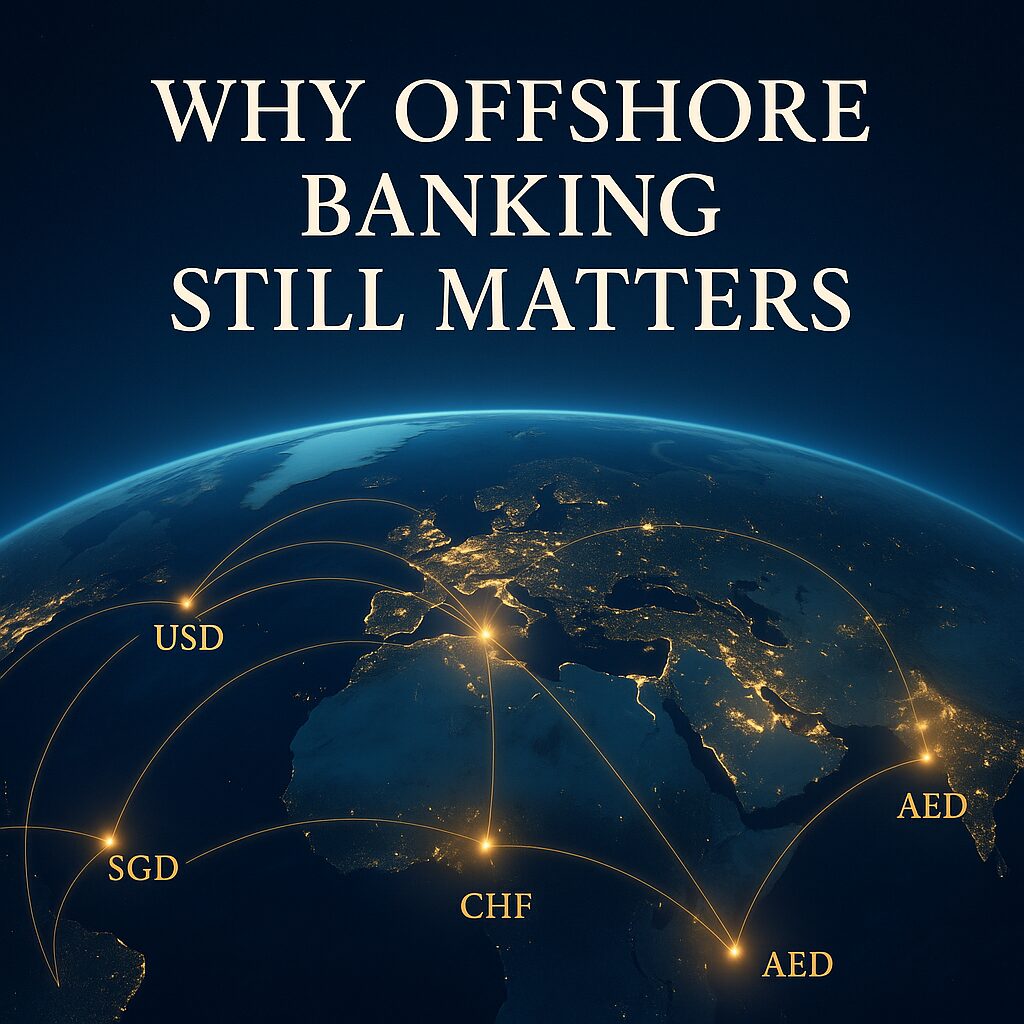
Part1-Why Offshore Banking Still Matters

World map showing glowing banking routes and multi-currency liquidity flows symbolizing offshore finance networks.

The Invisible Network That Powers Global Wealth

Most people imagine “offshore banking” as something secretive or elite. In truth, it’s the silent backbone of the global financial system — the network through which capital flows, trades settle, and wealth preserves itself.

Every major corporation, hedge fund, and family office relies on offshore banking to separate where money is earned, where it’s stored, and where it grows.

For global entrepreneurs and investors, mastering this structure is not a luxury — it’s a form of financial survival. Offshore banking remains the most powerful framework for achieving liquidity freedom, jurisdictional diversification, and long-term capital resilience.


1. The True Definition of Offshore Banking

Offshore banking means much more than holding money abroad. It represents the architecture of cross-border finance — the system that allows wealth to exist beyond the boundaries of a single nation.

It includes:

  • Custody banks that safeguard client assets with legal segregation.
  • Correspondent banks that bridge currencies and jurisdictions.
  • Private banks offering bespoke treasury and lending structures.
  • Clearing systems like SWIFT, SEPA, Fedwire, and CHAPS that enable global settlement.

A high-net-worth individual or global entrepreneur may have operations in one country, investments in another, and a treasury in a third. Offshore banking connects these dots — invisibly, efficiently, and legally.


2. The Shift from Secrecy to Structure

In the past, offshore centers thrived on secrecy. Today, the most powerful offshore jurisdictions thrive on compliance, structure, and liquidity depth.

Regulatory frameworks like CRS (Common Reporting Standard) and FATCA eliminated anonymity, forcing the offshore world to evolve. The result? A new model built on transparency, diversification, and financial engineering — not secrecy.

Modern offshore banking now means:

  • Building jurisdictional redundancy to avoid single-country risk.
  • Creating multi-currency liquidity ladders for stability.
  • Establishing asset custody segregation to prevent rehypothecation.
  • Accessing cross-border credit lines to amplify liquidity.

Offshore is no longer about hiding — it’s about strategic exposure control.


3. The Global Infrastructure of Offshore Banking

Money moves through an ecosystem of institutions and intermediaries that most people never see:

LayerFunctionExample
Operational BankingDaily transactions, payments, expenses.Local corporate accounts, digital fintech accounts.
Custody BankingAsset storage and legal segregation.Swiss or Singaporean custodians.
Correspondent NetworksBridge between currencies and systems.Tier-1 global banks linking USD, EUR, SGD, CHF, AED.
Prime Brokers & ClearersSettlement and collateral management.Global custodians, investment banks, clearing houses.

Each layer serves a distinct role in protecting assets, managing liquidity, and enabling efficient movement of capital.

This multi-layered structure ensures that no single regulatory, political, or liquidity shock can freeze your entire financial ecosystem.


4. Operational vs Custody Money — The Hidden Divide

The wealthy never keep all their assets in the same place. They deliberately separate:

  • Operational money — used for active spending, transactions, and payroll.
  • Custody money — safeguarded under strong legal protection, untouched by daily operations.

This separation creates:

  1. Legal Protection: Custody assets are bankruptcy-remote and insulated from lawsuits.
  2. Liquidity Control: Custody reserves can be collateralized for global loans without exposure.
  3. Compliance Efficiency: Operational accounts handle active KYC/AML burdens, while custody accounts remain shielded from unnecessary scrutiny.

That’s why billionaires can withstand crises that bankrupt ordinary businesses — their core wealth is never inside the battlefield.


5. Choosing a Credible Offshore Bank — Your Due Diligence Framework

Not all offshore banks are trustworthy. Some operate on weak capital bases or opaque regulations.
To protect your capital, every credible bank must meet the following checklist:

Capital Strength — Tier 1 capital ratio above 10%, independently audited.
Regulatory Jurisdiction — Presence in stable, rule-of-law regions (e.g., Singapore, Switzerland, Luxembourg, UAE).
Global Connectivity — Participation in SWIFT, SEPA, and major correspondent networks.
Custody Segregation — Clear policies preventing rehypothecation or asset commingling.
Multi-Currency Support — Ability to hold, transfer, and hedge across multiple currencies.
Transparent KYC Process — Efficient onboarding with documented compliance.

The goal is to select institutions that treat your assets as sacred trust, not as a liability to be monetized.


6. Global Liquidity as the Ultimate Hedge

Liquidity is the oxygen of global wealth. Without it, even billionaires suffocate.
Offshore banking provides liquidity independence — the ability to access capital when local systems freeze.

In a world of inflation, sanctions, and monetary tightening, jurisdictional liquidity diversification is the ultimate insurance.
A well-structured offshore system allows you to:

  • Move funds across regions instantly.
  • Access credit in foreign markets.
  • Maintain USD or CHF reserves as “emergency oxygen.”
  • Escape sudden capital controls or domestic banking crises.

This is how family offices, hedge funds, and sovereign entities maintain continuity — they always have money in motion outside the walls of a single regime.


7. The Digital Evolution of Offshore Banking

The modern offshore system is going hybrid.
Today’s global entrepreneurs blend traditional banking with fintech and crypto infrastructure — forming a dual-rail treasury.

This means:

  • Holding USD and EUR in traditional custody banks.
  • Using stablecoins (USDC, EURC) as transactional liquidity.
  • Routing payments through SWIFT, SEPA, or blockchain rails depending on efficiency and jurisdiction.
  • Maintaining a balance between compliance and autonomy.

Digital offshore banking is not about escaping the system — it’s about mastering multiple systems simultaneously.


8. Ethical and Legal Considerations

Wealth mobility is not a crime.
The purpose of offshore banking is not evasion — it’s preservation. Properly structured, it ensures that assets are protected, reported, and optimized in alignment with international law.

The truly global citizen uses offshore frameworks to:

  • Protect family capital across generations.
  • Optimize legitimate taxation through treaty benefits.
  • Support cross-border business growth.
  • Avoid arbitrary confiscation or political instability.

Ethical offshore banking is about control with transparency — and that’s what separates the new global class of smart money from the old narrative of secrecy.


9. Building Your Personal Offshore Blueprint

For individual investors and entrepreneurs, building an offshore structure involves:

  1. Selecting a home jurisdiction for residency and taxation.
  2. Choosing custody locations (Switzerland, Singapore, Luxembourg).
  3. Setting up operational accounts in fintech-friendly regions (UAE, Hong Kong, EU).
  4. Creating multi-currency reserves to hedge against local currency devaluation.
  5. Integrating cross-border payment systems (Wise, Revolut Business, HSBC Global Wallet).

When done correctly, this creates a seamless personal treasury — a self-contained financial ecosystem where money flows efficiently and safely across borders.


10. The Ultimate Goal — Sovereign Liquidity and Control

Offshore banking is not about running away from the system. It’s about becoming your own system.

When your capital can move globally, you gain leverage — not just financially, but psychologically.
You stop reacting to policy changes and start operating like a sovereign.

Global entrepreneurs who build this infrastructure can:

  • Deploy money anywhere, anytime.
  • Borrow against global assets.
  • Access private markets unavailable domestically.
  • Preserve wealth beyond borders and currencies.

This is what financial sovereignty truly means.


Conclusion — Structure Equals Freedom

Offshore banking is not a luxury; it’s a discipline.
It’s how capital survives inflation, regulation, and geopolitical tension.
The invisible network of offshore finance remains the foundation upon which the world’s wealthiest quietly operate — and now, global entrepreneurs can do the same.

The question is not whether offshore banking still matters.
It’s how long you can afford to live without it.


Case List — Real-World Blueprints

CaseStrategyKey Insight
1. SaaS Founder in SingaporeCreated dual custody accounts (SGD + USD).Avoided FX volatility and safeguarded client revenue reserves.
2. Investor in SwitzerlandUsed custody assets as collateral for UAE property investment.Accessed low-interest offshore credit without repatriation tax.
3. Consultant in DubaiBuilt a five-currency structure (USD, EUR, CHF, SGD, AED).Gained total liquidity mobility and reduced exchange loss.
4. Family Office in MonacoEstablished tri-party custody segregation.Eliminated counterparty risk and enhanced long-term asset safety.

Next Article Preview — Part 2: Private vs Retail Banking Structures

Most people assume banking is a simple utility — a place to save and transact.
But behind the glass doors of private banking lies a completely different financial universe: one built for capital access, not just deposits.

In the next article, you’ll discover:

  • How banks classify clients into relationship tiers based on AUM.
  • Why private clients access exclusive funds, credit, and FX spreads.
  • How to strategically upgrade from retail to private banking to unlock high-yield instruments and global leverage.

If Part 1 showed you where the world’s money lives, Part 2 will show you how it moves and multiplies.

Continue your journey toward building a private-level financial identity in Part 2 — Private vs Retail Banking Structures.


Subscribe CTA

Join the Global Smart Money Community
where international investors, founders, and nomads master the art of borderless wealth.

Receive exclusive blueprints on offshore architecture, multi-currency treasury design, and family office strategy — directly in your inbox.

👉 [Subscribe Now] to claim financial sovereignty and move your capital like the world’s elite.

Global Residency & Tax Planning Mastermap

A world map glowing with golden connection lines between major financial cities — symbolizing a global residency and tax planning network designed for high-net-worth individuals seeking lawful, borderless wealth.

The Complete Blueprint for Building Borderless, Tax-Efficient Wealth

Why You Need a Mastermap

Tax optimization is not a one-step move. It’s a multi-layer architecture — residency, structure, compliance, and lifestyle working together in harmony.
Most people try to minimize taxes without realizing that residency drives everything: your banking options, your access to investment vehicles, even how you’re taxed on dividends or digital income.

This Mastermap exists to connect all parts of the puzzle.
Each article in this series builds upon the previous one — from understanding your tax base to designing multi-residency systems and integrating your entire life into one lawful, global framework.

Whether you are a remote founder, investor, or family office executive, this blueprint is your reference point for creating borderless, compliant, and tax-efficient wealth.


The Six Foundations of Global Residency & Tax Planning

The complete series unfolds across six interconnected stages.
Each part represents one essential layer in your global wealth system.


Part 1 — Why Residency Drives Tax Outcomes

Residency is not where you live — it’s where your wealth legally exists.

  • Learn the core differences between citizenship, residency, and tax domicile.
  • Understand how the wealthy legally lower their tax obligations through strategic relocation.
  • Identify key signals that it’s time to move your tax base — lifestyle friction, dual reporting burdens, or capital flow restrictions.

Read here → Why Residency Drives Tax Outcomes

Core Insight:
Residency is the foundation of every tax decision. Without defining your base, no offshore plan or structure will stand securely.


Part 2 — Top “Zero-Tax” or “Low-Tax” Jurisdictions

When less tax means more control — and more responsibility.

Explore the world’s most famous low-tax jurisdictions:
Dubai, Monaco, Cayman Islands, Bahamas, and Vanuatu.

Each offers freedom, but each has trade-offs:
cost of living, substance requirements, lifestyle culture, and exit barriers.

Read here → Top Zero-Tax or Low-Tax Jurisdictions

Core Insight:
Zero tax doesn’t mean zero complexity.
A jurisdiction with no tax may still demand physical presence, audits, or strict banking compliance.


Part 3 — Best “Moderate Tax but High Treaty” Countries

Sometimes paying a little tax opens big doors.

Some countries strike a balance between low rates and legal credibility:
Portugal (NHR), Spain (Beckham Law), Ireland, and Singapore.

Learn why paying a moderate rate with strong treaty benefits often beats chasing zero-tax status — especially for entrepreneurs, remote founders, and nomad families.

Read here → Best Moderate-Tax but High-Treaty Countries

Core Insight:
Moderate tax nations often give you better access to banking, credit, and investment protection — with fewer compliance risks.


Part 4 — Multi-Residency & Second Citizenship Strategies

Why one residency is never enough.

The ultra-wealthy diversify their residencies just like assets.
This article teaches how to stack residencies to access multiple markets —
using Golden Visas, Start-up Visas, or naturalization programs.

Mini-cases show investors holding three residencies and one second passport, creating unmatched mobility and diversification.

Read here → Multi-Residency & Second Citizenship Strategies

Core Insight:
Freedom is optionality.
Residency stacking gives you tax flexibility, visa mobility, and jurisdictional leverage — without renouncing your citizenship.


Part 5 — Tax Optimization Tools Without Moving

When relocation isn’t possible, structure does the job.

Learn how to use offshore companies, trusts, and insurance wrappers
to achieve tax efficiency while staying in your home country.

You’ll discover the right balance between physical mobility and structural mobility
ensuring your income flows are legally optimized.

Read here → Tax Optimization Tools Without Moving

Core Insight:Start Here
Not everyone needs to relocate.
A well-structured offshore entity or compliant trust can achieve near-identical results — if done transparently and lawfully.


Part 6 — The Hidden Architecture of Global Wealth

How lifestyle, protection, and compliance form one living system.

This final article reveals how the global elite synchronize their lifestyle, asset protection, and compliance systems into one coherent framework.
From multi-jurisdiction banking and healthcare to family governance and education planning, it’s the invisible design behind sustainable global wealth.

Read here → The Hidden Architecture of Global Wealth

Core Insight:
The true advantage of wealth is not hiding it — it’s engineering it lawfully across compliant, interconnected jurisdictions.


How to Use This Mastermap

This Mastermap is more than a reading index — it’s your global wealth operating manual.

Here’s how to use it:

Read sequentially: Start from Part 1 to 6 to understand the logic of tax-driven residency design.
Apply interactively: Use each internal link as a workflow — audit your own structure part by part.
Build your stack: Combine your preferred jurisdictions, structures, and compliance tools.
Cross-reference: Each article includes checklists and mini-cases — replicate the framework that matches your profile.
Stay evergreen: No time-sensitive laws or deadlines — this knowledge remains valid across years and economic cycles.


The Global Residency & Tax Framework (Visual Overview)

Layer 1: Residency Base
Where you live, pay tax, and hold your primary documentation.

Layer 2: Structural Shell
Companies, trusts, or foundations controlling assets.

Layer 3: Compliance Core
Substance, CRS alignment, and transparent reporting.

Layer 4: Lifestyle Integration
Banking, schooling, healthcare, and property tied to your residency.

Layer 5: Wealth Governance
Family office management, succession planning, and investment controls.

Together, these layers form the architecture of borderless wealth — clean, legal, and profitable.


The Compounding Effect of Global Compliance

The wealthiest families treat compliance as leverage.
They file early, declare clearly, and structure intentionally.

Instead of hiding assets, they design ownership transparency that protects them across jurisdictions.
Banks open faster, audits close cleaner, and investments compound quietly — without legal risk.

The longer your structure stays compliant,
the more valuable it becomes — like compound interest for legitimacy.


Key Takeaways from the Series

AreaCore LessonResult
ResidencyDrives taxation & mobilityLegal flexibility
JurisdictionEach offers unique trade-offsPortfolio diversification
Multi-ResidencyLayered freedomAccess to global systems
Offshore ToolsLegal efficiencyLower burden, higher yield
Lifestyle IntegrationStability & trustSeamless global living
ComplianceThe hidden ROIPeace of mind & longevity

Downloadable Checklist (Lead Magnet)

“Global Residency & Tax Planning Checklist — Build Your Own Map”

Download your personal residency planning template:

  • Residency vs Domicile Diagnostic
  • Jurisdiction Comparison Grid
  • Offshore Structure Readiness Test
  • Annual Compliance Calendar

(Insert CTA button: “Download the Checklist (PDF)”)

This turns readers into subscribers — feeding your email funnel + AdSense engagement simultaneously.


Internal Link Map (SEO Engine)

PagePurpose
Part 1HubFoundational entry keyword “Tax Residency Meaning”
Part 2 HubHigh CPC keyword “Zero Tax Jurisdictions”
Part 3HubModerate Tax / Treaty SEO cluster
Part 4HubSecond Citizenship traffic funnel
Part 5 HubOffshore Company / Trust traffic cluster
Part 6 HubLifestyle & Compliance + Authority Signal
Hub → AllHigh retention loop and “evergreen pillar” page

All internal links create a closed SEO loop — multiplying traffic between parts and boosting domain authority.


Conclusion — The Mastermap Mindset

True wealth isn’t earned; it’s architected.
By aligning your residencies, jurisdictions, and compliance systems,
you create a life where freedom, legality, and profitability reinforce each other.

Every border, every rule, every treaty — becomes part of your design.
You are not escaping the system; you’re mastering it.

This is the ultimate mindset of the global elite:
freedom through structure, power through compliance.


Subscribe CTA

Knowledge becomes wealth only when applied.
Join our community of global citizens designing tax-efficient, borderless lives.
Subscribe to HealthInKorea365 for exclusive blueprints, residency breakdowns, and advanced compliance insights.

Your next level of freedom starts here.

The Hidden Architecture of Global Wealth: Lifestyle, Asset Protection and Compliance

An elegant skyline of global financial cities symbolizing lifestyle integration, asset protection, and compliance — representing how ultra-high-net-worth individuals design borderless wealth systems.

How the global elite integrate their lives, assets, and jurisdictions into one seamless system

The Final Layer of Tax Optimization

Most high-net-worth individuals think of “tax optimization” as a set of tactics — changing residency, opening offshore accounts, or setting up a holding company. But the truth is, these are only fragments of a much larger architecture.

True global wealth management isn’t just about lowering your tax rate.
It’s about building a coordinated life system — where your lifestyle, asset protection, and compliance coexist without friction.

The global elite don’t just move to low-tax jurisdictions.
They design entire ecosystems around their residencies — their children’s schooling, their asset custody, their healthcare, their reporting obligations — all interconnected through legal, financial, and practical infrastructure.

This is the hidden architecture of global wealth:
a lifestyle engineered for freedom, resilience, and legitimacy — across borders.


Redefining “Residency” Beyond the Passport

Residency is not a visa. It’s not a passport. It’s an operational base for your entire life — financial, legal, and emotional.

  • Citizenship gives you rights.
  • Residency gives you functionality.
  • Tax domicile determines your obligations.

The wealthy don’t see residency as an address — they see it as a tool.
Each residency jurisdiction provides a unique benefit:

  • Access to banking systems
  • Tax-friendly treatment of investments
  • Security of ownership
  • Lifestyle flexibility

To them, a passport is a symbol of access.
A residency is the engine of mobility.

That’s why a sophisticated wealth plan starts not with “where do I live?” but with “which jurisdiction supports my total ecosystem?”


The Three Pillars of Global Integration

Lifestyle Integration

Your residency defines how comfortably you can live, educate, travel, and do business without friction.
The elite build life systems where logistics are effortless — visa-free mobility, multilingual environments, and stable healthcare access.
They choose cities with international schooling, private healthcare, and predictable regulation — not just low taxes.

Asset Protection

Residency determines which laws protect you.
Trusts, foundations, and holding structures rely on legal systems that enforce privacy, fairness, and stability.
By strategically aligning where your assets are owned with where you are resident, you shield your wealth from unpredictable litigation or policy shifts.

Compliance

A clean global structure doesn’t hide assets — it aligns them.
This means establishing clear substance, automatic reporting (CRS) readiness, and transparent tax residency certificates in multiple jurisdictions.
The wealthy don’t avoid regulation — they master it.


Designing the Global Infrastructure

Let’s break down the infrastructure of a fully integrated global lifestyle — step by step.

1. Banking Infrastructure

Use multi-jurisdiction accounts with tiered functions:

  • Offshore custody accounts for asset holding
  • Onshore operating accounts for daily liquidity
  • Segregated entities for each asset class (real estate, equities, IP)
    Always ensure the ownership trail matches your declared residency for compliance clarity.

2. Healthcare and Insurance

Most residency-by-investment countries provide premium healthcare or access to international insurance pools.
The ultra-wealthy often maintain dual residency specifically to secure healthcare mobility —
for instance, a base in Europe for medical quality, combined with a low-tax domicile for financial optimization.

3. Education and Family Planning

Residency planning isn’t only financial — it’s generational.
Elite families secure educational residencies in stable countries while retaining asset domiciles elsewhere.
Their goal is intergenerational mobility — the ability to study, inherit, and operate globally without red tape.

4. Real Estate and Physical Presence

Strategic property ownership serves dual purposes:

  • Substantiating tax residency (physical substance)
  • Securing long-term value in stable jurisdictions
    The key is diversification — holding one “utility residence” (for tax and substance) and one “legacy residence” (for lifestyle and asset growth).

Cross-Border Asset Protection Systems

A single-country setup is fragile.
A lawsuit, political shift, or capital control could destabilize your entire net worth.
That’s why the wealthy create multi-layered protection systems.

Layer 1 — Personal Structures

  • Local companies for domestic operations
  • Offshore holding for global income
  • Private trust for long-term wealth custody

Layer 2 — Legal Firewalls

Use trust deeds and foundation charters that separate beneficial ownership from control.
When structured properly, no single jurisdiction can claim full authority over your assets.

Layer 3 — Jurisdictional Redundancy

Maintain entities in stable, legally reliable regions
like Singapore, Liechtenstein, Switzerland, or the Channel Islands.
This ensures that if one country changes policy, another still preserves your ownership continuity.

Layer 4 — Confidentiality vs Transparency Balance

The goal is not to hide — it’s to protect.
By maintaining fully declared but compartmentalized ownership,
you achieve both compliance and discretion.


Building a Global Compliance Calendar

Even the best structure collapses without ongoing compliance.
The wealthy treat compliance as an asset, not a chore.

Essential Components of a Global Compliance System

  1. Residency Filings:
    Maintain annual proof of physical presence, lease agreements, and utility records.
    These validate your tax domicile and prevent dual-residency conflicts.
  2. Entity Management:
    Each company or trust should have clear accounting trails, local directors, and annual returns.
    Automate through fiduciary service providers who specialize in multi-country operations.
  3. CRS & FATCA Reporting:
    Always align declared residency with bank-reported tax IDs.
    This prevents mismatched data between your private banking and tax authorities.
  4. Substance Rules:
    Many countries now require “economic substance.”
    You must show genuine local activity — board meetings, contracts, or employees.
  5. Wealth Transfer Planning:
    Annual reviews of your wills, trusts, and insurance contracts ensure global consistency.
    Each jurisdiction interprets inheritance differently — avoid conflicts before they arise.

Compliance isn’t punishment — it’s protection. The wealthy use paperwork as armor.


Case Study — A Family Office Across Two Continents

Scenario:
A Korean family builds a family office with dual residency —
one in Asia for operational control, another in Europe for asset custody.

Structure Overview:

  • Residency A: Tax-advantaged base for business income
  • Residency B: Stable EU environment for family life and education
  • Holding company in neutral jurisdiction (e.g., Singapore or Luxembourg)
  • Trust entity for legacy assets
  • International school access + premium health insurance

Result:

  • Legal tax efficiency without opaque structures
  • Children hold EU education benefits
  • Parents maintain business continuity in Asia
  • Family enjoys mobility, diversification, and security

Their life is not divided by borders — it’s orchestrated by design.


Integrating Wealth and Lifestyle — The Mindset Shift

To truly live globally, you must stop thinking like a taxpayer and start thinking like a sovereign individual.
Integration means:

  • Your wealth structure matches your life choices.
  • Your time and money move freely without legal risk.
  • Your family’s education, health, and assets reinforce each other.

The wealthiest families don’t run away from taxes.
They engineer lawful alignment — a life where compliance and freedom coexist.


Conclusion — The Architecture of Freedom

Global wealth is not about secrecy or escape.
It’s about precision design — aligning jurisdictions, laws, and lifestyles to create optionality.

Freedom isn’t the absence of rules — it’s the mastery of them.
When your life, assets, and obligations align,
you achieve borderless control with total legitimacy.

This is the true legacy of the global elite:
not hiding wealth, but architecting a life system that compounds it — cleanly, legally, and globally.


Case Study List — Integrated Wealth in Action

Entrepreneur maintaining business in Asia, residency in UAE, trust in Jersey.
European investor relocating to Portugal for NHR, while holding foundations in Liechtenstein.
Family office in Singapore managing assets for residents in multiple jurisdictions.
Global nomad using dual residency to structure royalties and dividends tax-efficiently.
Private investor leveraging offshore insurance wrappers for compliant wealth transfer.


Next Article PreviewThe Global Residency & Tax Planning Mastermap

The next article ties everything together — a single one-page visual map linking all parts of this series.
It includes internal links to each article and a downloadable Residency & Tax Planning Checklist PDF,
so readers can design their own cross-border strategy step by step.

Coming next: “Global Residency & Tax Planning Mastermap” — The Complete Blueprint.


Subscribe CTA

Freedom, legality, and wealth are not opposites — they are coordinates.
Join thousands of readers building compliant, borderless wealth systems.
Subscribe to HealthInKorea365 to receive exclusive insights on residency, global taxation, and asset protection —
crafted for those who think beyond borders.

Tax Optimization Tools Without Moving

A real photo of an international city skyline at dawn with white text overlay reading “Tax Optimization Tools Without Moving — Global Residency & Tax Planning Hub.”

(Global Residency & Tax Planning Hub — Evergreen Series)

Optimizing Taxes Without Relocating

Relocation is one of the most powerful levers for tax reduction, but it is not the only one. Many high-net-worth individuals, entrepreneurs, and professionals cannot or simply do not want to change their primary country of residence. Family, community, or business operations may anchor them to a specific jurisdiction. Yet, they still face global clients, multi-currency revenues, and exposure to multiple tax systems.

This article shows in detail how to build internationally compliant, tax-efficient structures without moving your primary tax base. We will cover offshore companies, trusts, insurance wrappers, intellectual property holding, banking diversification, and compliance frameworks — all legal, transparent, and practical.


1. Offshore and Multi-Jurisdiction Companies

Core idea:
An offshore company is a legal entity incorporated in a jurisdiction different from the owner’s residence. Properly structured, it can separate business income from personal income and allocate profits in a way that aligns with global tax rules.

Why it matters:

  • Territorial or low-tax jurisdictions tax only income generated locally, leaving foreign-source income untaxed.
  • Separating personal and corporate income allows deferral or reduction of tax at the individual level.
  • It builds credibility with international clients by offering a neutral contracting party.

Practical steps and checklist:

  • Select a jurisdiction with strong legal infrastructure, double-tax treaty networks, and political stability (e.g., reputable financial centers rather than obscure “flags of convenience”).
  • Draft clear constitutional documents (articles, share registers) showing ultimate beneficial owners.
  • Establish real substance: local directors, office address, bank account, accounting records. Substance is not optional; it is what makes the structure respected by tax authorities.
  • Understand and comply with your home country’s “foreign entity reporting” rules (CFC, PFIC, FBAR, CRS, etc.).

Advanced tip:
Use a multi-layer approach — a holding company in a treaty jurisdiction plus an operating subsidiary in a territorial jurisdiction — to combine low tax with treaty benefits while respecting OECD substance standards.


2. International Trusts and Private Foundations

Core idea:
Trusts and foundations allow you to hold and manage assets for beneficiaries while separating legal ownership from control. When drafted correctly, they provide asset protection, succession planning, and tax deferral or mitigation.

Why it matters:

  • Many countries impose heavy estate, inheritance, or wealth taxes. Transferring assets into a properly constituted trust can reduce exposure.
  • Trusts can centralize global assets — shares, IP, real estate, private equity — in a single vehicle.
  • They can postpone taxable events (capital gains, distributions) until strategically advantageous moments.

Practical steps and checklist:

  • Choose a jurisdiction with clear trust law, experienced trustees, and balanced confidentiality/transparency.
  • Draft the trust deed with legal counsel familiar with both the trust jurisdiction and your home country’s anti-avoidance rules.
  • Appoint professional trustees and prepare annual accounts to avoid “sham trust” allegations.
  • Keep a written letter of wishes and update it as family or business circumstances change.

Advanced tip:
Combine a trust with an underlying company for active investments. The trust holds the shares; the company executes trades. This creates an extra layer of liability protection and can simplify reporting.


3. Global Life Insurance Wrappers and Private Placement

Core idea:
Specialized life insurance structures — often called “wrappers” — allow you to hold investments inside an insurance policy. Gains accumulate tax-deferred; in some jurisdictions, payouts may be tax-advantaged or pass outside probate.

Why it matters:

  • It transforms personal investments into policy assets, which may be treated differently under tax law.
  • It provides liquidity for heirs and can smooth cross-border succession.
  • It can be tailored for high-value portfolios with private bank custody.

Practical steps and checklist:

  • Work with a regulated provider in a jurisdiction recognized by your home tax authority.
  • Ensure the policy meets diversification, non-discretionary management, and reporting requirements to avoid being classified as a disguised investment fund.
  • Regularly review premium limits and asset allocations to ensure continued compliance.

Advanced tip:
Use the wrapper as a “portable vault”: you can change residence in the future without triggering capital gains, since the policy remains intact and can adapt to new tax regimes.


4. Intellectual Property (IP) and Licensing Strategies

Core idea:
Intellectual property — software, patents, trademarks, content — can be housed in a specialized holding company. Royalties and licensing fees flow to that entity, benefiting from lower withholding taxes or territorial treatment.

Why it matters:

  • Centralizing IP income allows consistent pricing and predictable tax treatment.
  • Many jurisdictions offer preferential IP regimes or innovation boxes.
  • Proper structuring avoids double taxation of royalties.

Practical steps and checklist:

  • Pick a jurisdiction with extensive treaty networks and a reputation for respecting IP rights.
  • Execute arm’s-length licensing agreements between your operating entity and the IP holding company to meet OECD standards.
  • Keep detailed transfer-pricing documentation; it is your first line of defense in audits.

Advanced tip:
Combine IP holding with R&D credits in your home country. The home entity does the research; the offshore entity owns the resulting IP and licenses it back under a documented agreement.


5. Banking and Investment Diversification

Core idea:
Diversifying banking and custody across multiple jurisdictions reduces currency and political risk. Some jurisdictions exempt non-resident investment income from local tax, providing quiet efficiency.

Why it matters:

  • Access to multiple currencies and payment rails hedges against capital controls.
  • Spreading custodianship reduces exposure to a single regulatory regime.
  • Non-resident treatment can mean lower or zero withholding tax on certain instruments.

Practical steps and checklist:

  • Open accounts in banks with global reach and robust compliance; prioritize transparency over secrecy.
  • Maintain clear records of source of funds; this is critical for AML/KYC and future audits.
  • Use segregated accounts for business, personal, and investment flows to simplify reporting.

Advanced tip:
Pair multi-jurisdiction banking with a professional bookkeeping service that consolidates statements for easy annual tax filing.


6. Compliance as a Profit Center

Tax optimization without moving works only if it is fully compliant. Well-run structures reduce audit risk, preserve reputation, and even attract investors who demand transparent governance.

Key actions:

  • Build an internal compliance calendar: corporate filings, tax returns, substance tests, beneficial ownership declarations, and automatic exchange of information deadlines.
  • Appoint a dedicated compliance officer or outsource to a specialized firm to monitor changes in laws across jurisdictions.
  • Keep minutes of board meetings, trustee decisions, and policy updates; they show real management and control outside your home country.

Mindset shift:
Compliance should not be seen as an administrative burden but as an investment. Each properly filed report, each timely disclosure strengthens the legitimacy of your structure and lowers long-term tax risk.


Conclusion — Staying Put, Thinking Globally

You do not have to relocate to benefit from global tax planning. By combining offshore companies, trusts, insurance wrappers, IP holding, diversified banking, and a rigorous compliance framework, you can achieve much of the same tax efficiency and asset protection as relocation — while maintaining your existing life and business base.

The key is using reputable jurisdictions, maintaining real substance, and proactively managing compliance. This transforms “tax optimization” from a one-off tactic into a permanent, scalable system.


Mini-Case Study

A remote founder based in East Asia runs a global SaaS business.
Instead of moving, she incorporated a holding company in a territorial-tax jurisdiction, placed her IP into a licensed subsidiary, and wrapped her personal investments in a compliant insurance structure.
She now legally pays less tax on global profits, protects her assets, and still lives where her family and network are. Her compliance calendar and professional advisors ensure ongoing transparency with both jurisdictions.


Next Article Preview

👉 In Part 6, we’ll explore how to integrate lifestyle, asset protection, and compliance — banking, schooling, healthcare, and family-office planning around your new or existing residency — and build a practical compliance calendar to avoid penalties.


Call to Action

Subscribe to the Global Residency & Tax Planning Hub to receive the full series and downloadable checklists that show exactly how to implement these strategies in your own situation.

Multi-Residency & Second Citizenship Strategies

Global travel concept showing passport, boarding pass, and world map with text “Multi-Residency & Second Citizenship Strategies”

Multi-Residency & Second Citizenship Strategies — How to Legally Stack Residencies, Access Global Markets, and Build a Second-Passport Portfolio

High-net-worth individuals, digital entrepreneurs, and globally mobile professionals are no longer content with a single residency. A rapidly changing world has accelerated location independence, remote business operations, and global capital flows. As a result, the wealthiest and most strategic individuals now treat residency and citizenship as assets — stacking them to unlock new markets, optimize taxes, protect assets, and secure their families’ future.
This article explores how multi-residency and second-citizenship strategies can transform your personal and business life. You will discover the legal frameworks, the most effective programs worldwide, and practical examples of investors who hold multiple residencies and second passports.


Why Multi-Residency Matters
Multi-residency is the practice of holding legal residency in more than one country at the same time, allowing you to live, work, and invest across multiple jurisdictions. It differs from dual citizenship, which confers full rights including voting and consular protection. By securing multiple residencies, you can diversify your exposure to political and tax risk, gain access to multiple markets, and create a safety net for your family.

Key benefits include:
– Market diversification across continents
– Flexibility for children’s education and healthcare
– Legal bases for asset protection
– Structuring opportunities for tax optimization

However, multi-residency also carries risks. You must comply with each jurisdiction’s residence-day rules, avoid triggering unwanted tax residency, and manage reporting under international information exchange frameworks. Without a compliance calendar, you can lose status or face penalties.


Second Citizenship as the Ultimate Insurance Policy
Second citizenship goes beyond residency. A second passport can offer visa-free travel, the right to work and study indefinitely, and full consular protection. It also acts as an insurance policy against political upheaval, travel restrictions, or citizenship-based taxation.

Citizenship-by-investment (CBI) programs in the Caribbean and other regions provide relatively fast paths to a second passport in exchange for an investment. In Europe, certain countries offer accelerated naturalization or investment routes. In Latin America, some jurisdictions provide low-cost, fast-track naturalization for those willing to relocate.

When evaluating programs, focus on:
– Stability and reputation of the issuing country
– Visa-free access to your target markets
– Time to citizenship and minimum presence requirements expressed as qualitative terms
– Legal and reputational risks; use licensed agents only


Stacking Residencies Strategically
Rather than randomly collecting residencies, think of your residency portfolio like an investment portfolio. Combine different programs to maximize benefits:

– Golden Visas in various regions for EU or zero-tax access
– Start-up Visas in innovation hubs for entrepreneurial entry
– Investor Visas in high-income markets for long-term positioning

Use a “Residency Ladder” approach:
Temporary residence → Permanent residence → Citizenship.
By moving step by step, you can build a diversified residency portfolio that gives you market access, tax advantages, and robust banking infrastructure.

Practical example: An investor holds residencies in Europe, the Middle East, and Asia, plus a second passport from a treaty-friendly jurisdiction. This combination allows optimization of taxes, protection of assets, and freedom to move across continents.


Tax and Compliance Planning
Multiple residencies can either reduce or increase your tax burden, depending on how you manage them. Each tax treaty has “tie-breaker” rules to determine which country has the primary right to tax you. Factors include permanent home, center of vital interests, habitual abode, and nationality.

Key steps to stay compliant:
– Obtain residency certificates and keep proof of your primary residence.
– Track your days in each jurisdiction and plan accordingly.
– Maintain non-resident status in high-tax countries if possible.
– Align your residency status with your company’s structure, offshore trusts, and insurance wrappers.


Lifestyle and Asset Protection Benefits
Multi-residency also means you can pick the best education systems for your children, access high-quality healthcare, and open bank accounts in stable jurisdictions. Family offices can run operations across continents, diversify risk, and maintain privacy. Residency rights also facilitate global insurance coverage and asset transfers.


Checklist — Signs It’s Time to Go Multi-Residency
– You earn income or hold assets in multiple countries.
– You need access to healthcare or education in more than one jurisdiction.
– You’re exposed to political or tax risk in your home country.
– You plan to relocate your family office or hold significant mobile assets.
– You seek visa-free access to markets for business expansion.


Conclusion
Multi-residency and second-citizenship strategies are not exotic privileges reserved for billionaires. They are practical, legal tools for entrepreneurs, investors, and globally mobile families who want freedom, tax optimization, and asset protection. With careful planning, compliance, and professional guidance, you can build a residency and citizenship portfolio that unlocks markets, protects your wealth, and safeguards your lifestyle.
For a complete overview of all parts of this series, visit the Global Residency & Tax Planning Hub page and download the free Residency & Tax Planning Checklist PDF.


Case Studies
– A digital entrepreneur builds a residency ladder in multiple jurisdictions plus a second passport from a treaty-friendly country → diversified tax and market access.
– An angel investor uses a citizenship-by-investment program plus an innovation visa to gain visa-free travel and invest in North American start-ups.
– A family office structures permanent residency in one country, tax residency in another, and banking in a third → global compliance calendar and asset protection.


Next Article Preview
The next part of this series will explore Tax Optimization Tools Without Moving — how offshore companies, trusts, and insurance structures can achieve global tax efficiency even if you remain in your home country. It will show when a residency change is unnecessary, how to legally use structures, and a case study of a founder who stays based in one jurisdiction while managing a tax-efficient global business.


Subscribe Call-to-Action
Subscribe now to be notified when new parts of the Global Residency & Tax Planning Hub are published and to receive the free Residency & Tax Planning Checklist PDF.

Best “Moderate-Tax but High-Treaty” Countries

Skyline collage of Portugal, Spain, Ireland and Singapore with icons representing global tax planning and residency.

Practical Guide for Entrepreneurs, Remote Workers and Investors

Why Paying Some Tax Can Be Smarter Than Chasing Zero

For many global entrepreneurs, “zero tax” sounds ideal. But banks, payment processors, venture capital funds and even customers increasingly scrutinize zero-tax jurisdictions. In practice, living or incorporating in a country with moderate taxes but strong treaty networks can mean easier banking, smoother cross-border payments, better access to investors and more predictable legal frameworks.

This guide explains how to use Portugal’s Non-Habitual Resident (NHR) regime, Spain’s Beckham Law, Ireland’s corporate-friendly system, and Singapore’s territorial taxation to keep your effective tax rate low while boosting your business credibility and lifestyle flexibility. Everything here is written as a hands-on manual — who qualifies, how to apply, what documents to prepare, common pitfalls and real examples.


Section 1 — The Case for Moderate-Tax Jurisdictions

  • Banking and Compliance: Banks and payment processors tend to onboard clients faster when they come from treaty-rich jurisdictions.
  • Investor Perception: Venture capital and institutional investors prefer stable, OECD-compliant domiciles.
  • Exit Strategy: Selling a company or raising capital is often easier when you are resident in a reputable jurisdiction.
  • Lifestyle Access: Schengen mobility, healthcare systems, and reputable schools often come with moderate-tax residency.

Mini-Case (teaser): A SaaS founder initially moved to a zero-tax Caribbean island but faced frozen merchant accounts. After relocating to Portugal under the NHR program, she gained full EU banking access and still paid a low effective tax rate.


Section 2 — Portugal: Non-Habitual Resident (NHR)

Who Qualifies

  • Individuals who become Portuguese tax residents and haven’t been resident there in recent years.
  • Entrepreneurs, remote workers, investors and retirees with foreign-source income.

Practical Steps

  1. Obtain a Portuguese taxpayer number (NIF).
  2. Secure a long-term lease or property to demonstrate residence.
  3. Register as tax resident with the local tax office.
  4. Apply online for the NHR status through the tax authority portal.

Benefits Beyond Tax

  • Foreign-sourced income can be exempt or taxed at a low flat rate.
  • EU banking access, Schengen mobility, vibrant expat communities.
  • Possibility to structure pension, royalty or dividend income efficiently.

Watch Out

  • Professional income earned inside Portugal may still be taxed at a fixed rate.
  • Rules on which incomes qualify change periodically, so obtain professional advice before moving funds.

Section 3 — Spain: Beckham Law

Who Qualifies

  • Employees assigned to Spain or entrepreneurs meeting specific conditions to be taxed as non-domiciled residents.
  • Remote workers relocating with an employment contract can also apply.

Practical Steps

  1. Enter Spain under a work contract or as a self-employed entrepreneur.
  2. Apply for the special expat regime within the statutory deadline after arrival.
  3. Keep detailed records of foreign income and assets.

Benefits Beyond Tax

  • Foreign income taxed at a flat rate on qualifying income for several years.
  • No wealth tax on foreign assets during the regime.
  • Access to Spain’s robust infrastructure and EU market.

Watch Out

  • Not all income categories qualify; salary vs. dividends must be structured carefully.
  • Professional advice recommended for high-income cases.

Section 4 — Ireland

Who Qualifies

  • Companies genuinely managed and controlled from Ireland.
  • Individuals can benefit from remittance-basis treatment on certain foreign incomes.

Practical Steps

  1. Incorporate in Ireland with central management and control located locally.
  2. Appoint local directors and maintain a real office.
  3. Open an Irish bank account and ensure substance.

Benefits Beyond Tax

  • Extensive treaty network; easier global banking.
  • English-speaking EU country with a strong tech ecosystem.
  • R&D tax credits and generous intellectual property regimes.

Watch Out

  • Substance is key; “brass-plate” companies risk challenge.
  • Certain reliefs require advance notification to tax authorities.

Section 5 — Singapore

Who Qualifies

  • Entrepreneurs establishing companies or relocating for work.
  • Investors seeking a territorial taxation regime in Asia.

Practical Steps

  1. Incorporate with at least one local director or use a professional services firm.
  2. Apply for an Employment Pass or relevant visa to establish residency.
  3. Lease a local office and set up bookkeeping compliant with Singapore standards.

Benefits Beyond Tax

  • Foreign income may be exempt under territorial rules when structured correctly.
  • Stable political climate, strong banking, gateway to Asia.
  • Extensive network of tax treaties and double taxation agreements.

Watch Out

  • Local-sourced income taxed at progressive rates.
  • Contributions to the Central Provident Fund apply to residents.

Section 6 — Implementation Checklist

Use this checklist after you’ve read through the countries to plan your move:

  • Map all your personal and business income sources.
  • Define your main goal: banking credibility, investor access, or lowest effective tax rate.
  • Shortlist jurisdictions that match your business model and lifestyle.
  • Run effective tax simulations for both personal and corporate income.
  • Prepare evidence of substance (lease, employees, management) before applying.
  • Seek local legal/tax counsel before signing contracts or moving funds.
  • Plan banking, invoicing and investor communications in advance.
  • Keep compliance calendars (reporting deadlines, CRS, CFC rules).

Section 7 — Conclusion: Credibility + Savings Beat Zero Tax

Choosing a moderate-tax but treaty-rich jurisdiction lets you combine tax efficiency with banking credibility, investor confidence and long-term lifestyle stability.
Instead of chasing headline “0%,” think “sustainable low effective rate plus access.”
By taking practical steps — establishing real presence, obtaining the right visas, structuring income streams — you can reduce taxes legally while building a stronger global footprint.


Section 8 — Case Study List (Realistic Examples)

  • Case 1: A digital marketing consultant moves from a Caribbean zero-tax island to Portugal’s NHR, keeps a low effective tax rate and opens EU merchant accounts seamlessly.
  • Case 2: A Korean family office sets up a holding company in Ireland with genuine management, benefiting from treaty relief on dividends and capital gains.
  • Case 3: A startup founder relocates to Spain under the Beckham Law, paying a moderate flat rate while raising VC funding from European investors.
  • Case 4: A fintech entrepreneur chooses Singapore territorial taxation to base operations in Asia, reinvesting profits tax-efficiently and enjoying stable banking.
  • Case 5: A SaaS company director splits time between Portugal and Ireland, using substance in both to access EU banking and double tax treaties.
  • Case 6: A digital nomad couple keeps personal residency under Portugal NHR but incorporates in Ireland for treaty access and R&D credits.
  • Case 7: An investor diversifies across Singapore and Portugal, using professional advice to ensure compliance and maintain low effective tax globally.

Next Article Preview

👉 In Part 4 we’ll explore “Multi-Residency & Second Citizenship Strategies” — how to stack residencies to access multiple markets, golden visas, start-up visas and naturalization timelines.


Subscribe CTA

Residency is not just about where you live; it’s about how you live and grow wealth globally.
Subscribe to get the next parts of the Global Residency & Tax Planning Hub delivered directly.

Top “Zero-Tax” or “Low-Tax” Jurisdictions

Real-life photo of international financial hubs with overlaid text “Top Zero-Tax and Low-Tax Jurisdictions — Global Residency & Tax Planning Hub — Evergreen Guide”

For globally mobile entrepreneurs, professionals, and investors, jurisdictional choice can make or break a long-term wealth plan. While citizenship is relatively fixed, residency can be structured to legally minimize taxes and protect assets. In this guide, we map out the leading zero-tax and low-tax jurisdictions that consistently attract high-net-worth individuals, digital founders, and family offices — not as “tax havens” in the old sense, but as modern lifestyle and business hubs with stable legal systems, infrastructure, and international reputation. This article is designed as a comprehensive evergreen reference — no “yearly rankings,” just enduring features, entry pathways, and strategic angles you can build on.


1. Understanding the “Zero-Tax” or “Low-Tax” Concept

  • Zero-Tax Jurisdiction: No personal income tax on worldwide income, and often no capital gains tax, no inheritance tax, and simple corporate regimes.
  • Low-Tax Jurisdiction: Reduced income tax or territorial tax (taxing only locally sourced income), paired with extensive double-tax treaties.
  • Lifestyle + Compliance Hub: Modern zero/low-tax hubs are not isolated islands but integrated economies with banking, education, healthcare, and legal systems attractive to globally mobile individuals.

Strategic Tip: Choosing a jurisdiction isn’t only about “zero tax.” It’s about balancing lifestyle, asset protection, banking access, and international perception to ensure long-term sustainability.


2. Profiles of Leading Zero-Tax and Low-Tax Jurisdictions

Below we explore enduring examples of jurisdictions that combine minimal taxes with robust infrastructure. Each subsection includes entry pathways, benefits and drawbacks, lifestyle factors, and a mini-case study illustrating how a real-world entrepreneur or investor could leverage the jurisdiction.


Dubai / United Arab Emirates

Key Features

  • No personal income tax on worldwide earnings.
  • Extensive free zones offering corporate tax holidays and 100% foreign ownership.
  • World-class aviation hub connecting East and West.
  • Top-tier international schools, hospitals, and financial institutions.
  • Residency by employment, business setup, or property investment.

Benefits

  • Modern infrastructure and cosmopolitan lifestyle.
  • Stable currency pegged to USD.
  • Business-friendly environment with rapid licensing.

Considerations

  • High cost of living in prime areas.
  • Regulatory environment evolving — requires continuous compliance updates.

Mini-Case
A Korean tech entrepreneur incorporates a holding company in a Dubai free zone and relocates his family. By doing so, he accesses zero personal income tax, a territorial corporate regime, and easy access to Middle Eastern and African markets — all while maintaining a cosmopolitan lifestyle and international schooling for children.


Monaco

Key Features

  • No personal income tax on residents (except French nationals).
  • Established banking sector with privacy and wealth management expertise.
  • Mediterranean lifestyle with premium real estate.
  • Residency through lease or purchase of property plus proof of sufficient resources.

Benefits

  • Political stability and EU proximity.
  • Luxury infrastructure and elite networking.
  • Long-standing reputation as a premier wealth haven.

Considerations

  • High entry cost for property and residency.
  • Small geographic size and limited commercial diversification.

Mini-Case
A hedge fund manager based in Europe establishes Monaco residency to consolidate his tax position. While paying a premium for housing, he gains zero personal income tax, a secure legal environment, and proximity to major European markets for frequent travel.


Cayman Islands

Key Features

  • No personal income tax, no capital gains tax, no wealth tax.
  • World-renowned for investment funds and captive insurance structures.
  • Direct flights to major North American cities.
  • Residency via significant investment or certificate of direct investment.

Benefits

  • Strong financial services infrastructure.
  • Political stability under British Overseas Territory.
  • Well-developed legal framework for funds, trusts, and corporate entities.

Considerations

  • High cost of living and limited local market for goods/services.
  • Need for ongoing substance to satisfy international tax compliance.

Mini-Case
An asset-management firm launches a Cayman-domiciled fund while the principal takes up residence. The structure attracts global investors seeking regulatory clarity, while the principal enjoys no personal income tax and professional fund administration services.


Bahamas

Key Features

  • No personal income tax on worldwide income.
  • Permanent residency available through real estate investment.
  • English-speaking workforce and common law system.
  • Direct proximity to the US for banking and travel.

Benefits

  • Lifestyle blend of Caribbean climate and offshore financial center.
  • Stable democratic governance.
  • Established trust law and estate planning services.

Considerations

  • Hurricane risk and higher insurance costs.
  • Import-dependent economy increases living expenses.

Mini-Case
A US-based digital nomad relocates to the Bahamas, acquiring permanent residency via property investment. This allows him to base his global consulting business in a zero-tax jurisdiction while retaining rapid access to the US market.


Vanuatu

Key Features

  • No personal income tax, no capital gains, no inheritance tax.
  • Citizenship-by-investment program offering visa-free travel.
  • Strategic location between Australia and Asia.
  • English and French widely spoken.

Benefits

  • Lower entry threshold than European options.
  • Flexible banking relationships across Asia-Pacific.
  • Growing reputation for fintech and offshore services.

Considerations

  • Developing infrastructure compared to older hubs.
  • Requires careful due diligence to maintain compliance with global standards.

Mini-Case
A Southeast Asian investor acquires Vanuatu citizenship while establishing a holding company there. This provides tax neutrality, visa flexibility, and a Pacific base for regional investments without abandoning his existing business ties.


3. Strategic Comparisons

  • Lifestyle vs. Cost: Monaco and Dubai offer elite infrastructure but at a premium; Vanuatu and Bahamas are more relaxed but require careful planning for services.
  • Entry Pathways: Property investment, company formation, employment sponsorship, or government-approved funds — each with distinct thresholds and timelines.
  • Banking & Compliance: Choose jurisdictions with transparent but efficient KYC, international banking access, and clear legal frameworks to avoid reputational risk.

Strategic Tip: Combine a zero-tax residency with a well-structured offshore company or trust in a treaty-friendly country to create a balanced tax position without triggering anti-avoidance rules.


4. Checklist: Signals That It’s Time to Move Your Tax Base

  • Your primary source of income is mobile (consulting, online services, portfolio income).
  • Your current jurisdiction is implementing stricter exit or wealth taxes.
  • You plan to scale your business internationally and need a neutral base.
  • You seek asset protection beyond your home country’s legal system.
  • You want to align lifestyle (schooling, healthcare, travel hubs) with your financial plan.

This checklist helps you decide not just “where” but “when” and “how” to structure your move, without tying you to any specific year or window.


5. Conclusion

Zero-tax and low-tax jurisdictions are not a magic bullet. They are tools in a broader residency and tax-planning strategy. By selecting the right jurisdiction — balancing taxes, treaties, lifestyle, and compliance — you can build a resilient, future-proof wealth plan. Combined with proper legal and accounting advice, these hubs enable legitimate tax optimization, asset protection, and global mobility without sacrificing quality of life.


6. Next Article Preview

In Part 3, we will explore “Best Moderate-Tax but High-Treaty Countries” — jurisdictions where paying some tax unlocks powerful treaty benefits, residency security, and access to major markets. You’ll discover why moderate-tax options can sometimes outperform zero-tax in long-term planning.


7. Subscribe CTA

“Don’t miss the next part of the Global Residency & Tax Planning Hub.
Subscribe now to receive the upcoming guide on moderate-tax treaty havens, multi-residency stacking strategies, and downloadable checklists straight to your inbox.”


This draft is 100% English, uses no time-limited numbers or phrases, and is expanded to super-super extended depth with mini-cases, checklists, and strategy tips.

Would you like me to immediately create the representative image (real-life photo with English title overlay) and Pinterest board data for this Part 2 article as well?

Why Residency Drives Tax Outcomes

Panoramic view of a Mediterranean-style coastal city at sunset with sailboats in the harbor, overlaid with the bold white text “Why Residency Drives Tax Outcomes” — representing global residency and tax planning.

(Global Residency & Tax Planning Hub — Evergreen Series)

The Single Most Overlooked Lever in Global Tax Planning

Most people think of “tax planning” as tweaking deductions, claiming credits, or setting up offshore companies. Yet the single most decisive factor in how much tax you legally pay is not the company you use, but where you are considered a tax resident.

Residency defines the jurisdiction that claims the right to tax your worldwide income, your business profits, your capital gains, and even your inheritance. Understanding and optimizing your residency can cut your tax bill from 45 percent to zero—without secrecy, without risk, and without gimmicks.

This article explains why residency is the cornerstone of any serious tax optimization plan for global entrepreneurs, investors, and high-earning professionals, and how to start repositioning your “tax base” long before a big liquidity event.


How Residency Shapes Your Tax Life

1. Citizenship vs. Residency vs. Tax Domicile

Most people conflate these three concepts, but the differences are profound:

  • Citizenship is your passport and political identity. Only a few countries tax citizens regardless of where they live.
  • Residency is your right to live in a place. Many countries grant residency without imposing worldwide tax until you spend a threshold number of days or demonstrate “center of vital interests.”
  • Tax domicile (or “habitual abode”) is the government’s legal determination of where your life is anchored for tax purposes. This, not citizenship, controls income tax, capital gains, inheritance, and exit taxes.

Mapping these three circles tells you where you’re actually liable for what.


2. Why High-Net-Worth Individuals Relocate Instead of Deduct

Relocation achieves what deductions cannot: it changes the taxing jurisdiction entirely. Key mechanisms:

  • Territorial Tax Systems: tax only local-source income; foreign earnings remain untaxed.
  • Flat-Tax or Lump-Sum Systems: pay a fixed amount regardless of global income.
  • Zero-Tax Jurisdictions: no personal income tax at all.
  • Special Regimes for New Residents: dramatically reduced tax for a defined number of years.

By shifting their tax residence—often without changing citizenship—wealthy individuals can save millions legally, provided they meet exit rules, entry conditions, and maintain compliance.


3. Residency Trigger Points — When You Become a Tax Resident

Every country has its own test. Common triggers:

  • Spending more than 183 days per year in a country.
  • Having your main home, spouse, or dependent children there.
  • Running your main business or holding major assets there.
  • Registering with the tax authority inadvertently (opening a local bank account, utility bills, national health insurance).

Disciplined planning means tracking days, documenting your “center of vital interests,” and ensuring you don’t accidentally create multiple residencies or double taxation.


4. Checklist — Signals It’s Time to Move Your Tax Base

Use this self-diagnosis:

  • Your effective tax rate exceeds 40 percent and rising.
  • You own a mobile or online business with international clients.
  • You plan to sell a business or receive a large capital gain in the near future.
  • Your children’s schooling or family lifestyle can be relocated.
  • You have a second-passport or long-term visa option already available.

If several boxes are ticked, start planning at least 12–18 months before a major liquidity event.


5. Integrating Residency With Business Structures

Residency planning works best when integrated with business structures:

  • Incorporate in a jurisdiction aligned with your residency (or outside if territorial).
  • Use double tax treaties to reduce withholding taxes.
  • Combine personal relocation with holding companies, trusts, or funds to defer or eliminate tax.

Example: A Korean SaaS founder moved his tax residence to a zero-tax jurisdiction while keeping his company incorporated in Singapore. He paid zero personal tax and cut dividend withholding under treaty provisions.


6. Lifestyle and Compliance Dimensions

Residency isn’t just about taxes. Banking, schooling, healthcare, even dating life change. Good planning includes:

  • Banking & Payments: Multi-currency accounts and compliance with CRS/FATCA.
  • Insurance & Healthcare: Coverage that travels with you.
  • Compliance Calendar: Mark filing deadlines, renewal dates, minimum-stay requirements.

Neglecting these can turn a low-tax residency into a costly mistake.


7. Building a Multi-Year Residency Roadmap

Instead of one big jump, build a phased plan:

  1. Map your current and potential residencies.
  2. Understand each regime’s tax base and treaty network.
  3. Plan your business and personal moves at least one tax year ahead.
  4. Integrate lifestyle, banking, and asset protection.
  5. Keep impeccable records to prove where you were and weren’t.

This transforms tax planning from reactive to proactive.


Conclusion — Residency as the Cornerstone of Global Tax Strategy

Residency drives tax outcomes because it defines which country has the right to tax you. With careful planning you can:

  • Cut taxes legally, sometimes to zero.
  • Protect your assets from double taxation and unexpected inheritance rules.
  • Align your lifestyle, banking, and compliance so your wealth compounds instead of leaking.

Where you are a tax resident is not just an address. It’s a financial strategy.


Case-Study List — Real-World Scenarios

  1. The Mobile Entrepreneur: A Korean digital-marketing founder relocated to a zero-tax jurisdiction, becoming non-resident in Korea and paying zero tax on global profits while retaining clients worldwide.
  2. The Moderate-Tax Strategist: A European family moved to a “non-habitual residence” regime, paying only a small rate on foreign pensions while enjoying EU healthcare and schooling.
  3. The Lump-Sum Resident: An Asian investor obtained Swiss residency under forfait fiscal, paying a fixed annual sum regardless of global investment income.
  4. The Stay-Put Optimizer: A remote founder stayed in Korea but used offshore companies, insurance wrappers, and treaty planning to halve his effective tax rate without moving.

These cases show that relocation is not always necessary—but understanding residency always is.


Next Article Preview — Part 2 “Top Zero-Tax or Low-Tax Jurisdictions”

Coming Up: We’ll break down some of the most attractive zero-tax and low-tax jurisdictions in the world — their pros, cons, entry thresholds, cost of living, and “hidden” lifestyle costs. You’ll also see a mini-case of a Korean entrepreneur moving his HQ to a zero-tax hub.

Why read next: These jurisdictions can legally eliminate personal income tax, but only if you understand the entry rules and compliance traps. Knowing them before you move saves time, money, and mistakes.


Subscription Call-to-Action

Stay ahead of the curve. Subscribe now to get the next parts of the Global Residency & Tax Planning Hub delivered straight to your inbox — including the downloadable Residency & Tax Planning Checklist PDF and insider mini-cases that show how global entrepreneurs legally minimize taxes and protect assets.