Global Smart Money Series — The Complete Multi-Passport Blueprint (1–6)

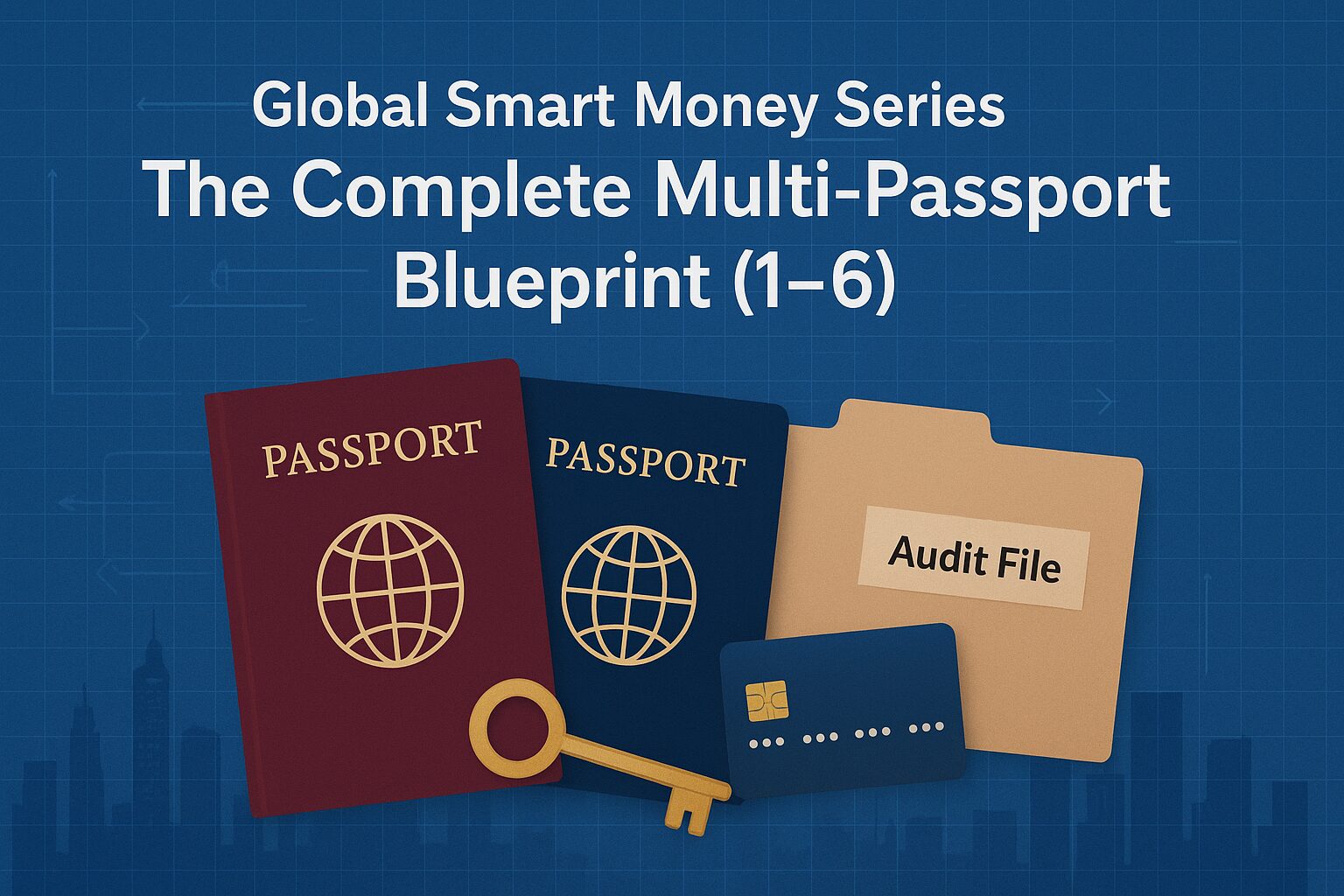
Passports, a golden key, a payment card, and an “Audit File” folder on a blueprint-style background with blended global skylines, representing the series hub for multi-passport guides.

From second passports to Golden Visas, tax residency, real case stacks, and a final blueprint you can copy.

Build a stack that actually works under scrutiny: a passport for mobility, a residency you can defend, and banking/company rails partners trust—locked in with an Audit File so reviews stay green. This hub gathers all six long-form guides, each written to be evergreen and directly actionable. Start where you are, then follow the path that fits your life and business.

Series Index (cards)

Use your own permalinks if they differ; below are clean slugs you can keep.

  1. Top Citizenship by Investment Programs — Caribbean to Europe
    How ordinary people (not just billionaires) get real mobility.
    • Fast Caribbean options vs. prestige EU routes
    • Banking perception & due-diligence realities
    • Copyable cases and decision matrix
      → Read now: /top-citizenship-by-investment-programs-caribbean-to-europe
  2. Residency by Investment — Golden Visas Explained
    Why residency is the smarter first step (with success & failure cases).
    • EU, UAE/Asia options compared
    • Minimum stay pitfalls, policy shifts, exit strategies
    • Checklist to pick your Golden Visa
      → Read now: /residency-by-investment-golden-visas-explained
  3. Tax Residency vs. Citizenship — What’s the Difference?
    Stop mixing identity with taxation—stay compliant and keep more.
    • Day-count, center-of-life, treaty tie-breakers
    • 12-point change-of-residency checklist
    • Audit-proof habits that compound
      → Read now: /tax-residency-vs-citizenship
  4. Second Passports for Entrepreneurs & Digital Nomads
    Mobility tools, not trophies—stacks that remove real bottlenecks.
    • Founder/nomad use-cases with mini-cases
    • Banking acceptance & PSP stability
    • Mistakes to avoid (and fixes)
      → Read now: /second-passports-for-entrepreneurs-digital-nomads
  5. Case Studies — Celebrities, Billionaires, and Global Families
    Replicable stacks, step-by-step: what worked, what failed.
    • Athlete, musician, founder, trader, family patterns
    • How to copy on a normal budget
    • Risks that trigger audits or freezes
      → Read now: /case-studies-celebrities-billionaires-global-families
  6. The Final Blueprint — Building Your Multi-Passport Portfolio
    The construction manual: layers, milestones, stacks, templates.
    • Mobility → Residency → Rails → Stability
    • Playbooks, decision matrix, PE/KYC templates
    • Folder tree for your Audit File
      → Read now: /final-blueprint-multi-passport-portfolio

“Start Here” — Choose Your Path (anchors inside this page)

  • Founders (US/EU sales): Read 4 → 3 → 6, optionally 1/2 to add mobility/residency.
  • Creators/Nomads: Read 4 → 5 → 6, then 3 for compliance discipline.
  • Global Families: Read 2 → 5 → 6, optionally 1 for faster mobility.
  • Traders/Crypto: Read 3 → 6 → 5, keep the Audit File routine.

CTA: Not sure where to begin? Start with #6 The Final Blueprint and follow the Milestones.


Downloads & Templates (link to the relevant posts)

  • Audit File checklist & folder tree: in #6 The Final Blueprint/final-blueprint-multi-passport-portfolio
  • Residency Narrative one-pager: in #6
  • KYC Bundle index + PE memo outline: in #6
  • Decision Matrix (scorecard): in #6

FAQ (evergreen)

Q1. Do I need a second passport to change my taxes?
No. Taxes follow residency facts and filings, not citizenship. See #3.

Q2. Should I start with citizenship or residency?
Most readers start with residency (Golden Visa) and add citizenship later. See #2 and #1.

Q3. Will a Golden Visa guarantee profitable real estate?
No—underwrite as if there were no visa. See failure cases in #2 and #5.

Q4. Why do accounts freeze?
Mixed income streams, weak evidence, or single-provider dependency. Fix with stream separation, KYC bundle, and two-region banking. See #4/#5/#6.

Internal Navigation (optional “Next/Prev” at page bottom)

  • Previous: n/a (This is the series hub)
  • Next: #1 CBI Guide/top-citizenship-by-investment-programs-caribbean-to-europe

Build a system, not a souvenir: pick one outcome—mobility, banking reliability, market access, or family stability—and take the first step today; if you’re unsure where to begin, go straight to The Final Blueprint (/final-blueprint-multi-passport-portfolio) or jump into #1 CBI Guide (/top-citizenship-by-investment-programs-caribbean-to-europe), keep your Audit File updated, and let the stack compound freedom and income—quietly, cleanly, and legally.
The Final Blueprint — Building Your Multi-Passport Portfolio

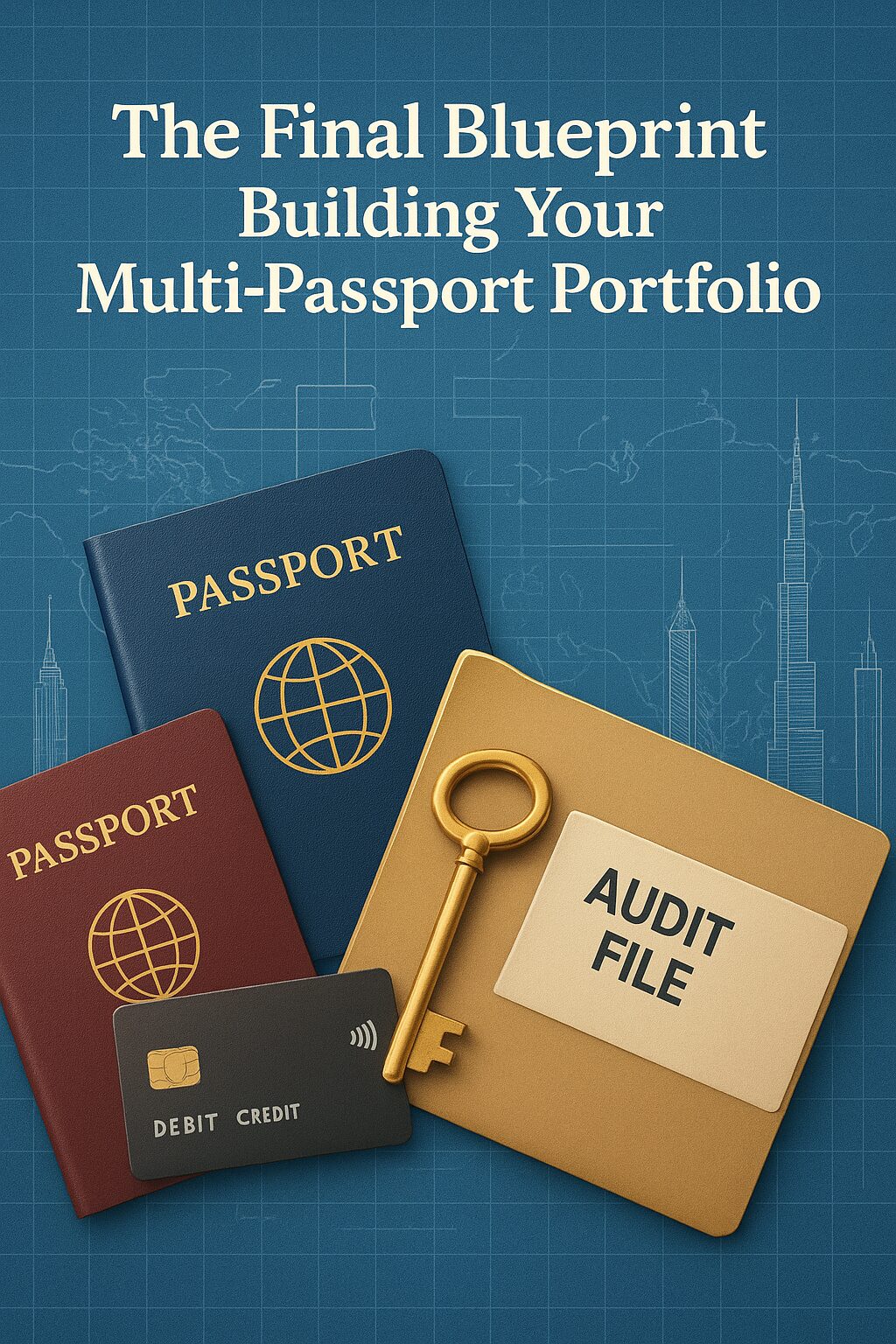
Passports, a golden key, a payment card, and an “Audit File” folder on a blueprint-style background with global skylines, symbolizing a layered multi-passport blueprint.

A complete, practical system for assembling passports, residencies, banking, and companies into one friction-light operating model (with copy-ready case stacks).

This isn’t a country list—it’s a construction manual for a life that moves smoothly across borders. You’ll assemble a stack that works under real scrutiny: a passport for mobility, a residency you can defend, and banking/company rails that partners and platforms actually trust. Then you’ll lock the whole system with an Audit File so reviews, renewals, and onboarding stay green.

Who it’s for: founders who sell in one market while living in another, creators who need payout stability, traders who face constant compliance checks, and global families that want mobility and a stable base for school and healthcare. No theory, no fluff—just components that click together and keep working.

What you’ll get: a layered blueprint (Mobility → Residency → Rails → Stability), a milestone ladder that uses order—not dates, copy-ready stacks for different profiles, practical playbooks you can run as-is, a simple decision matrix to choose jurisdictions, and paste-ready templates for KYC, PE governance, and your Audit File.

How to use it: pick one primary outcome—mobility, banking reliability, market access, or family stability—then follow the milestones in order. Start with one base you’ll actually live in, add the mobility you’ll actually use, build rails that actually pay you, and keep evidence that actually convinces reviewers. By the end, you’ll know what to build first, how to prove it, and how to expand without drama.

Read this first: how to use this blueprint

This is a construction manual, not a lecture. You’ll:

  • design a passport + residency stack that fits your life,
  • build banking and company rails partners actually trust, and
  • maintain a clean Audit File so approvals, renewals, and bank reviews stay green.

Everything below is evergreen (no time-limited references) and written so readers can apply it immediately—founders, creators, traders, and global families alike.


The architecture (4 layers that snap together)

  1. Mobility Layer (Passports & Long-Stay Rights)
    Purpose: stop begging consulates and move freely where you actually do life and business.
    Tools: ancestry routes, naturalization via residency, and—if you need instant lift—reputable investment routes.
  2. Life & Tax Layer (Residency Base)
    Purpose: a place you can really live, bank, insure, school, and file with clear rules.
    Tools: residency by investment, talent/entrepreneur permits, lifestyle visas with documented substance.
  3. Business Rails (Company & Banking)
    Purpose: invoice clients, receive payouts, hire, and pass KYC with minimal friction.
    Tools: parent + subsidiary structure, two-region banking, PSP diversification, PE/CFC governance.
  4. Stability Layer (Custody, Estate, Evidence)
    Purpose: asset continuity, stress-free audits, and next-gen planning.
    Tools: custody accounts, simple holdings/optional trusts, notarized evidence, yearly Statement of Assets & Liabilities.

Rule of thumb: A passport opens doors. A residency decides the bill. Rails get you paid. Evidence keeps every reviewer comfortable.


Milestone ladder (order only, no dates)

Milestone 1 — Clarity

  • One page: Goal → People → Income Sources → Target Markets.
  • Pick one Primary Outcome to start: mobility / banking reliability / market access / family stability.

Milestone 2 — Mobility Anchor

  • Choose first passport route: ancestry if eligible; otherwise naturalization track; if you need instant mobility, a reputable investment route.
  • Create a Documents Vault: civil records, apostilles, police clearances, certified translations, standardized name spellings.

Milestone 3 — Residency Base

  • Pick one country you’d truly live in.
  • Secure lease, utilities, local number, health insurance; obtain local ID/tax number where applicable.
  • Start the Audit File: day-count logs, bills, school/clinic letters, bank letters—everything as PDFs.

Milestone 4 — Banking & PSP Pack

  • Open two banks in two regions + one EMI/PSP.
  • Split income streams: ads/sponsorships/products or performance/licensing/merch—separate accounts and invoices.
  • Build a zipped KYC Bundle: passport(s), address proof, source-of-funds narratives, contracts.

Milestone 5 — Company & PE Governance

  • Decide where management & control genuinely occur (board minutes, signature location, IP decisions).
  • If you sell in another region, spin a subsidiary there; keep R&D/management in your base.
  • Draft a PE memo: who does what, where, with which evidence (meeting logs, payroll, org chart).

Milestone 6 — Portfolio Expansion

  • Add a secondary residency or begin a citizenship track you can actually complete.
  • Open a second custody relationship in another region.
  • Refresh the Audit File and renewals cadence.

Copy-ready stacks (why they work, how to copy, risks)

Stack A — Founder: sell into a major market, live where you like

  • Passport: high-acceptance (ancestry if possible; investment route if speed needed).
  • Residency Base: predictable rules, good life fit.
  • Rails: parent where you truly manage and control; subsidiary in sales market; two-region banking.

Why it works

  • Investors and banks understand the separation: management in base, sales in market.
  • Personal taxes align with life; corporate taxes align with operations.

How to copy

  • Board minutes and signatures in your base; local payroll and customer contracts in the market.
  • Maintain a Sales Folder: country tax registrations, invoices, withholding receipts.

Risks

  • Accidental permanent establishment if you run core ops in the sales market without structure.

Stack B — Creator: platform-friendly, freeze-resistant payouts

  • Passport: mobility-strong.
  • Residency Base: fintech-positive; clear digital-business rules.
  • Rails: three accounts minimum—ads, sponsors, digital products—plus a backup PSP in a second region.

Why it works

  • PSPs love clean separation; fewer holds, faster settlements.

How to copy

  • Label accounts by stream; unique invoice sequences per stream; contracts stored in the Audit File.
  • Create a Content→Cash Map (channel → platform → payout).

Risks

  • One bank/PSP dependency; inconsistent name spellings across documents.

Stack C — Global Family: mobility first, then lifestyle

  • Passport: investment or ancestry route for immediate visa relief.
  • Residency Base: schools, healthcare, clear renewals.
  • Rails: two banks; insurance; pediatric/clinic registrations; Family Pack in the Audit File.

Why it works

  • Parents move freely; kids have a stable base for education and care.

How to copy

  • If budget allows: mobility first, lifestyle second.
  • If budget is tight: start with residency; add a second passport later via naturalization or ancestry.

Risks

  • Assuming school seats are automatic; forgetting to renew local evidence.

Stack D — Trader / Crypto: documentation beats suspicion

  • Passport: bank-friendly reputation.
  • Residency Base: explicit digital-asset guidance; mainstream banks.
  • Rails: two banks + one EMI; quarterly on-chain and exchange statement exports; realized P/L spreadsheet.

Why it works

  • When compliance asks, you send a single PDF bundle—review ends quickly.

How to copy

  • Consistent addresses and names; source-of-funds narratives for each inflow.
  • Standardize wallet labeling (personal vs business).

Risks

  • Mixed personal/business funds; unvetted offshore venues.

Stack E — Long-Term Investor / Family Office-Lite

  • Passport: high-trust for travel and custody onboarding.
  • Residency Base: rule-of-law financial hub with strong schools/hospitals.
  • Rails: holding company; two custody relationships; yearly Statement of Assets & Liabilities; Letter of Wishes.

Why it works

  • Clean structure → easy banking; predictable estate planning across borders.

How to copy

  • Even without a fortune: set a personal holding company, open a second custody/brokerage in another region, archive annual statements.

Risks

  • Over-engineering trusts without understanding reporting; heirs’ documents not prepared.

Expanded case studies (applied, specific, copy-able)

Case 1 — SaaS Founder: market access without life upheaval

Profile: sells to enterprise clients abroad; wants investor meetings and local sales presence.
Setup:

  • Residency in a base he enjoys; parent company there with real management.
  • Subsidiary in the sales market for contracts, payroll, support.
  • Two-region banking; board minutes signed in the base.
    Why it worked: investors saw governance clarity; banks saw clean PE separation.
    How to copy: write an Intercompany Services Agreement (R&D/management fees one way; sales margin the other), keep a PE memo with meeting logs.
    Risk control: don’t sign major customer MSAs outside your declared management location.

Case 2 — Creator Family: frictionless travel + stable school

Profile: two remote parents; young child.
Setup:

  • Mobility-strong second passport to erase visa friction.
  • Residency in a family-friendly country; School acceptance + pediatric clinic registrations.
  • Three-stream payouts (ads/sponsors/products) with separate accounts.
    Why it worked: the family had freedom and stability; PSPs loved the clean stream separation.
    How to copy: build a Family Pack PDF (enrollment letters, insurance cards, clinic visits, lease, utilities) and renew it with fresh documents regularly.

Case 3 — Touring Athlete: event taxes without chaos

Profile: prize money and sponsorships across many countries.
Setup:

  • Hub-city residency with clear filing rules; day-count log.
  • Separate contracts: appearance/prize vs sponsorship/licensing.
  • Treaty credit worksheets per event.
    Why it worked: source-withheld taxes were credited cleanly; sponsorship income didn’t contaminate prize accounting.
    How to copy: keep an Event Tax Folder per country: venue contract, settlement sheet, withholding slip, flight/hotel receipts.

Case 4 — Trader / Crypto: the instant-review bundle

Profile: high volume; compliance reviews frequent.
Setup:

  • Residency in a jurisdiction with explicit digital-asset guidance.
  • Banks in two regions + one EMI; quarterly on-chain & exchange exports; P/L sheet.
    Why it worked: every review received a single, labeled PDF bundle.
    How to copy: name files consistently: YYYY-Q#_ExchangeName_Statements.pdf, YYYY-Q#_WalletLabels.pdf, YYYY-Q#_RealizedPL.xlsx.

Case 5 — Real-Estate-Led Residency: visa value ≠ investment value

Profile: family wants EU lifestyle; budget finite.
Setup:

  • Chose a home they’d rent even with no visa; conservative maintenance reserve.
  • Family registrations (school, clinics) and insurance completed first month.
    Why it worked: the home penciled on its own; visa was a bonus.
    How to copy: underwrite at modest rent assumptions; pre-book school visits; store property and school documents in the Audit File.

Templates you can paste into your post (reader-usable)

A) Residency Narrative (one page)

  • Who I am: name, profession, family members included.
  • Why this base: lifestyle fit, market access, schools/healthcare.
  • Where I live: address, lease copy, utilities in my name, local number.
  • What I do here: management/creation/R&D activities; where sales/support occur.
  • Evidence: attached—ID/permit, lease, bills, insurance, bank letters, day-counts.

B) KYC Bundle (index page)

  1. Passports (all)
  2. Proof of address (lease + utilities)
  3. Source-of-funds narratives (salary, distributions, royalties, capital gains)
  4. Company docs (incorporation, shareholders, board minutes)
  5. Contracts (by income stream)
  6. Tax numbers and filings (as applicable)

C) PE (Permanent Establishment) Memo (outline)

  • Parent location: management & control evidence (meetings, signatures, IP).
  • Subsidiary location: sales/support staff, office lease, local taxes.
  • Intercompany pricing: services provided, rates, invoices.

D) Audit File — Folder structure

/AuditFile
/ID-Residency
/Lease-Utilities-Insurance
/DayCounts-Flights
/Family-School-Clinic
/Income-Streams
/Ads
/Sponsors
/Products
/Performance
/Licensing
/Bank-PSP
/Company-Governance
/Taxes
/Assets-Custody
Statement_of_Assets_Liabilities.pdf

Decision matrix (score before you move)

Score 1–5 for each candidate passport or residency; add totals:

  • Visa freedom you will actually use
  • Banking & PSP acceptance
  • Family fit (schools, care, language)
  • Cost you can live with (cash + attention)
  • Rules clarity (residency, reporting, renewals)
  • Treaty relevance to your income
  • Company alignment (can management really live there?)
  • Upgrade path (residency → citizenship)
  • Renewal logistics from abroad
  • Personal resonance (will you go back happily?)

Pick one base and one expansion. Build in that order.


Risk controls that protect the whole stack

  • Evidence > opinions: leases, utilities, day counts beat arguments.
  • Two of everything: two banks, two regions, two custody providers.
  • Stream separation: ads / sponsors / products (or performance / licensing / merch).
  • PE discipline: write where decisions happen; sign where you say you sign.
  • Name hygiene: identical spellings across all documents and platforms.
  • Policy changes: expect them; your edge is optionality, not prediction.

Three playbooks (step-by-step, no dates)

Playbook 1 — From Nowhere to Operating Base

  1. Choose one base you truly like.
  2. Lease, utilities, local number, health insurance.
  3. Bank #1 in base; EMI/PSP; Bank #2 in another region.
  4. Start Audit File; backfill twelve months.
  5. Route payouts by stream.

Playbook 2 — Market Access Without Life Uproot

  1. Keep management in base; document it.
  2. Form market subsidiary; local payroll for sales/support.
  3. Bank in market; treasury in base.
  4. PE memo + intercompany agreements.

Playbook 3 — Family Stability

  1. Secure school seat and clinic registrations.
  2. Insurance + Family Pack.
  3. Evidence cadence: bills, day counts, renewals.

What to publish alongside this post (reader value boosters)

  • Downloadable Audit File checklist (use the structure above).
  • Decision Matrix bullets (scorecard).
  • Three Playbooks (copy/paste).
  • Two Blueprints (SaaS Founder, Creator Family).
  • Internal links to your earlier posts on CBI, Golden Visas, Tax Residency, and Case Studies.

Conclusion: Build a system, not a souvenir

A passport is not the finish line—it’s the first layer. The win comes when you:

  • anchor a residency you can defend,
  • assemble rails that move money fast and clean, and
  • maintain evidence that keeps every reviewer comfortable.

Build in that order. Keep proof. Add options as you grow. That’s how a multi-passport portfolio compounds freedom and income together—without drama.


If you want, I can also deliver the featured image brief + WordPress SEO meta + Pinterest kit for this final blueprint post.

Case Studies — Celebrities, Billionaires, and Global Families

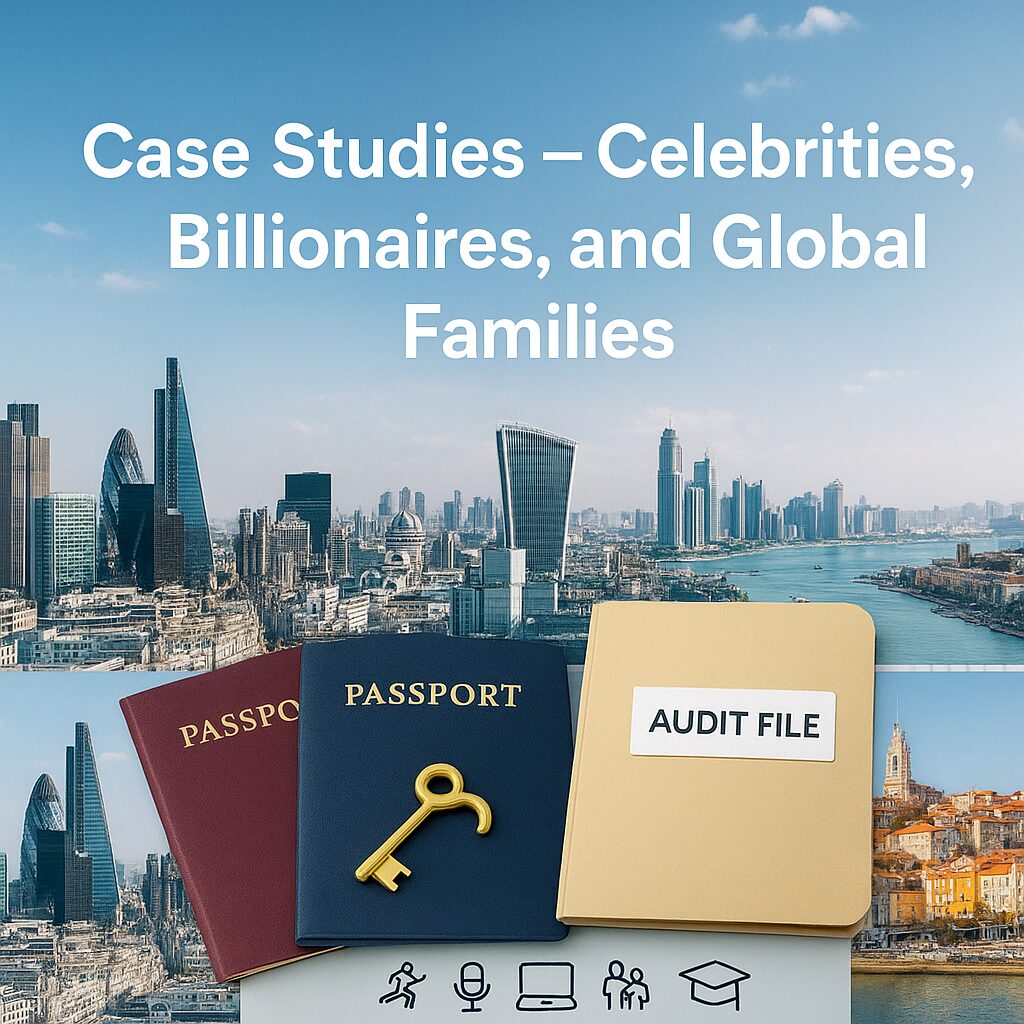
Passports, a golden key, and an “Audit File” folder over blended skylines of London, Dubai, Singapore, and Lisbon, symbolizing real global case studies across celebrities, billionaires, and global families.

Real setups you can copy (legally), what went wrong for others, and step-by-step plays you can run today.

Celebrities, billionaires, and global families don’t “collect flags”—they build stacks: a passport for mobility, a residency for life and taxes, and banking/company rails that partners actually trust. This casebook breaks down those stacks exactly as they’re used in the real world, then shows which parts you can copy on a normal budget.
You’ll see touring athletes, global musicians, tech founders, active traders, and multi-generational families—each with a clear Profile & Goal → Setup (passport, residency, banking, company) → Why it worked → How to copy → Risks.
No gossip, no time-limited rules—just evergreen plays that reduce visa friction, improve onboarding, and protect your time and cash flow. Pick a single outcome—mobility, banking reliability, market access, or family stability—and map one case onto your life. By the end, you’ll know which passport-plus-residency stack to build first and what to keep in your Audit File to keep everything clean and defensible.

How to use this casebook

Each case follows the same pattern so readers can copy, adapt, and execute:

  • Profile & Goal → what they needed.
  • Setup → passports, residencies, banking, company rails.
  • Why it worked → the tiny levers that moved everything.
  • How to copy (on a normal budget) → concrete steps you can take.
  • Risks to watch → the trap that kills approvals or triggers audits.

No gossip. No time-limited rules. Just evergreen strategies you can apply.


1) Touring Athlete — “Three engines: training, taxes, travel”

Profile & Goal
International athlete with prize money and sponsorships in multiple countries; needs frictionless travel, predictable taxation, and reliable banking.

Setup

  • Passport: High-mobility passport (by birth or ancestry) to reduce consulate visits.
  • Residency: A hub city with world-class facilities and clear tax rules.
  • Company: Separate entities for appearance fees, sponsorship/likeness, and merch.
  • Documentation: Day-count app + match schedules + flight stubs saved to a cloud “Audit File.”

Why it worked

  • Countries that host events withhold at source; the athlete used treaties to credit that tax in the residency country.
  • Sponsorship/likeness revenue flowed to a distinct contract and account, so it wasn’t confused with prize money.

How to copy

  1. Use one residency base with clear rules; log every night you sleep there.
  2. Split revenue: performance vs. brand vs. merch (separate contracts + accounts).
  3. Keep a treaty worksheet per event: gross → host withholding → credit at home.

Risks

  • “Center of life” left in the old country (spouse, lease, utilities) → residency challenge.
  • One bank for everything → a single compliance review freezes your season.

2) Global Musician / Touring Creator — “An itinerant business, not a hobby”

Profile & Goal
Concerts, digital royalties, sponsorships, and e-commerce all mixed; PSPs (payment processors) keep asking questions.

Setup

  • Residency: Creative hub city for visas, studios, and touring access.
  • Accounts: Three rails—royalties, e-commerce/merch, sponsorship/ads—with separate invoicing and payout.
  • Inventory: Merch handled by a third-party fulfillment partner to avoid unexpected permanent establishment.

Why it worked

  • PSPs saw clean separation of revenue types; fewer suspensions, faster settlements.
  • Host-country withholding on shows credited at residency base.

How to copy

  • Open 3 accounts now (royalties / shop / ads).
  • Build an “Event Tax Folder”: venue contract, withholding slip, settlement sheet.
  • Add one backup PSP in a second region.

Risks

  • “No tax anywhere” signaling → account freezes.
  • Bundling everything through one Stripe/PayPal → cash-flow risk.

3) Tech Founder — “US access without moving your whole life”

Profile & Goal
Sell into a major market and raise capital there, but keep personal life and taxes in a base you actually like.

Setup

  • Passport: A widely accepted passport; some founders add a treaty-eligible second passport to unlock investor visas.
  • Residency: Territorial or remittance-style base for predictable personal taxes.
  • Company: Parent company where management and control genuinely occur; subsidiary in the sales market for hiring and contracts.

Why it worked

  • Clear governance: board minutes and signatures in the parent’s jurisdiction; sales and support in the market.
  • Investors and banks understood who does what and where.

How to copy

  1. Decide whether your home or your base will be the real HQ (board meetings, IP, hiring).
  2. Put sales and customer service in the market via a subsidiary.
  3. Keep two banks: one in your base, one in the sales market.

Risks

  • Creating an accidental permanent establishment by running core operations in the sales market without structure.

4) Family Office / Long-Term Investor — “Education, custody, continuity”

Profile & Goal
Protect capital, secure top education for kids, simplify cross-border banking.

Setup

  • Residency: A rule-of-law financial hub with strong schools and hospitals.
  • Structure: Holding company (and sometimes a trust) separating ownership from management.
  • Banking: Two custody relationships in different regions; reporting ready for information-exchange regimes.

Why it worked

  • Clean structure → easy bank onboarding; predictable estate planning.
  • Family has access to international schools and medical care without visa drama.

How to copy

  • Even on a normal budget, you can:
    • Create a personal holding company for investments.
    • Start a school + healthcare file (acceptance letters, insurance cards).
    • Keep a simple Statement of Assets & Liabilities updated yearly.

Risks

  • Treating “visa property” like a guaranteed investment.
  • Inheritance plans only in your head, not on paper.

5) Global Family — “Mobility first, then lifestyle”

Profile & Goal
Parents still work online; child needs long-term schooling; everyone wants frictionless travel.

Setup

  • Second passport via an investment route for immediate mobility.
  • Residency in a family-friendly country for school enrollment, pediatric care, and community.
  • Internal links between their own articles, so the plan remains organized and defensible (for the blog—and for the family’s paperwork).

Why it worked

  • The passport removed visa friction; the residency delivered real life (school, clinics, leases).

How to copy

  • If budget allows: mobility (passport) → lifestyle (residency).
  • If budget is tight: start with a residency that has long-stay visas and later add a second passport via ancestry or naturalization.

Risks

  • Assuming school seats are automatic—apply early and keep all letters.

6) Crypto / Active Trader — “Documentation wins the bank interview”

Profile & Goal
High transaction volume; compliance questions never stop.

Setup

  • Residency: Jurisdiction with clear digital-asset rules and access to multiple compliant banks.
  • Evidence: Source-of-funds trail, on-chain analytics snapshots, exchange statements, tax filings.
  • Banking: Two banks + one EMI in different regions.

Why it worked

  • When reviews came, the client emailed a single PDF bundle—case closed.

How to copy

  • Keep a quarterly export of exchanges, wallets, and realized gains/losses.
  • Use consistent naming across passports, accounts, and platforms.

Risks

  • Mixing personal and client funds.
  • Failing to track which wallets are yours (and which are business).

7) International Professional (Doctor, Professor, Engineer) — “Credential portability + visas”

Profile & Goal
Remote research or consulting, frequent conferences, flexible residency.

Setup

  • Residency: University or hospital hubs with straightforward residence permits.
  • Contracts: Split between research, clinical/consulting, and speaking; separate invoicing.
  • Paper trail: Professional licensing, insurance, and conference invitations.

Why it worked

  • Visas issued smoothly; tax filings clean due to differentiated income types.

How to copy

  • If you consult, separate advisory from speaking, and keep invitations and agendas in your Audit File.

Risks

  • Letting “temporary” gigs stack up in one country → accidental residency.

8) Real-Estate-Led Residency — “Lives there… and still invests like an adult”

Profile & Goal
Family wants EU lifestyle; budget is finite.

Setup

  • Residency: Property-linked route with modest physical stay rules.
  • Investment rule: Buy a home you’d rent even without the visa; no yield promises.
  • Finances: Fixed-rate mortgage if available; conservative maintenance reserve.

Why it worked

  • Visa goal and investment goal were decoupled. The home made sense on its own.

How to copy

  • Underwrite the home as if there were no visa.
  • Keep vacancy, repairs, and tax assumptions conservative.

Risks

  • Developer-sold “guaranteed yields.”
  • No exit plan (liquidity matters).

Cross-cutting lessons (the patterns behind the people)

  • Passport ≠ tax residency. Your tax base is chosen with day counts, leases, family location, utilities, and real substance.
  • Separate income streams (ads, sponsors, merch, consulting). That alone lowers compliance friction.
  • Two-region banking beats one fancy bank. Diversify PSPs for payout stability.
  • Paper trumps opinions. Keep leases, utility bills, school/clinic cards, travel logs, board minutes.
  • Treaties help—but only if your facts fit the tie-breaker ladder. Engineer your permanent home and center of vital interests before you move.

Ready-to-run “stacks” (copy one, then adapt)

Stack A — US Sales Founder

  • Passport: high-acceptance (treaty-eligible helps).
  • Residency: territorial/remittance base.
  • Rail: US subsidiary for sales; parent where management actually occurs.
  • Banking: base + US.
  • Win: market access without moving your whole life.

Stack B — EU Build + Education

  • Passport: ancestry or naturalization track; CBI for mobility if needed.
  • Residency: EU hub for schools and talent.
  • Rail: EU entity for grants and hiring.
  • Win: kids in school, parents mobile, business credible.

Stack C — Nomad Creator

  • Passport: mobility-strong.
  • Residency: one lifestyle base for clarity.
  • Rail: three revenue accounts (ads/sponsors/products).
  • Win: fewer PSP holds, predictable filings.

Stack D — Family Safety Net

  • Passport: investment route covering spouse + kids (+ sometimes parents).
  • Residency: healthcare + school ecosystem.
  • Rail: two banks, one custody if investing.
  • Win: mobility first, life second.

The “Audit File” (make this once)

Create a folder for each year with:

  • Lease/utility/insurance/ID copies
  • School or healthcare letters
  • Day-count exports + flights/boarding passes
  • Contracts (by revenue type) + invoices
  • Bank KYC bundle (ID, address, source-of-funds)
  • Board minutes and signature logs (if you run a company)
  • Withholding slips for events/sales abroad + your treaty credits worksheet

When someone asks, you email one ZIP. Green check.


Your 7-Day Action Plan (readers can actually do this)

Day 1 — Pick your primary goal: mobility / banking / family / market access.
Day 2 — Shortlist two residency bases you’d truly live in.
Day 3 — Map your revenue streams and split accounts accordingly.
Day 4 — Open a second bank/PSP in another region.
Day 5 — Start your Audit File and load the last 12 months.
Day 6 — Draft a one-page Residency Narrative (where you live, why, and evidence).
Day 7 — Add three internal links: from this post to (1) CBI guide, (2) Golden Visa guide, (3) Tax Residency guide.


Conclusion: Tools, not trophies

A passport opens doors. A residency gives you a home. A clean company + banking rail gets you paid.
Put those three in the right order—with proof—and your life becomes friction-light and opportunity-heavy.


📌 Next Article Preview — The Final Blueprint: Building Your Multi-Passport Portfolio

You’ve seen what works. Next, we assemble the exact timeline to build your own stack—quarter by quarter—so you can compound mobility, credibility, and cash flow. Miss that, and you’ll keep collecting pieces without ever finishing the machine.

Second Passports for Entrepreneurs & Digital Nomads

Passports and boarding pass over blended skylines of Singapore, Lisbon, Dubai, and London, symbolizing second-passport mobility for entrepreneurs and digital nomads

A practical playbook with real-world cases, mistakes to avoid, and ready-to-use decision tools


Why founders and nomads build a “passport stack”

A second passport isn’t a vanity trophy. Used right, it’s a business instrument: it removes visa friction, opens banking rails, lowers operational risk, and gives your family a safety net. The goal isn’t to disappear—it’s to operate globally without unnecessary bottlenecks.

This guide shows how entrepreneurs and digital nomads are actually getting and using second passports—what worked, what backfired, and how you can copy the playbook legally and confidently.


1) What a second passport really changes (and what it doesn’t)

It changes:

  • Mobility: fewer consulates, more last-minute flights, longer visa-free stays.
  • Banking & compliance: easier onboarding in some regions; more options when one jurisdiction tightens rules.
  • Business access: investor visas, founder programs, free-trade areas.
  • Resilience: backup consular support, alternative evacuation routes, fewer single-country dependencies.

It doesn’t change:

  • Where you owe taxes (that’s tax residency, not citizenship).
  • Corporate obligations (permanent establishment, VAT/GST, CFC rules still matter).
  • KYC/AML visibility (CRS/FATCA style reporting means secrecy is gone).

Use a second passport as optionality, not as a hiding place.


2) Pathways to a second passport (ranked by practicality)

  1. Ancestry routes
    • If a parent/grandparent held a certain nationality, you may qualify.
    • Pros: Low cost, high-trust passports, often fast once documents are set.
    • Cons: Paperwork heavy; requires certified lineage proof.
    • Who uses it: Founders with European/Latin roots looking for EU mobility or easier investor visas.
  2. Naturalization via residency
    • Live legally in a country long enough → become eligible to apply.
    • Pros: Widely available; integrates life, business, education.
    • Cons: Time; minimal language/civics tests in many places.
    • Tip: Pair with a friendly tax base to make the waiting years profitable.
  3. Citizenship by investment (CBI)
    • Government-approved contribution or investment → citizenship.
    • Pros: Speed, family coverage, mobility boost.
    • Cons: Capital cost; banking perception varies by country.
    • Best for: Frequent travelers who need immediate visa freedom.
  4. Marriage/descendant of nationals
    • Legal marriage or special descent categories.
    • Pros: Low cost.
    • Cons: Time, genuine relationship required; strict anti-fraud rules.
  5. Special contribution/merit
    • Exceptional talent, economic contribution, national interest.
    • Pros: Tailored, prestigious.
    • Cons: Rare; case-by-case.

Rule of thumb: If you can use ancestry, take it. If you need speed, CBI. If you want long-term EU or structured life change, residency → naturalization.


3) Entrepreneur & nomad use-cases (with mini-cases you can model)

A. The “US market access” founder

  • Goal: Build in/with the US without a green card.
  • Stack: Second passport that qualifies for a treaty investor visa + low-tax residency base.
  • Case: Logistics SaaS founder acquires Turkish citizenship (qualifies for a treaty investor route), opens a US entity, relocates a small US team, keeps personal residency in a territorial-tax base.
  • Result: US operations + optimized personal tax + diversified banking.

B. The “EU sell-in” B2B startup

  • Goal: Seamless Schengen travel, investor meetings, EU talent.
  • Stack: EU second passport (ancestry or naturalization) or a strong CBI + EU residency.
  • Case: Korean game studio CEO obtains ancestry-based EU passport through a grandparent, bases product team in an EU hub, accesses local grants and university hiring pipelines.
  • Result: Faster visas for staff, cheaper student-to-hire funnels, easier sales trips.

C. The “Nomad family”

  • Goal: Stable schooling/healthcare + visa-free mobility for parents.
  • Stack: CBI for mobility + residency in a family-friendly country.
  • Case: Remote marketer + designer couple secure a Caribbean passport for travel ease and long-stay EU trips; they hold residency in a Mediterranean country for their child’s schooling.
  • Result: Easy travel, affordable education, multiple safe harbors.

D. The “Payments & Banking reliability” freelancer

  • Goal: Reduce onboarding rejections, diversify payout corridors.
  • Stack: Second passport from a bank-friendly jurisdiction, residency in a FinTech-friendly base.
  • Case: YouTube educator adds a second passport recognized widely by European PSPs, keeps residency where marketplaces onboard quickly, spreads income across 2–3 compliant institutions.
  • Result: Fewer account freezes, quicker settlement, better FX.

E. The “FX & sanctions risk” hardware trader

  • Goal: Keep supply chain and payments open.
  • Stack: Second passport + company in neutral trade hubs + residency in a non-sanctioned corridor.
  • Case: Parts exporter facing rising restrictions secures a neutral second passport; re-papers supply contracts via a trade hub; moves personal residency to a pragmatic logistics center.
  • Result: Carriers accept shipments, banks retain the account, margins survive.

4) How to evaluate passport “quality” (without getting lost in tables)

  • Visa-free reach (Schengen, UK, Japan, Singapore are big multipliers).
  • Bank onboarding reputation (does the passport trigger extra checks?).
  • Consular protection (crisis evacuation, minor incident help).
  • Bilateral treaty network (investor/worker/study programs you care about).
  • Name-change, dual citizenship policies (avoid conflicts; know the rules).
  • Family coverage (spouse, kids, sometimes parents).
  • Renewal distance (can you renew abroad easily?).

Reality: Two passports with similar “visa counts” can be worlds apart in banking and immigration pathways. Ask banks/agents what they see right now.


5) End-to-end acquisition plan (field-tested)

  1. Goal design
    • Rank goals: mobility, banking, US/EU access, family, taxes, asset security.
  2. Shortlist 2–3 routes
    • Ancestry (check civil registries), residency → citizenship, or CBI.
  3. Document vault
    • Birth/marriage certificates (apostilled), police clearances, proof of funds, translations.
    • Scan to a cloud vault; keep notarized hard copies.
  4. Licensed professionals only
    • Use government-licensed agents/lawyers. No WhatsApp shortcuts.
  5. Banking/CRS plan
    • Decide which accounts go under which citizenship; keep source-of-funds trails pristine.
  6. Timeline realism
    • Parallelize: while ancestry docs are processed, set up residency and life admin.
  7. Family coordination
    • School calendars, healthcare registrations, spousal documents synchronized.
  8. Comms discipline
    • Keep a master file: receipts, emails, day logs, courier tracking, stamped copies.

6) 12 common mistakes (and the fix)

  1. Thinking “passport = tax change.” → Fix: separate citizenship from tax residency planning.
  2. Using unlicensed intermediaries. → Fix: verify licenses on government portals.
  3. Treating CBI properties as guaranteed investments. → Fix: underwrite like there’s no visa.
  4. Over-optimizing and under-living. → Fix: choose places you’ll actually spend time in.
  5. Ignoring family ties. → Fix: spouse/kids often decide your “center of life.”
  6. No exit plan. → Fix: ask “How do I renew? Sell? Downgrade?” before you start.
  7. Banking mismatch. → Fix: pick passports/residencies that your target banks like.
  8. Forgetting treaty nuances. → Fix: if a treaty matters to you, confirm it exists and fits your pattern.
  9. Sloppy evidence. → Fix: timestamped leases, utility bills, travel logs, doctor/dentist registrations.
  10. One-bank risk. → Fix: 2–3 institutions across 2 regions.
  11. Name spelling inconsistencies. → Fix: exactly match all documents (passports, cards, contracts).
  12. Assuming rules never change. → Fix: build optionality—two routes, two bases.

7) Founder-grade “passport stacks” you can copy

A “stack” = second passport + residency base + business rail that work together.

Stack 1 — US Access + Tax-Light Personal Base

  • Passport: Treaty-eligible second passport
  • Residency: Territorial/low-tax base
  • Business rail: US entity + compliant payroll/PE planning
  • Who: SaaS/B2B founders selling into the US.

Stack 2 — EU Build + Education

  • Passport: EU via ancestry or naturalization track
  • Residency: EU hub city for team + school access
  • Business rail: EU company for grants/talent visas
  • Who: Deep-tech, gaming, creative studios.

Stack 3 — Nomad Creator

  • Passport: Mobile-friendly CBI or ancestry
  • Residency: Stable, lifestyle-friendly base with clear tax rules
  • Business rail: Platform payouts across 2–3 PSPs
  • Who: YouTubers, newsletter writers, course creators.

Stack 4 — Trade & Supply-Chain Resilience

  • Passport: Neutral second passport
  • Residency: Logistics hub
  • Business rail: Company in trade-friendly jurisdiction + multi-currency accounts
  • Who: Hardware/parts exporters, import-export founders.

Stack 5 — Capital & Banking Optimization

  • Passport: High-reputation passport for onboarding
  • Residency: Financial hub with robust investor base
  • Business rail: Brokerage + custody across 2 regions
  • Who: Traders, fund managers, high-volume affiliates.

8) Deep-dive case studies

Case 1 — Ancestry to EU, Startup to Scale-up

A developer discovers a grandparent born in Europe. He assembles civil records, hires a licensed lawyer, and obtains an EU passport. He then opens a small studio in an EU capital, hires graduates via internship pipelines, and lands an R&D grant. Travel to investor meetings becomes trivial.
Key levers: ancestry route; university hiring; grant ecosystem.
Pitfall avoided: Didn’t assume tax change—he re-established tax residency step-by-step.

Case 2 — CBI for Mobility, Residency for Family

A remote couple with a young child needs long-stay flexibility. They choose a reputable Caribbean passport to drop visa friction, then secure residency in a Mediterranean country for schooling and healthcare. They vacation across Schengen without consulates.
Key levers: instant mobility + lifestyle residency.
Pitfall avoided: Didn’t overpay for trophy real estate; rented first.

Case 3 — Bank-Friendly Stack for a Creator Business

A content creator faced repeated PSP rejections. She added a second passport from a bank-friendly jurisdiction, obtained residency in a fintech-positive base, and opened accounts at two institutions plus a backup EMI. Disputes and holds dropped; settlement times improved.
Key levers: passport perception; diversified payout rails.
Pitfall avoided: Kept airtight source-of-funds documentation.

Case 4 — US Entry Without Immigration Drama

A founder wants US clients and a small US sales team. He acquires a treaty-eligible passport, qualifies for an investor route, and launches a US subsidiary. Personal residency stays in a low-tax base, while corporate PE is planned with advisors.
Key levers: treaty eligibility; PE planning; dual-region ops.
Pitfall avoided: Didn’t mix personal and company funds; clean governance.

Case 5 — The Over-Optimized Nomad (what went wrong)

A videographer tried to be “nowhere”—short stays everywhere, no real base. A country still claimed tax residency on center-of-life grounds (partner, storage unit, local doctor). One PSP froze funds after an address mismatch.
Fix: He chose a real base, documented presence, aligned bills and licenses, and unfroze accounts with a clean paper trail.


9) Your personal decision matrix

Score each item 1–5 (low→high), then add up for each candidate passport/residency:

  • Visa freedom importance
  • Banking & PSP acceptance
  • Family schooling/healthcare fit
  • Language/culture fit
  • Time-to-acquire / admin effort
  • Cost (cash + opportunity)
  • Pathway to third-country visas (e.g., investor routes)
  • Dual citizenship policy compatibility
  • Renewal logistics from abroad
  • Treaty network relevance to your income sources

Pick the top two, then validate with a licensed provider.


10) “Do this now” checklist

  • Make a documents kit (scans + notarized originals).
  • Pull civil records for ancestry eligibility.
  • Shortlist two second-passport routes and one residency base.
  • Open an audit folder: leases, utilities, day logs, flight stubs.
  • Map banking plan (which passport opens which bank).
  • Book calls with licensed firms only; verify license numbers.
  • Decide your Next Article link placement in-post (3x internal links to the series hub).

Conclusion: Build a passport stack, not a passport trophy

Entrepreneurs and digital nomads win by stacking:

  1. a second passport that reduces friction,
  2. a residency base that fits taxes and life, and
  3. business rails that banks and partners trust.

Do it once, document everything, and your operating surface becomes global—with fewer lines, fewer “come back later” emails, and more green lights where it counts.


📌 Next Article Preview

Case Studies – Celebrities, Billionaires, and Global Families
You’ve seen the frameworks—now see how high-profile people choreograph multi-passport and multi-residency setups (and what parts an ordinary family can copy without the billionaire budget). We’ll break down bank onboarding, school moves, and the exact order of operations.
Miss it, and you’ll miss the shortcuts.

Tax Residency vs. Citizenship — What’s the Difference?

Passport versus home lease and utility bills with city skylines, illustrating the difference between citizenship and tax residency

A practical, real-life guide to keep more of your money while staying fully compliant

Why this matters (and why so many get burned)

Lots of smart people mix up tax residency with citizenship. They get a new passport, fly to a sunny place, and assume their taxes magically vanish. Then a letter arrives: “We think you still owe us.”
This guide fixes that—step by step, case by case—so you can design a global life that’s legal, practical, and profitable.


1) First principles (super clear, no jargon)

  • Citizenship = your nationality (the passport you hold). It gives you political rights and consular protection.
  • Tax residency = the country that can tax your worldwide income because you live there (by its rules).

Key idea: Passports don’t decide taxes. Presence, ties, and domestic rules do.


2) How countries decide tax residency (the real levers)

Most countries use one 또는 several of these tests:

  1. Days test (physical presence)
    • The classic 183-day rule (roughly half a year).
    • Many countries also use rolling 12-month or 4-year look-back tests.
  2. Permanent home
    • Do you have a place you can return to anytime (owned or rented, even long Airbnb)?
    • If yes, that’s a strong residency signal.
  3. Center of vital interests
    • Where are your family, main home, business, bank accounts, clubs, doctor, driver’s license, phone bills?
  4. Habitual abode
    • Where do you usually spend time over several years?
  5. Nationality (tie-breaker only)
    • Used late in the analysis when treaties apply and everything else is still unclear.

Reality check: You can be non-resident for taxes in your home country without changing citizenship. And you can be resident for taxes in a country where you hold no passport.


3) Three very different tax systems (pick your playground)

  1. Citizenship-based taxation
    • A tiny club (famously, one very large country) taxes citizens wherever they live.
    • Residents still file; citizens abroad must file and often pay (with credits/exclusions available).
  2. Residency-based worldwide taxation
    • The majority. Become a tax resident → your worldwide income is taxable there.
  3. Territorial or remittance-style systems
    • Tax mainly local-source income (and/or foreign income when remitted).
    • Popular with entrepreneurs and mobile professionals—but rules are nuanced.

4) Double Tax Treaties (DTT) and the tie-breaker ladder

When two countries both claim you, a treaty (if one exists) applies a ladder:

  1. Permanent home → 2) Center of vital interests → 3) Habitual abode → 4) Nationality → 5) Mutual agreement between tax authorities.

Action tip: If you plan to shift residency, engineer this ladder in your favor (cancel lease, move family, cut local utilities, open utilities in the new place, etc.).


5) The seven myths that cost people money

  1. “I got a second passport, so I’m taxed there now.” → False.
  2. “If I never spend 183 days anywhere, I’m tax-free.” → Often false. Center-of-interest rules bite.
  3. “Remote income isn’t taxed where I live.” → Usually taxed if you’re resident.
  4. “My company is offshore, so I’m safe.” → CFC rules + permanent establishment risks.
  5. “A treaty will always save me.” → No treaty? Domestic law wins.
  6. “Digital nomad visas mean zero taxes.” → They’re residency by definition.
  7. “Bank secrecy protects me.” → CRS and information exchange changed the game.

6) Case studies (wins + avoidable mistakes)

Case A — The Dubai move that actually works

Profile: Indian SaaS founder.
Plan: Residency in a no-income-tax jurisdiction; substance for the company outside high-tax zones.
Moves that mattered:

  • Set up real office and full-time staff; obtained local lease and utility bills.
  • Migrated personal primary home and schooling for kids.
  • Kept meticulous day-count logs.
    Result: Clear facts → strong non-residency arguments elsewhere, legitimate low-tax base.

Case B — The second passport that didn’t change taxes

Profile: Korean entrepreneur; obtained a Caribbean passport for travel.
Assumption: “New passport = new taxes.”
Reality: Spent most time in Seoul; family, house, accounts stayed.
Outcome: Still Korean tax resident. Passport ≠ tax move.
Fix: Reduce days, relocate family later, close local lease, demonstrate new center of life before asserting non-residency.

Case C — EU prestige, Italian taxes

Profile: Marketing exec gained EU citizenship via ancestry, then lived in Milan.
Outcome: Proud passport holder and Italian tax resident (worldwide income taxed).
Lesson: If you live in a country, expect taxation there—passport prestige doesn’t override residency rules.

Case D — The “183-day everywhere” fail

Profile: YouTuber rotates 3–4 countries, thinking he’s nowhere.
Issue: One country used habitual abode + vital interests (girlfriend, gear, storage unit) to claim residency; another taxed local ad income; no treaty to protect.
Result: Double trouble.
Fix: Choose one base, structure contracts and company PE carefully, keep evidence.

Case E — Real estate “guaranteed yield” trap

Profile: Investor bought “Golden Visa” property in a tourist town.
Problem: Developer inflated valuations; rentals collapsed.
Tax wrinkle: Residency obtained, but property loss + unexpected local taxes.
Lesson: Visa goals ≠ investment goals. Underwrite as if there’s no visa.


7) Designing your tax-residency plan (the blueprint)

Step 1 — Define the why

  • Mobility? Education? Tax reduction? Asset protection? Business proximity?

Step 2 — Choose your base jurisdiction (facts that matter)

  • Tax system (residency vs territorial).
  • Treaty network with your home/market countries.
  • Banking, schools, healthcare, language, lifestyle.
  • Path to permanent residence/citizenship if you want it.

Step 3 — Build substance (be real, not paper)

  • Lease or purchase; utilities in your name.
  • Local phone, cards, doctor, gym, associations.
  • If business: staff, office, decision-making onshore.

Step 4 — Exit your old tax residency cleanly

  • End leases, deregister utilities, move family (if possible).
  • Close local employer registrations; update mailing address.
  • Handle exit taxes if applicable; pay final bills.

Step 5 — Day-count discipline

  • Track every night. Keep flight tickets, hotel invoices, passport stamps, app logs.
  • Back up to cloud. If audited later, you’ll thank yourself.

Step 6 — Corporate alignment

  • Where is the company managed and controlled?
  • Avoid creating permanent establishment (salespeople, warehouses, servers in high-tax locations).
  • Study CFC rules where you could be resident.

Step 7 — Banking & payments

  • Open accounts in your base; keep proof of address updated.
  • Clean money flows: personal ↔ company ↔ investments are clearly documented.

Step 8 — Asset holding & trusts (optional, advanced)

  • Use holding companies or trusts for succession and privacy, not tax evasion.
  • Check reporting: many structures are transparent for tax purposes.

Step 9 — Reporting calendar

  • Register for tax IDs where needed.
  • Note filing dates for returns and foreign asset reports.
  • Save all logs for 7–10 years.

8) Picking your base (quick matrix)

GoalStrong OptionsWhat to watch
Simple, low personal taxTerritorial / low-tax basesSubstance + banking reputation
EU mobility + educationEU residenciesDay-count + center-of-interest
US market accessTreaty-friendly residencies, E-visasPE risk if team operates in US
Nomad flexibilityTerritorial/remittance systemsDon’t become “accidental resident” elsewhere

Remember: the “best” base is the one you can really live in and prove you live in.


9) Family realities most people forget

  • Spouse & kids often decide your “center of vital interests.”
  • School contracts, pediatrician visits, local sports clubs = big signals.
  • If your family stays put, you may still be resident there—no matter your travel.

10) Corporate & freelance structures (keep it clean)

  • Freelancers: place core ops where you are tax resident; avoid invoicing from places where you spend time without registering.
  • Companies: align management & control with your base. Board meetings, key decisions, and signatures should happen there.
  • Sales in other countries? Check VAT/GST and PE thresholds early.

11) Information exchange (the invisible web)

  • CRS: over 100 jurisdictions share bank and asset data automatically.
  • One big non-participant uses FATCA instead; its banks report to it, not to CRS.
  • Translation: assume accounts are visible. Hide-and-seek doesn’t work.

12) The 12-point checklist to change tax residency

  1. New lease/purchase + utilities in your name
  2. Local phone + health insurance
  3. Register for local tax ID (if required)
  4. Open local bank/investment accounts
  5. Move family or document why not (school letters help)
  6. Cancel/transfer old lease and utilities
  7. End old club memberships; update driver’s license
  8. Update billing addresses (cards, PayPal, platforms)
  9. Notify old tax authority if that’s a formal process
  10. Track days religiously (apps + physical evidence)
  11. Re-paper company governance to your new base
  12. Keep an audit file (PDF folder) for each year

13) Red flags that trigger audits

  • “No tax anywhere” lifestyle.
  • Offshore company but all sales/meetings in a high-tax market.
  • Claiming non-residency while spouse/kids, house, car, dog stay put.
  • Permanent home and local employment in your “old” country.
  • Big asset sales near your move date without clean documentation.

14) Smart savings (legal, simple, compounding)

  • Pair a territorial/remittance base with global investing.
  • Use treaties to cut withholding on dividends/interest.
  • Align citizenship planning with residency (you can keep your passport while lowering taxes—if the facts support it).
  • Reinvest the delta into index funds, second-home equity, or your own business.

15) Quick FAQ

Q. Do I need a second passport to change tax residency?
A. No. A lease and real life in a new country matter more than a new passport.

Q. Can I be tax resident in two places at once?
A. Yes. A treaty (if any) decides who wins. Without a treaty, double tax is possible.

Q. Is a “zero-tax” base always best?
A. Not for everyone. Banking, family life, and market access can be worth moderate tax.

Q. How do I prove non-residency in my old country?
A. End ties, reduce days, document everything, and—if formal—file the non-residency paperwork.


Action plan you can start today

  1. Pick your target base (fit > hype).
  2. Schedule 30 days on the ground to set up lease, ID, banking.
  3. Build your audit file from day one.
  4. Re-paper company management to your base.
  5. Track days forever. This is a habit, not a project.

Conclusion: Citizenship is identity. Tax residency is strategy.

Your passport opens doors. Your residency decides the bill.
Design them together and you get freedom, safety, and surplus cash flow—the compounding engine behind global wealth.


📌 Next Article Preview

Second Passports for Entrepreneurs & Digital Nomads
Most people chase the “strongest” passport. Winners design a stack: the passport that protects you, the residency that optimizes taxes, and the business base that attracts capital.
In the next chapter you’ll see exact passport + residency combos used by founders, creators, and global families—plus the traps that quietly kill approvals and bank onboarding. Miss it, and you’ll build an expensive setup that banks (and investors) don’t trust.

Residency by Investment – Golden Visas Explained

Golden Visa residency programs in Europe, UAE, and Asia with passports, city skylines, and investment lifestyle concept

Why Residency by Investment Is the Real Game-Changer

Most people dream about holding a second passport, but here’s a surprising truth: residency often matters more than citizenship.
Why? Because residency gives you the right to live, invest, and build your life in another country, and in many cases, it naturally evolves into full citizenship.

Golden Visas—formal Residency by Investment (RBI) programs—are becoming the strategic choice of global entrepreneurs, families, and even middle-class digital nomads. They are cheaper, less controversial than Citizenship by Investment, and often lead to the same outcome.


1. How Residency by Investment Works in Practice

Residency by Investment means:

  • You put money into a country’s economy—real estate, government bonds, startups, or funds.
  • The government grants you long-term residency rights (often 5–10 years, renewable).
  • You gain access to schools, healthcare, banking, and in many cases, regional travel freedom.
  • After a qualifying period, you may apply for citizenship.

Key insight: RBI is not a loophole. It’s a strategic policy that countries use to attract stable capital and talent.


2. Europe – The Golden Standard for Golden Visas

Europe dominates the RBI landscape. Let’s break down the most practical options.

Portugal Golden Visa

  • Investment Options: €500,000 in funds, €250,000 in cultural projects, or job creation.
  • Residency Requirement: Just 7 days per year.
  • Path to Citizenship: 5 years → full EU citizenship.
  • Case Study (Success): A Korean game developer bought into a Lisbon venture fund. With only minimal physical stay, he secured Portuguese residency and later citizenship. His kids gained access to top EU universities at local tuition rates.
  • Case Study (Failure): A Chinese investor bought overpriced real estate in Porto through an unlicensed agent. Property values dropped, and while he gained residency, he lost nearly 30% of his investment. Lesson: always verify projects and agents.

Spain Golden Visa

  • Investment: €500,000 in real estate.
  • Residency Benefits: Right to live in Spain, travel Schengen freely.
  • Path to Citizenship: 10 years (shorter for Latin Americans).
  • Case Study: A Mexican entrepreneur invested in Barcelona apartments, relocated his design startup, and scaled across Europe. Spain became his springboard to EU markets.

Greece Golden Visa

  • Investment: €250,000 real estate (one of the cheapest EU entries).
  • Residency Requirement: No minimum stay.
  • Case Study: A Turkish family bought a villa in Athens. They rarely lived there but enjoyed visa-free EU travel and had a safe fallback home.

Practical takeaway:

  • Portugal = best balance of flexibility + citizenship track.
  • Spain = lifestyle-focused, family-friendly.
  • Greece = cheapest, but weaker pathway to citizenship.

3. Beyond Europe – Middle East & Asia

Residency isn’t just for Europe. Other regions offer high-value Golden Visas.

United Arab Emirates (UAE)

  • Golden Visa Options: Real estate, business setup, exceptional talent.
  • Tax Advantage: Zero personal income tax.
  • Lifestyle: Global hub for business, aviation, and luxury living.
  • Case Study: An Indian tech founder moved his HQ to Dubai. By eliminating personal income taxes, he reinvested millions back into his company while securing a safe, tax-free base for his family.

Singapore Global Investor Program

  • Investment: S$2.5M in a business or fund.
  • Advantage: Access to Asia’s top financial hub.
  • Case Study: A hedge fund manager relocated from London, securing Singapore residency. Within two years, he expanded his fund with Asian investors who preferred the region’s stability.

Thailand Elite Visa

  • Not citizenship, but lifestyle residency.
  • Cost: $20,000–$60,000 depending on package.
  • Case Study: A Canadian digital nomad tired of visa runs paid for a 10-year Elite Visa. He now bases his life in Bangkok, travels easily around Asia, and runs his consulting business online.

Malaysia – MM2H (Malaysia My Second Home)

  • Long-term social visa, renewed every 10 years.
  • Popular with retirees and digital workers.
  • Case Study: A German retiree sold his house, settled in Penang with MM2H, enjoying low living costs and tropical climate.

4. Global Alternatives – Often Overlooked

  • Canada Start-Up Visa: For entrepreneurs launching businesses. Offers permanent residency leading to citizenship.
  • Australia Significant Investor Visa (SIV): Requires AUD 5M investment; pathway to permanent residency.
  • Indonesia Second Home Visa: A new option requiring proof of funds; popular with expats seeking long-term Bali lifestyle.

5. The Risks You Must Understand

  • Policy Shifts: Portugal recently closed its real estate path. Spain debates program changes. Always expect rules to evolve.
  • Residency vs. Tax Residency: Holding a Golden Visa doesn’t always mean tax residency. If you spend more than 183 days, you may become a tax resident automatically.
  • Liquidity Risks: Real estate investments can lose value; don’t treat them as guaranteed profits.

Case Study (Warning): An investor bought Greek apartments through a local developer who promised high rental yields. Tenants never materialized, and the project collapsed. Though the family gained residency, their capital eroded.


6. How Ordinary People Are Actually Using RBI

Residency by Investment is not just a billionaire tool anymore.

  • Freelancers: Secure EU residency → work remotely with EU clients.
  • Families: Relocate children’s education to Europe while parents maintain global business.
  • Entrepreneurs: Use UAE residency → launch tax-free startups.

7. A Practical Checklist – Which Golden Visa Fits You?

Ask yourself:

  1. What is my primary goal? (mobility, education, tax planning, retirement)
  2. What is my budget? (€250K? €1M? More?)
  3. Do I want a clear path to citizenship, or just lifestyle benefits?
  4. Am I comfortable investing in real estate, or do I prefer funds/business?
  5. How much time can I actually live in the new country?
  6. Do I need family coverage? (Spouse, children, parents)

This self-check helps narrow the best option before engaging agents.


8. Lifestyle Transformation – The Hidden Value

Residency is not just legal paperwork. It’s about how your life changes.

Imagine…

  • Working mornings in Lisbon, afternoons surfing in Cascais.
  • Watching your children enter EU universities at a fraction of US tuition.
  • Building a tax-free business empire from Dubai.
  • Retiring to Malaysia’s beaches while keeping global banking access.

This is what residency by investment truly delivers: freedom, security, and lifestyle design.


Conclusion: Residency Is the Foundation of Global Wealth Strategy

Golden Visas are more than legal documents. They are lifestyle platforms and wealth strategies.
For entrepreneurs, families, and even freelancers, RBI is the most accessible way to unlock global opportunities—without the high cost or controversy of citizenship programs.

By choosing wisely, you future-proof your life: securing education, healthcare, financial freedom, and a safety net in uncertain times.


👉 Next Article Preview

In the next article, we’ll dive into “Tax Residency vs. Citizenship – What’s the Difference?”

If today’s guide showed you how residency gives freedom, the next will reveal the tax traps many global citizens fall into. Misunderstand these, and you risk double taxation, compliance nightmares, and lost opportunities.

📌 Don’t miss it—understanding tax residency is the cornerstone of true global wealth planning.

Top Citizenship by Investment Programs – Caribbean to Europe

Caribbean and European citizenship by investment programs with passports, cities, and travel freedom concept

Why Citizenship by Investment Is No Longer Just for Billionaires

For a long time, the idea of “buying” a second passport felt like a privilege reserved only for oligarchs, celebrities, or billionaires hiding their fortunes. But the reality is different. Citizenship by Investment (CBI) programs are legal, structured, and increasingly accessible to entrepreneurs, freelancers, and families who want more freedom in travel, taxes, and lifestyle planning.

The real question is not whether these programs exist, but how ordinary people can apply them in their own lives.

Today, we’ll explore the top Citizenship by Investment programs, from the Caribbean to Europe. You’ll discover what works, where pitfalls exist, and how global families—just like yours—are leveraging them to unlock mobility, opportunity, and security.


1. What Citizenship by Investment Really Means

Citizenship by Investment (CBI) is a government-approved route to acquiring a passport by making a qualifying investment—usually real estate, bonds, or a national development fund.

It is not a loophole. It’s not a shady backdoor. It is a structured policy tool that small or strategically positioned countries use to attract foreign capital.

For applicants, the reward is clear:

  • Visa-free travel to dozens (sometimes over 150+) countries.
  • A backup plan in case your home country faces political instability.
  • Tax planning opportunities, especially if combined with smart residency choices.
  • Family security, since many programs extend to spouses, children, and even parents.

2. Caribbean Programs – The “Fast Track” Second Passport

The Caribbean has become the epicenter of CBI for one main reason: speed and affordability.

Saint Kitts & Nevis

  • The world’s first CBI program (since 1984).
  • Investment: Contribution starting from $150,000 to the Sustainable Growth Fund.
  • Travel: Visa-free access to over 150 countries, including the EU and UK.
  • Case Study: A Korean entrepreneur in the shipping industry acquired a Saint Kitts passport to avoid constant Schengen visa hassles. Within 3 months, he could travel to 27 EU states visa-free, enabling smoother business expansion.

Dominica

  • Known as the most cost-effective CBI passport.
  • Investment: $100,000 single applicant, $200,000 family.
  • Strength: Simple process, relatively quick approval.
  • Case Study: A digital nomad couple from Canada used Dominica CBI to gain global mobility after selling their home. They now live 6 months in Europe, 6 months in Asia, running an online consulting business.

Antigua & Barbuda

  • Investment: $100,000 to the National Development Fund (minimum for a family of 4).
  • Special: Family-friendly, ideal for large families.
  • Case Study: An Indian IT executive relocated his parents and children under one CBI application, reducing education visa hassles for his kids in the UK.

Saint Lucia

  • Flexible options: Real estate, bonds, or national fund.
  • Case Study: A young blockchain investor chose Saint Lucia for its bond option, ensuring not only a passport but also a safe investment return after 5 years.

Takeaway for Readers: If you’re an entrepreneur or freelancer tired of visa headaches, Caribbean CBI is the fastest and most affordable way to unlock freedom.


3. European CBI – Prestige, Stability, and Long-Term Power

Europe is a different story. The price is higher, but so is the global prestige.

Malta

  • The only EU country with a current CBI route (formally called the “Exceptional Investor Naturalisation”).
  • Investment: €600,000–€750,000 contribution, plus real estate.
  • Advantage: Citizenship in an EU member state = right to live, work, and study anywhere in the EU.
  • Case Study: A South African family relocated via Malta CBI, giving their children EU education access while the parents managed their global businesses remotely.

Turkey

  • Citizenship via real estate investment ($400,000 minimum).
  • Benefits: Visa-free or visa-on-arrival in 110+ countries, and easier access to the US E-2 Investor Visa.
  • Case Study: A Pakistani entrepreneur bought Istanbul property, secured citizenship, and then used the Turkish passport to apply for a US E-2 visa, relocating his family to Houston to start a logistics business.

Cyprus (Suspended, but Important Case Study)

  • Cyprus ran one of the most popular programs until 2020.
  • Case Study: Several Chinese investors used it to secure EU citizenship quickly, boosting demand for Cyprus real estate. Its closure shows the risk of policy shifts and why diversification is crucial.

4. Comparing Caribbean vs. Europe – Which One Fits You?

  • Caribbean = Fast, affordable, mobility-focused.
  • Europe = Expensive, prestigious, access to entire EU market.

Practical Decision Matrix for Readers:

  • If you are a digital nomad/freelancer → Caribbean CBI is enough.
  • If you are a family with children’s education in mind → Malta is unbeatable.
  • If you are an entrepreneur targeting the US/EU market → Turkey (for E-2) or Malta.

5. Risks and Considerations

  • Due Diligence: Programs reject applicants with criminal records or shady funds.
  • Policy Changes: Cyprus is a warning—programs can close suddenly.
  • Reputation: Some banks scrutinize Caribbean passports more strictly; EU passports hold more weight.

Case Example: A Chinese billionaire faced banking issues after obtaining a Caribbean passport, leading him to later invest in Malta for stronger credibility.


6. How Ordinary People Are Actually Using CBI

CBI isn’t just for tycoons. More middle-class entrepreneurs are entering:

  • Freelancers: Secure Caribbean passport → easier EU visa-free travel for conferences.
  • Small Business Owners: Use Turkish passport → enter US via E-2.
  • Families: Choose Malta → secure children’s education pathway.

7. Action Steps if You’re Considering CBI

  1. Define your goal: Mobility? Tax optimization? Family security?
  2. Choose region: Caribbean for speed, Europe for prestige.
  3. Hire licensed agents: Never DIY—legal complexity is high.
  4. Plan for long-term portfolio: One passport today, another residency tomorrow.

Conclusion: Citizenship as a Tool, Not a Luxury

Your passport is not just a travel document—it is your lifestyle key, business enabler, and family safeguard.
CBI programs are not about running away from your country. They are about adding options so you can thrive globally, with freedom of movement, tax flexibility, and personal security.


👉 Next Article Preview

In our next installment, we’ll break down Residency by Investment – Golden Visas Explained.

If today’s article showed you how a second passport can open the world, the next will reveal the step-by-step process of building permanent residency in Europe and beyond—a strategy many global entrepreneurs use before upgrading to full citizenship.

📌 If you stop here, you’ll only know half the story. To unlock the full blueprint of multi-passport freedom, you can’t miss the next guide.

Global Wealth Casebook – Real Stories of the Super-Rich

Case studies of how the ultra-rich use offshore banking, trusts, family offices, real estate, and private banking to protect and grow wealth

Strategy Becomes Real Through Stories

Offshore banking, trusts, family offices, luxury real estate, and private banking sound powerful in theory. But for most readers, abstract finance can feel distant. What makes these strategies real is stories of people who actually used them — billionaires, dynasties, entrepreneurs, and even athletes who turned structures into shields, tools, and passports for wealth.

This casebook collects the most revealing examples from across the globe, showing how ultra-rich families apply strategies in practice. For aspiring investors, these are not just tales of unreachable luxury — they are blueprints to adapt at smaller scales.


Part 1. Offshore Banking Hubs – Liquidity Without Borders

Case 1: South African Mining Magnate

  • Problem: Political instability threatened capital controls.
  • Strategy: Opened accounts in both UBS (Switzerland) and DBS (Singapore).
  • Result: Dual access — Europe for stability, Asia for growth opportunities.
  • Lesson: Never depend on one jurisdiction; even two accounts abroad create resilience.

Case 2: Indian Tech Entrepreneur

  • Problem: Needed global market access and a safe family base.
  • Strategy: Opened DIFC (Dubai) private banking account, purchased $3M villa.
  • Result: Secured Golden Visa, tax-free base, expanded to Middle East.
  • Lesson: Banking + property + residency = mobility shield.

Case 3: Russian Oligarch Post-Sanctions

  • Problem: Swiss accounts frozen after sanctions.
  • Strategy: Shifted capital into Luxembourg SICAV funds.
  • Result: Retained access to European markets legally.
  • Lesson: Funds domiciled in politically neutral hubs act as “back doors” to markets.

Part 2. Trusts & Foundations – Firewalls of Dynastic Wealth

Case 4: Latin American Agricultural Family

  • Problem: Facing lawsuits and political pressure at home.
  • Strategy: Cook Islands Asset Protection Trust (APT) + Panama Private Foundation.
  • Result: Courts at home couldn’t seize assets, time limits prevented foreign claims.
  • Lesson: Multi-layered structures are shields across borders.

Case 5: European Noble Family

  • Problem: Generational inheritance disputes over estates and art collections.
  • Strategy: Liechtenstein Stiftung (foundation).
  • Result: Assets remain intact after 5 generations, with governance rules controlling heirs.
  • Lesson: Civil law foundations preserve not just assets, but cultural legacy.

Case 6: U.S. Tech Billionaire’s Divorce

  • Problem: Risk of losing half in settlement.
  • Strategy: Cayman trust + Delaware LLC ownership.
  • Result: Assets legally shielded from direct claims.
  • Lesson: Proper structuring can make fortunes “judgment-proof.”

Part 3. Family Offices – Private Governments for Wealth

Case 7: Rockefeller Family Office (USA)

  • Founded 1882, still managing billions.
  • Key: Created governance rules, education programs, and philanthropy that endured.
  • Lesson: Institutionalization breaks the “three-generation curse.”

Case 8: Singapore Tech Founder

  • Problem: IPO windfall ($500M).
  • Strategy: Established Family Office under MAS, enjoyed tax incentives, invested in SE Asia startups.
  • Result: Became a venture capital hub, while optimizing global taxes.
  • Lesson: Modern family offices are investment accelerators, not just wealth protectors.

Case 9: Middle Eastern Oil Dynasty

  • Strategy: Joined London Multi-Family Office.
  • Result: Managed $2B across renewable energy, UK real estate, and education trusts.
  • Lesson: MFOs democratize elite tools for smaller fortunes.

Case 10: Hollywood Actor & Sports Star

  • Problem: Royalties and endorsement income fluctuating.
  • Strategy: MFO pooled management with other celebrities.
  • Result: Stable long-term portfolio, estate planning for heirs.
  • Lesson: Even volatile income can be stabilized with institutional structure.

Part 4. Luxury Real Estate Havens – Homes as Passports

Case 11: Indian IT Entrepreneur in Dubai

  • Purchased $3M villa on Palm Jumeirah.
  • Received Golden Visa + tax-free residency.
  • Lesson: Property = residency + tax advantage.

Case 12: Formula 1 Drivers & Celebrities in Monaco

  • Rented or purchased apartments.
  • Saved millions annually with zero personal income tax.
  • Lesson: Prestige + tax haven + networking hub.

Case 13: Brazilian Business Family in Lisbon

  • Bought $1M property.
  • Secured Portuguese residency → EU citizenship.
  • Lesson: Real estate can be the cheapest path to second passports.

Case 14: Middle Eastern Royals in Paris

  • Purchased historic palaces.
  • Used properties as both residences and diplomatic assets.
  • Lesson: Real estate doubles as soft power.

Case 15: Chinese Billionaire in Manhattan

  • Bought $20M condo on Billionaire’s Row.
  • Dollar-denominated safe haven, global visibility.
  • Lesson: U.S. property remains prestige + security play.

Case 16: Qatari Royal Family

  • Acquired Harrods (London) + Hôtel du Louvre (Paris).
  • Properties became global influence symbols.
  • Lesson: Trophy assets equal diplomatic leverage.

Part 5. Private Banking – Engines of Multiplication

Case 17: German Automotive Dynasty (UBS)

  • Strategy: $1.2B portfolio, cross-border trusts, philanthropic arm.
  • Lesson: Swiss banks = stability + legacy.

Case 18: Russian Energy Tycoon (Julius Baer)

  • Built $500M Picasso & Modigliani collection with art advisory.
  • Lesson: Art = portable safe haven.

Case 19: Silicon Valley Founder (JP Morgan)

  • $200M into Private Bank.
  • Pre-IPO allocations doubled wealth in 3 years.
  • Lesson: Access > interest rates.

Case 20: Latin American Agribusiness Family (Citi Private Bank)

  • Structured $800M trust in New York.
  • Protected land assets from political seizure.
  • Lesson: Cross-border structuring neutralizes local risks.

Case 21: Middle Eastern Royals (HSBC)

  • Used Private Banking to structure ESG investments + jet financing.
  • Lesson: Banks manage both capital and lifestyle.

Part 6. Integrated Strategies – Fortresses of Wealth

Case 22: Rockefeller Legacy

  • Integrated trusts + family office + banks + real estate + philanthropy.
  • Survived 140 years and 6 generations.
  • Lesson: Full integration is what breaks time limits.

Case 23: Rothschild Dynasty

  • Used family banks, multiple trusts, pan-European real estate, and charitable networks.
  • Maintained relevance for 200+ years.
  • Lesson: Wealth becomes dynastic only when diversified across systems.

Case 24: Asian Tech Conglomerate

  • Singapore Family Office + Dubai real estate + UBS Private Bank + Cayman Trust.
  • Lesson: Modern billionaires mimic old dynasties, but faster.

Case 25: Middle Eastern Oil Wealth

  • Diversified oil revenues into Swiss banks, London estates, New York hedge funds.
  • Result: Stability beyond oil cycles.
  • Lesson: Resource wealth only lasts if converted into global assets.

Case 26: South American Family

  • Cook Islands Trust + Monaco apartment + Citi Private Bank.
  • Children secured EU citizenship + assets protected from lawsuits.
  • Lesson: Three-pronged system (trust + property + banking) creates global citizenship.

Conclusion: Stories as Blueprints

From Swiss banks to Monaco apartments, from Cook Islands trusts to Singapore family offices, the ultra-rich don’t just accumulate — they engineer wealth ecosystems.

The lesson for aspiring investors is not imitation, but adaptation:

  • A modest second bank account abroad.
  • A will or local trust as a starter firewall.
  • A small overseas property that doubles as a second residency.
  • A disciplined, family-office style approach to household finance.

These small-scale versions reflect the same mindset: wealth is not just earned, it is protected, multiplied, and transmitted.

The Final Master Guide – Building Your Own Global Wealth Haven Strategy

Global wealth haven strategy integrating offshore banking, trusts, family offices, luxury real estate, and private banking

From Fragments to a Unified Strategy

Throughout history, the ultra-rich have mastered the art of protecting and expanding wealth by combining multiple tools: offshore banking, legal structures, family offices, luxury real estate, and private banks. Each of these pillars is powerful on its own, but their true strength emerges when woven together into a single strategy.

This final master guide is not just a summary. It is a blueprint — showing how dynasties convert fragmented assets into a global wealth haven that transcends borders, politics, and even generations.

For ordinary investors, it offers inspiration: you may not replicate every structure, but you can learn to think like the ultra-rich and adapt the same principles at your own scale.


Offshore Banking – The Foundation of Mobility

Offshore banking provides the entry point for global wealth planning.

  • Switzerland: Credibility and trust. Ideal for safe custody and multi-currency portfolios.
  • Singapore: Innovation with structures like VCC, bridging Asian growth with global diversification.
  • Cayman Islands: Hedge fund dominance and legal clarity.
  • Dubai: Combining residency incentives with private banking.

Integration Tip:
Open at least two accounts across jurisdictions (e.g., Switzerland + Singapore). This ensures financial continuity if one region faces political or regulatory shocks.

Case Example – Global Entrepreneur:
A South African mining magnate used Swiss and Singaporean banks simultaneously, ensuring liquidity in Europe while tapping into Asian growth funds.


Trusts & Foundations – The Legal Firewall

Trusts and foundations are the defensive walls of dynastic wealth.

  • Cook Islands APT: Nearly impregnable asset protection.
  • Liechtenstein Stiftung: Civil-law friendly structure for European dynasties.
  • Panama PIF: Flexible cross-border foundation.

Integration Tip:
Layer structures: for example, a Cayman trust that owns shares in a Liechtenstein foundation. This creates multiple legal jurisdictions between wealth and potential threats.

Case Example – Latin American Business Family:
After facing lawsuits, a family placed assets into a Cook Islands trust feeding into a Panamanian foundation. Courts in their home country could not penetrate the layered defense.


Family Offices – The Command Center

A family office is the nerve center of ultra-wealthy strategies.

  • SFO (Single Family Office): For dynasties with $100M+, offering total customization.
  • MFO (Multi-Family Office): Affordable option pooling families together.
  • Integration with Private Banks: Many offices use banks for execution while retaining strategy in-house.

Integration Tip:
Use the family office as the decision-maker, outsourcing execution to banks, trust companies, and fund managers.

Case Example – Tech Billionaire in Singapore:
After an IPO, he established a family office with MAS tax incentives, managing $500M across VC, hedge funds, and philanthropy — coordinated under one roof.


Luxury Real Estate – The Physical Anchor

Real estate is the visible proof of wealth and the passport to global mobility.

  • Dubai: Golden Visa for property owners.
  • Monaco: Residency tied to luxury apartments, with zero income tax.
  • London & New York: Prestige plus access to schools, markets, and culture.
  • Portugal & Greece: Golden Visa programs offering EU residency.

Integration Tip:
Select properties that combine lifestyle, residency rights, and long-term appreciation.

Case Example – Brazilian Family in Lisbon:
By purchasing a $1M apartment, they secured Portuguese residency, eventually gaining EU citizenship. Their property also appreciated by 40% over five years.


Private Banking – The Wealth Multiplier

Private banks are the growth engines.

  • UBS / Julius Baer: Stability, art advisory, and ESG portfolios.
  • JP Morgan / Goldman Sachs: Pre-IPO allocations and custom derivatives.
  • HSBC / Citi: Cross-border structuring for globally mobile families.

Integration Tip:
Don’t rely on one bank. Spread mandates across two or three institutions to access broader deal flow.

Case Example – Silicon Valley Founder:
By splitting assets between JP Morgan and UBS, he gained pre-IPO access in the U.S. and sustainable investment products in Switzerland — maximizing opportunity.


The Global Wealth Haven Blueprint

The ultra-rich combine these pillars into a cohesive system:

  1. Offshore Banking: Liquidity and currency diversification.
  2. Trusts & Foundations: Legal shields against lawsuits and taxation.
  3. Family Office: Strategic coordination of all moving parts.
  4. Luxury Real Estate: Residency, prestige, and tangible security.
  5. Private Banking: Growth through exclusive deals and tailored products.

Together, these create a wealth ecosystem that no single government, crisis, or lawsuit can dismantle.


Dynastic Case Studies of Integration

  • The Rockefellers (USA): Used trusts, family offices, and banks to sustain wealth for over a century.
  • Middle Eastern Royals: Blended oil wealth into global real estate, Swiss banks, and London philanthropy.
  • Asian Tech Founders: Used Singapore family offices + private banks + Dubai real estate to secure both mobility and growth.

Each case proves one truth: the integration of tools, not the tools themselves, ensures dynastic wealth.


Lessons for Aspiring Investors

Even without billions, you can adapt these strategies:

  • Multi-Jurisdiction Banking: A second account abroad builds resilience.
  • Mini Trusts / Insurance Wrappers: Local tools can mimic offshore structures.
  • Diversify into Real Estate: Even a modest overseas property provides global optionality.
  • Adopt Family Office Thinking: Treat your wealth like an institution, with systems and governance.
  • Borrow Private Banking Ideas: Use ETFs or crowdfunding platforms to mimic institutional diversification.

The point is not replication, but adaptation.


Conclusion: Building Your Own Haven

Global wealth havens are not accidental. They are engineered systems designed by the ultra-rich to defend, grow, and transmit wealth across generations.

By combining offshore banking, trusts, family offices, luxury real estate, and private banking, dynasties create structures that transcend borders and time.

For you, the aspiring investor, the key is mindset:

  • Think global, not local.
  • Build systems, not just savings.
  • Plan for legacy, not just income.

Wealth havens are not about hiding; they are about building a fortress of freedom.

Private Banking & Wealth Management – Inside the World’s Elite Banks

Ultra-wealthy clients using UBS, JP Morgan, and Julius Baer private banks for global wealth management

Banking at the Pinnacle of Power

For most people, banking is about depositing paychecks, paying bills, or saving for retirement. But for the global elite, banking is a gateway to power. The ultra-rich don’t just store money; they leverage private banks as engines of growth, influence, and dynastic continuity.

Private banking and elite wealth management represent the most exclusive corner of finance — a realm where billionaires gain access to investments, lifestyle services, and legacy tools that are invisible to ordinary clients.

Understanding this world is not about envy. It is about learning the principles, structures, and opportunities that can inspire any ambitious investor to manage their own wealth with more strategy and foresight.


What Makes Private Banking Different?

Private banking is bespoke finance. Unlike retail banks, which serve the masses, private banks limit their services to clients with $5–50M+ in investable assets (Ultra High Net Worth Individuals, or UHNWIs).

Core services include:

  • Dedicated relationship managers who serve as financial concierges.
  • Access to hedge funds, private equity, and pre-IPO allocations.
  • Cross-border tax structuring using trusts and foundations.
  • Lifestyle financing (jets, yachts, art, philanthropy).
  • Confidentiality and multi-generational planning.

It is banking transformed into a strategic partnership for dynasties.


🇨🇭 Switzerland – Stability and Prestige

Switzerland remains the gold standard in private banking.

  • UBS & Credit Suisse (now under UBS): Manage trillions for global UHNWIs.
  • Julius Baer: Known for personalized portfolios and art advisory.
  • Pictet & Lombard Odier: Boutique private banks with centuries-old reputations.

Case Study – European Industrial Family
A German automotive dynasty facing succession issues consolidated €1.2B into Zurich-based UBS. The bank structured a multi-jurisdictional trust, established a philanthropic foundation, and hedged Eurozone risks through global allocations. The result: a smooth generational handover without family conflict.


🇸🇬 Singapore – Asia’s Rising Powerhouse

Singapore has become the new Switzerland of Asia.

  • DBS Private Bank & OCBC Private Banking: Blending Asian growth opportunities with international reach.
  • VCC (Variable Capital Company): Allows private banks to create umbrella funds with sub-funds tailored to each client.
  • Integration with Family Offices: Singapore’s Monetary Authority (MAS) actively encourages UHNWIs to set up family offices, often in partnership with private banks.

Case Study – Chinese Tech Billionaire
After listing a company in Hong Kong, a Chinese entrepreneur transferred $600M to Singapore, splitting funds between DBS and a new family office. With MAS incentives, he secured tax exemptions while investing directly into Southeast Asian startups through private banking channels.


🇬🇧 London – Heritage Meets Global Capital

London remains a magnet for old and new wealth.

  • HSBC Private Banking: Offers a bridge between Asian and European markets.
  • Coutts (the Queen’s banker): A heritage institution serving aristocrats and modern UHNWIs alike.
  • Barclays Wealth: Focused on entrepreneurs and global families.

Case Study – Middle Eastern Oil Dynasty
A Gulf family diversified oil wealth through HSBC Private Banking in London. The bank designed renewable energy investments, London real estate purchases, and a charitable foundation to boost the family’s global reputation.


🇺🇸 New York – Wall Street’s Private Empires

The United States houses some of the most sophisticated private banking platforms.

  • JP Morgan Private Bank: Known for global reach and access to exclusive deals.
  • Goldman Sachs Private Wealth Management: Provides access to hedge funds and private equity unavailable elsewhere.
  • Citi Private Bank: Specializes in cross-border families.

Case Study – Silicon Valley Founder
After selling a tech startup for $300M, the founder entrusted $200M to JP Morgan Private Bank. Within two years, allocations into pre-IPO rounds of fintech startups doubled his wealth, while Goldman Sachs structured impact investment vehicles aligned with his philanthropic goals.


Beyond Banking: Lifestyle Services

Private banks offer more than finance. They curate lifestyles.

  • Yacht & Jet Financing: Structuring ownership through offshore entities to minimize tax and liability.
  • Art Advisory: Julius Baer and UBS help clients build billion-dollar collections, treating art as portable wealth.
  • Concierge Services: From securing Wimbledon tickets to arranging elite medical care.

Case Study – Russian Energy Magnate
A billionaire worked with Julius Baer’s art team to acquire masterpieces by Picasso and Modigliani. The collection, worth $500M, became both an investment and a mobile “store of value” — easier to transport than property in times of political risk.


Wealth Management: The Institutional Core

Wealth management overlaps with private banking but emphasizes strategy.

  • Asset Allocation: Designing diversified portfolios across asset classes.
  • Risk Hedging: Using derivatives and currency swaps to neutralize exposure.
  • Estate Structuring: Coordinating trusts, foundations, and wills for smooth succession.
  • Global Tax Planning: Using treaties to minimize multi-jurisdictional liabilities.

Case Study – Latin American Agricultural Dynasty
A wealthy farming family faced political instability at home. Through Citi Private Bank, they shifted $800M into New York-managed trusts, diversified into global equities, and protected land assets through offshore holding companies.


Why the Ultra-Rich Trust Elite Banks

  1. Access: Pre-IPO deals, hedge funds, and exclusive funds.
  2. Customization: No two portfolios look alike.
  3. Privacy: Discretion without opacity.
  4. Global Networks: From Zurich to Singapore to New York.
  5. Legacy Support: Succession planning and philanthropy advisory.

More Real-World Examples

  • Middle Eastern Royals: Use Swiss banks to finance global philanthropic initiatives, enhancing influence.
  • Hollywood Celebrities: Entrust U.S. private banks to manage royalties, real estate, and charitable funds.
  • South American Entrepreneurs: Use Swiss & Singaporean banks to protect assets from local political upheaval.

Lessons for Everyday Investors

Even without $50M, you can apply private banking principles:

  • Think Globally: Diversify with ETFs or foreign real estate.
  • Seek Institutional Tools: Use REITs, digital platforms, or funds that mimic elite allocations.
  • Plan for Legacy: Wills, insurance, and basic estate planning are mini-versions of dynastic planning.
  • Align Wealth with Values: Impact investing is scalable at any level.

Conclusion: Guardians of Global Wealth

Private banking and elite wealth management form the hidden backbone of dynastic wealth. From Zurich’s discretion to Singapore’s innovation, from London’s heritage to New York’s deal-making, elite banks are the architects of financial empires.

For the ultra-rich, they are indispensable. For ambitious investors, they are a blueprint for discipline, foresight, and global vision.


📌 Next Article Preview

In the final article, we’ll combine everything into a practical framework:

“The Final Master Guide – Building Your Own Global Wealth Haven Strategy.”

You’ll learn how to integrate offshore banking, trusts, family offices, real estate, and private banking into a personalized system — one that protects wealth, enhances mobility, and builds legacy across generations.